

Rate and Term Refinance vs Cash Out: A 2026 Guide
If you own a rental with usable equity, the biggest difference is simple: a rate-and-term refinance gives you zero equity out but usually better pricing and more room, while a cash-out refinance gives you cash but often costs about 0.25 to 0.50 percentage points more and faces tighter underwriting. In practice, rate-and-term can often go to roughly 95 to 97% LTV, while cash-out is commonly capped at 80% LTV, and many investment-property DSCR cash-out programs fall closer to about 70 to 75% LTV.
That's the fork in the road a lot of investors are standing at right now. You've got a property in Georgia or Texas that's gone up in value, rents are stable, and you know there's equity sitting there. The question isn't whether refinancing is possible. The question is which structure fits the deal.
Most borrowers frame this as a generic pros-and-cons choice. That's not how lenders underwrite it, and it's not how experienced investors should think about it either. In practice, rate and term refinance vs cash out comes down to limits, DSCR tolerance, payment impact, and whether the new debt helps or hurts your next move.
Here's the side-by-side view before we get into the mechanics:
| Refinance type | Main purpose | Cash to borrower | Typical leverage treatment | Pricing tendency | Underwriting pressure |
|---|---|---|---|---|---|
| Rate-and-term refinance | Improve rate, term, or loan structure | None beyond allowable closing costs | Often allows roughly 95 to 97% LTV in conventional lending | Usually better than cash-out | Can be more forgiving in some DSCR programs |
| Cash-out refinance | Pull equity for redeployment | Yes | Commonly capped at 80% LTV, and often about 70 to 75% LTV for investment-property DSCR programs | Often about 0.25 to 0.50 percentage points higher | DSCR standards often tighten as leverage rises |
Understanding the Two Refinance Paths
A stabilized rental in Georgia or Texas often hits this decision right after rehab and lease-up. The rents are in, the property appraises higher than your basis, and the original loan no longer fits the hold plan. At that point, the question is not whether you can refinance. It is whether the file works better as a payoff transaction or an equity-withdrawal transaction.

What a Rate-and-Term Refinance Actually Is
A rate-and-term refinance replaces the current mortgage to change the interest rate, the amortization period, or both, without sending material cash back to the borrower beyond allowable closing costs. Underwriting usually views that as a straight debt replacement. Because of that, lenders often give it more room on loan-to-value limits and, in some programs, a little more tolerance on coverage.
That matters on investment property.
If the goal is to lower the payment, clean up a short-term loan, or lock a property into longer fixed debt, rate-and-term is usually the cleaner structure. It solves a debt problem without forcing the property to carry a larger balance than it needs.
For a practical rental-property example, this guide on what a rate-term refinance is gives the basic structure.
What a Cash-Out Refinance Actually Is
A cash-out refinance replaces the existing loan and increases the new balance beyond payoff and closing costs, so the borrower receives equity back at closing. That changes the file immediately. The lender is no longer just evaluating whether the property can support replacement debt. The lender is also evaluating a larger loan amount, a lower equity cushion, and the reason proceeds are being pulled.
That is where many deals get tight.
Cash-out can still make sense if the proceeds have a clear job. I have seen it work well for paying off expensive bridge debt, funding the next down payment, or recapitalizing after a value-add project. But on a rental, every dollar pulled out has to survive underwriting twice. First through loan-to-value limits, then through debt service coverage once the payment is recalculated at the new loan amount and rate.
Why the Distinction Matters Early
Borrowers often treat these as two versions of the same refinance. They are not underwritten that way.
A rate-and-term file is usually built around loan payoff, payment improvement, and term changes. A cash-out file has more moving parts. The appraised value matters more, the available equity matters more, and the monthly payment can move the wrong direction if the property is already close to the lender's DSCR floor.
That is why experienced investors start with the numbers, not the label. If the property has strong equity but thin coverage, the deal may qualify as rate-and-term and fail as cash-out. If the property throws off plenty of cash flow and the proceeds will be redeployed into another acquisition with better returns, cash-out may be the better business move even with a higher rate or added pricing hit.
The structure should match the actual objective. Better debt calls for rate-and-term. Usable capital calls for cash-out, but only if the asset can still carry the new note comfortably after closing.
LTV Caps and Underwriting Differences
Investors usually focus on rate first. Lenders usually focus on risk first. That's why the underwriting gap matters more than the marketing language.
The LTV Gap That Decides the Deal
For investment property, the cleanest way to understand rate and term refinance vs cash out is this: lenders will usually allow more flexibility when they aren't sending equity back to the borrower. According to the rate-and-term and cash-out LTV guidance summarized here, rate-and-term can reach roughly 95 to 97% loan-to-value in conventional lending, while cash-out is commonly capped at 80% LTV. In investment-property DSCR programs, cash-out often drops further to about 70 to 75% LTV.
That gap changes what is even possible.
If a property has meaningful appreciation but also carries a loan balance that's already substantial, a rate-and-term refinance may still work because the lender is evaluating a payoff transaction. A cash-out refinance on the same property may fail immediately because there isn't enough equity cushion left after applying the lower cap.
The refinance structure doesn't just change proceeds. It changes eligibility.
DSCR Gets Tighter When Cash Comes Out
Cash-out also tends to create more pressure on debt service coverage. The reason is straightforward. Higher proceeds usually mean a larger loan balance, and a larger balance generally means a larger payment burden that the property has to support.
The cash-out refinance rate and DSCR guidance summarized by Bankrate notes that cash-out refinances typically price worse because they carry higher lender risk, often with a premium of about 0.25 to 0.50 percentage points above a comparable rate-and-term refinance. The same guidance indicates cash-out in investor-focused lending commonly requires a minimum DSCR around 1.00x, with stronger coverage often needed as borrowing increases, such as roughly 1.10 to 1.25 DSCR at higher LTVs.
For investors, deals break. Not on interest alone, but on the combination of lower allowed debt, higher pricing, and tighter coverage expectations.
What This Looks Like in a Real File
Here's how I'd evaluate the file before even asking for term sheets:
- Current situation first: If the property is already carrying a meaningful balance relative to value, cash-out may be constrained before rate is even discussed. A clear explanation of LTV ratio in real estate helps when you're modeling this.
- Property cash flow second: If rents leave only a modest cushion after taxes, insurance, and operating drag, a larger cash-out loan can push the DSCR in the wrong direction.
- Use of proceeds third: Pulling equity to sit in a bank account rarely justifies a weaker debt structure. Pulling equity for a near-term acquisition, rehab, or debt cleanup can.
One issue that also surfaces more often than newer investors expect is title friction. If there's an existing tax lien or another claim affecting priority, understanding irs lien subordination 2026 can help you see whether the refinance path is even workable before you spend time chasing approvals.
Cost, Cash Flow, and Tax Implications
The refinance that looks best on a quote sheet isn't always the one that improves the portfolio. What matters is how the new loan changes monthly cash flow and what you're doing with the proceeds.
Cost of Capital Versus Use of Capital
Rate-and-term usually wins when you want a cleaner cost structure. You're not asking the lender to fund distributable equity, so the transaction is simpler in purpose and often better in pricing. Cash-out asks the property to do more work. It has to support a larger loan and absorb the higher rate environment that often comes with that request.
That doesn't make cash-out bad. It just means the return on the capital you're pulling needs to beat the drag you're adding.

How Each Option Affects Monthly Performance
Rate-and-term often helps in one of three ways:
- Lower payment pressure: A better rate or longer amortization can improve breathing room on a rental that's still stabilizing.
- Term reset: A maturing loan, bridge note, or structure with payment uncertainty can be replaced with longer-duration debt.
- DSCR preservation: Keeping the balance focused on payoff rather than proceeds gives the property a better chance of carrying the debt cleanly.
Cash-out works when the proceeds have a job. If you pull equity and deploy it into another rental, a rehab, or a project with a clear path to income, the portfolio can improve even if the subject property's individual debt load rises. If you want to study one version of that strategy, this overview of a rental property cash-out refinance is a useful reference.
A cash-out refinance should act like working capital, not a reward for appreciation.
Tax Treatment Depends on Use
Tax conversations around refinancing get sloppy fast because investors mix up debt structure with deductibility. The important issue usually isn't whether the refinance is called rate-and-term or cash-out. It's what the borrowed funds are used for and how that use connects to the property or broader investment activity.
If cash-out proceeds go toward investment purposes, the analysis can look different than if the money is used personally. If you're allocating refinance proceeds across multiple projects or properties, it's worth reviewing tax planning for property investors with a qualified tax professional so the paper trail and use-of-funds logic are clean.
The Strategic Trade-Off
There's a simple way to frame it.
Rate-and-term is usually a cash flow optimization move. Cash-out is usually a capital redeployment move. If you mix those goals, you can end up with the worst version of both: a higher payment and no clear return on the proceeds.
When to Choose Rate and Term Refinancing
The right answer usually becomes obvious when you stop thinking about mortgage products and start thinking about investor behavior. Two borrowers can own the same kind of house, in the same city, with similar equity, and still need completely different refinance structures.
The Investor Who Should Choose Rate-and-Term
This borrower isn't trying to squeeze every dollar of equity out of the property. The priority is stability.
Maybe the property was financed with a short-term bridge loan after renovation. Maybe the original note has terms that no longer match the rent. Maybe insurance and taxes moved, and now the owner wants a payment structure that leaves more room each month.
That investor usually benefits from rate-and-term because the property's job is simple: carry itself, preserve optionality, and avoid stress. A lower payment or longer runway can improve hold quality even if the owner doesn't touch a dollar of equity.
A common version of this borrower owns a rental that's doing fine, not spectacularly, just reliably. The tenant pays on time, maintenance is manageable, and the property's value has improved. Pulling cash might be possible, but it isn't necessary. In that case, adding debt just because equity exists often weakens a good asset.
If the property already does its job, don't burden it with a second job unless the return is clear.
The Investor Who Should Choose Cash-Out
This borrower sees equity as trapped capital. The property is stabilized, the numbers are healthy, and the next acquisition or project is already identified.
That's the key distinction. Cash-out works best when the money has an immediate, disciplined use. A down payment on another rental. Capital for a renovation with a defined budget. A contribution to a ground-up project where the equity pull lowers dependence on more expensive short-term capital.
The investor profile matters here. This borrower usually has a growth plan, not just a wish list. They know what the proceeds are for, how quickly they'll be deployed, and what return or strategic benefit they expect.
A Side-by-Side Investor Snapshot
| Investor profile | Better fit | Reason |
|---|---|---|
| Owner focused on payment relief | Rate-and-term | Improves debt structure without increasing extraction pressure |
| Owner trying to replace short-term debt with stable hold debt | Rate-and-term | Better for stabilization and cleaner monthly coverage |
| Owner with strong equity and a ready next deal | Cash-out | Converts trapped value into deployable capital |
| Owner who wants cash but doesn't have a defined use | Usually rate-and-term | Pulling equity without a plan often creates dead debt |
The Mistake I See Most Often
Investors sometimes ask for cash-out because it feels like maximizing the property. But maximizing proceeds and maximizing deal quality are not the same thing.
The cleaner move can be refinancing into a structure the asset can support comfortably, then preserving the property as a strong balance sheet piece for the portfolio. On the other hand, avoiding cash-out when equity is sitting idle and your next deal is time-sensitive can slow growth for no good reason.
There's no prize for having equity trapped in a performing rental if that capital could be earning elsewhere. There's also no prize for pulling it out if the new debt damages the hold.
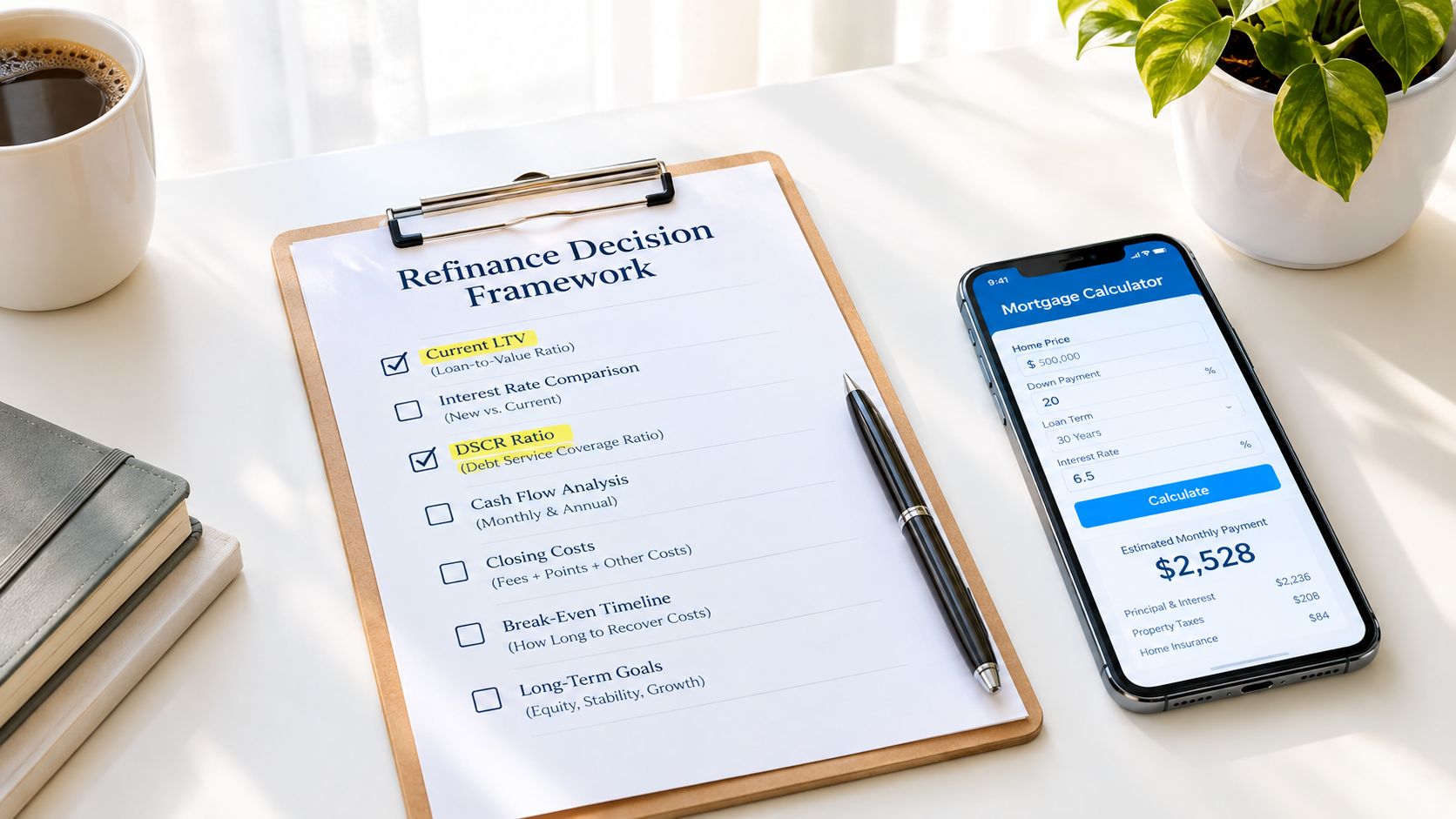
Building Your Refinance Decision Framework
A workable refinance decision starts with a blunt question: are you solving a debt problem or funding a capital plan? If you can't answer that clearly, don't refinance yet.
The Five Questions That Matter
Use this checklist before you send the file anywhere:
What is the property's current debt position?
If your existing balance is already aggressive relative to value, cash-out may be unrealistic. Start there.What does the property support on a DSCR basis?
Don't guess. Use actual rents, taxes, insurance, association dues if applicable, and a realistic view of the payment.What's the objective?
Lower payment, longer term, payoff of maturing debt, reserve creation, or capital for the next acquisition. Pick one primary goal.How soon will proceeds be used?
Cash-out tied to a near-term transaction is very different from cash-out with no immediate deployment plan.What happens if rents soften or expenses rise?
Stress-test the property mentally. If the new loan only works in a perfect month, it's probably too aggressive.
A Simple Decision Matrix
| If this is your main goal | Usually points to | Why |
|---|---|---|
| Reduce payment stress | Rate-and-term | You're improving loan structure, not extracting capital |
| Replace short-term or mismatched debt | Rate-and-term | Better alignment with hold strategy |
| Fund a new deal or project | Cash-out | Equity becomes usable capital |
| Improve both payment and liquidity | Depends | One goal usually has to lead, and the structure should follow that priority |
Common Mistakes to Avoid
- Choosing by headline rate alone: The better quote isn't better if the result kills flexibility.
- Pulling equity because it's available: Available doesn't mean productive.
- Ignoring exit timing: If another purchase is likely soon, preserving borrowing capacity matters.
- Skipping lender fit: Conventional, DSCR, and asset-based lenders all look at these deals differently. In markets like Georgia, the Carolinas, and Texas, investors often evaluate options that include local banks, DSCR lenders, and firms like Sims Ventures for investment-property refinance structures tied to cash flow and collateral.
Underwriting isn't just approval logic. It's portfolio design in disguise.
What Works in Practice
The strongest refinance decisions usually have three traits. The borrower knows the property's real numbers, the use of proceeds is specific, and the loan structure matches the hold strategy.
What doesn't work is vague intent. “I might use the cash for something later” is how investors end up paying more for a loan that didn't need to be bigger. “I just want the lowest rate” can be just as shortsighted if the actual need was liquidity for the next acquisition.
Making the Right Choice for Your Portfolio
For most investors, the answer is cleaner than it first appears.
Choose rate-and-term when your priority is payment relief, term improvement, cleaner DSCR, or replacing debt that no longer fits the property. It's usually the better move when you want the asset to become more durable and less demanding on the monthly numbers.
Choose cash-out when the equity has a defined job and the property can support the new structure without strain. The best cash-out refinances are tied to specific action, not vague optimism. If the proceeds are heading straight into another income-producing move, the higher cost and tighter underwriting can make sense.
The wrong approach is letting the first lender frame the decision for you. Walk into the conversation knowing whether you need debt optimization or capital extraction. Those are different problems, and they need different solutions.
A good refinance should make the property more useful to the portfolio. Sometimes that means lower payments. Sometimes it means pulling equity and putting it to work. The structure matters because it determines whether the refinance strengthens your next move or gets in its way.
If you're weighing a refinance on a rental, Sims Ventures works with investors on rate-term and cash-out structures for income properties, with financing built around deal viability and property cash flow. If you want to see how that fits your hold strategy or next acquisition plan, visit Sims Ventures.
