

Private Money Lenders for Real Estate Guide in GA NC SC TX
You've found a property with enough upside to matter, but the seller won't wait while a bank reviews tax returns, debt ratios, renovation plans, and committee approvals. In Atlanta, Charlotte, Greenville, Charleston, Dallas, Houston, and markets across the Southeast, that delay can cost you the contract before you've had a chance to prove the deal.
Private money lenders for real estate solve that problem by underwriting the property, the project, and the exit strategy together. The trade-off is straightforward: you gain speed and flexibility, but you'll usually pay more and carry a shorter repayment window. The right lender isn't the one advertising the lowest rate. It's the one whose geography, program, financing structure, underwriting process, and closing capacity match your deal.
Introduction to Private Money Lending in the Southeast
Private money lending has moved well beyond informal loans between local investors. Private credit and insurers now finance about $1.2 trillion of U.S. commercial real estate, roughly 18.3% of the $6.4 trillion market, according to recent commercial real estate financing coverage. That scale matters to investors in Georgia, North Carolina, South Carolina, and Texas because private capital is now a durable financing channel, not merely a backup when a bank says no.
Banks remain useful for stabilized properties, documented income, and borrowers who can tolerate a slower process. They're poorly suited to many distressed acquisitions, short renovation cycles, land-to-build projects, and bridge transactions where the property's future value matters more than the borrower's conventional income profile.
What private lenders underwrite
A private lender typically focuses on several connected questions:
- What is the property worth today?
- What will it be worth after renovation or completion?
- How much capital does the project require?
- Can the borrower execute the scope of work?
- What is the credible exit, sale, refinance, or stabilization?
That asset-focused approach can help self-employed investors, builders, and landlords with complex income documentation. It doesn't remove underwriting. It changes the emphasis from bank-style income qualification to collateral strength, project viability, liquidity, and execution risk.
Practical rule: Use private money when the financing itself protects or creates value. Don't use it simply because the application feels easier.
The Southeast requires another layer of discipline. A lender that understands Texas construction may not understand a rural North Carolina acquisition, and a lender comfortable with Atlanta flips may not offer a workable DSCR structure for a South Carolina rental portfolio. Multi-state investors should prioritize consistent coverage and repeatable underwriting over a one-off quote that looks attractive on paper.
Understanding the Private Lending Market Landscape
The U.S. private real estate lending market now originates an estimated $75 billion to $100 billion annually across multiple sectors, according to the National Real Estate Investors Association timeline of private real estate lending. The market's institutional growth accelerated after 2013, when modern scaled platforms began building recurring deal flow and standardized processes.
The milestones tell the story. Kiavi was founded in 2013, Anchor Loans surpassed $1 billion in annual originations in 2016, and Kiavi originated more than $100 million per month by 2017, as documented in the same industry history. Those developments marked a shift from locally arranged hard-money transactions toward repeatable capital deployment across regions.

Why lender supply matters to borrowers
Private lending has also become more competitive. Industry data reported 241,701 private loans in 2023 and 276,909 in 2024, a 14% year-over-year increase, while private loan volume reached $125.6 billion through the first ten months of 2025. The same report counted nearly 13,631 active lenders by October 2025, up from 11,626 the prior year. These figures appear in HousingWire's private lending market summary.
More capital doesn't automatically produce better terms. It gives borrowers more opportunities to find a lender with the right credit box. One lender may prefer clean residential flips, another may specialize in construction draws, and another may focus on rental properties that can transition into long-term debt.
For investors operating across GA, NC, SC, and TX, the best comparison includes licensing, title and appraisal workflow, draw administration, extension policy, and the person making the credit decision. The rate is only one line in the term sheet.
A regional insurance review can also improve project preparation, particularly for construction, commercial, and renovation risks. Investors evaluating property and liability exposures should consult Select Insurance Group's expert guide before presenting a lender with a final project budget.
For a deeper distinction between loan structures, review this Southeast investor guide to hard money loans versus private lending. The key takeaway is simple: private capital is widely available, but program fit still determines whether the money is usable.
Comparison of Top Private Money Lenders in GA NC SC TX
A lender comparison should begin with coverage and programs, not a headline rate. Because exact terms vary by borrower, property, loan-to-value ratio, appraisal, and transaction structure, the table below uses market benchmarks rather than promises from named firms. Treat it as a screening tool for private money lenders serving real estate investors across Georgia, North Carolina, South Carolina, and Texas.
| Lender | Coverage | Rate Range | LTV Cap | Term | Close Time | Programs |
|---|---|---|---|---|---|---|
| Regional direct lender | GA, NC, SC, TX | 9.5% to 13% | 60% to 75% | 6 to 24 months | 7 to 21 business days | Flips, bridge, construction, DSCR |
| State-focused private lender | One or more Southeast states | Market dependent | Deal dependent | Short term | File dependent | Flips, bridge, selected construction |
| Construction-focused lender | Selected GA, NC, SC, TX markets | Market dependent | Deal dependent | Project dependent | File dependent | Ground-up construction, draws |
| Rental-focused lender | Multi-state coverage varies | Market dependent | Deal dependent | Longer-term or bridge | File dependent | DSCR purchases and refinances |
| Private lending broker | Multi-state network | Multiple quotes | Multiple structures | Multiple structures | Depends on selected lender | Complex or nonstandard transactions |
The published 2026 hard-money benchmark range is 9.5% to 13% interest, 1.5% to 3 origination points, 60% to 75% LTV, and 6 to 24 month terms, with typical closings in 7 to 21 business days when the file is complete, according to 2026 hard-money lending benchmarks. These are useful underwriting assumptions, not guaranteed offers.
How to read the comparison
Start with coverage continuity. If you buy in Georgia, build in North Carolina, and refinance in South Carolina, a lender that can handle all three states may reduce repeated onboarding and inconsistent documentation. Texas adds another consideration because the distance between markets and the diversity of property types can affect appraisal, inspection, and draw logistics.
Next, match the program to the business plan:
- Fix-and-flip: Look for ARV-based underwriting, rehab holdbacks, practical draw procedures, and a clear payoff process.
- Construction: Confirm builder requirements, plans and permits, draw inspections, interest reserves, and change-order treatment.
- DSCR: Ask how rent, vacancy, taxes, insurance, and projected debt service affect qualification.
- Bridge: Verify the stabilization milestones required before refinancing or selling.
Finally, compare the all-in cost, not just the rate. Points, legal fees, appraisal charges, inspection fees, draw fees, extension costs, and prepayment restrictions can change the economics. A lender that closes quickly but creates administrative bottlenecks during construction may be more expensive in practice than a lender with a slightly higher quoted rate and a cleaner draw process.
The market's expansion gives you an advantage as a borrower, but only if you request comparable term sheets. Submit the same property facts, budget, ARV support, borrower profile, and exit plan to each candidate. Otherwise, you're comparing different assumptions rather than different lenders.
Program Breakdown for Flips Construction and DSCR
The right private loan follows the project's cash-flow pattern. A flip needs acquisition and rehab capital with a sale exit. Construction financing needs controlled draws and milestone oversight. A DSCR loan needs stabilized rental income that can support the proposed debt.
Published 2026 benchmarks cluster around 9.5% to 13% interest, 1.5% to 3 origination points, 60% to 75% LTV, and 6 to 24 month terms, with closings in 7 to 21 business days when conditions are complete, as summarized by hard-money lending market benchmarks.
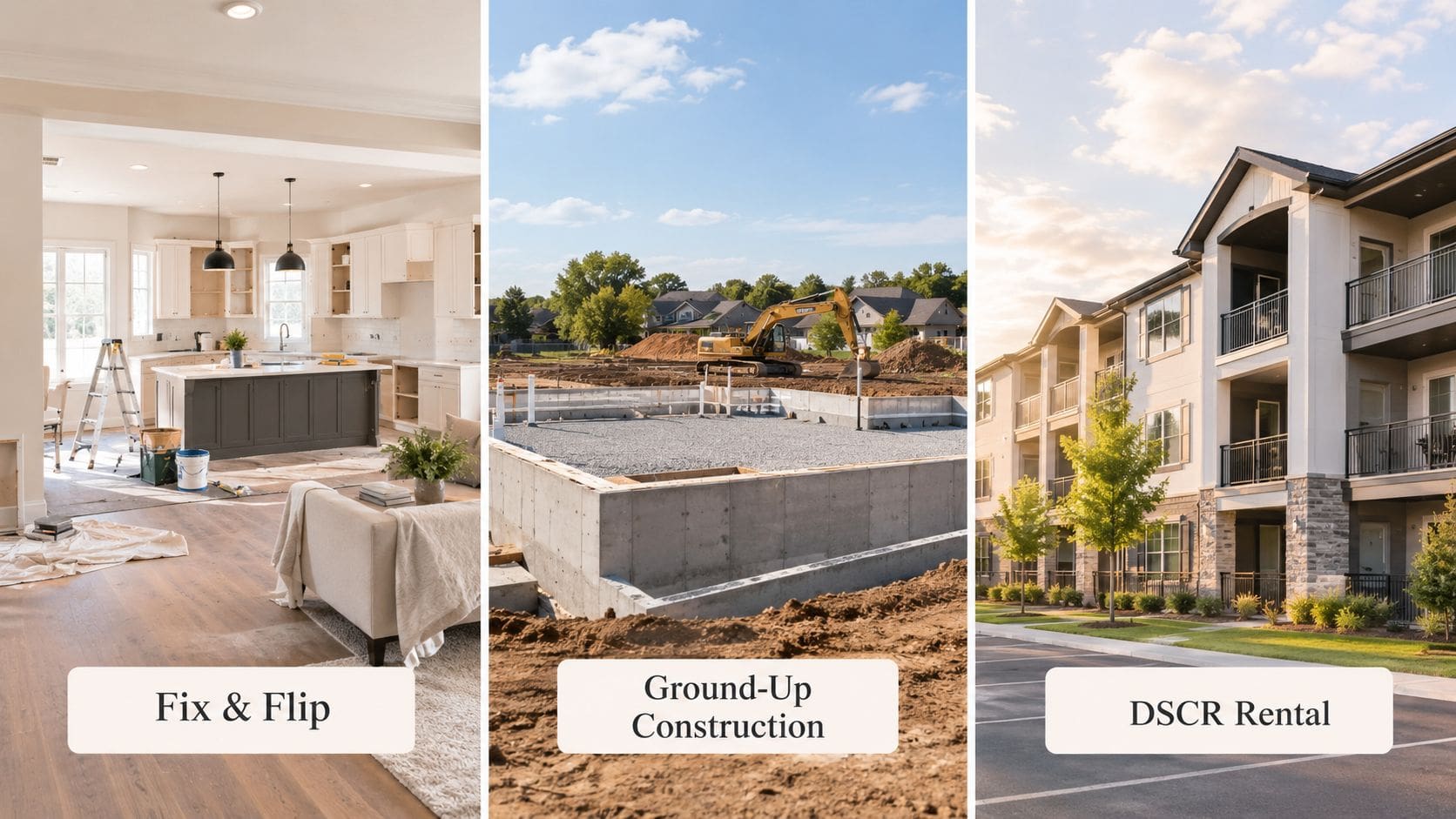
Fix-and-flip loans
A flip loan should be structured around purchase price, renovation budget, ARV, holding period, and sale costs. The lender may fund some or all of the rehab budget, but those funds are commonly released through draws rather than delivered entirely at closing.
Before accepting terms, ask:
- What percentage of ARV limits total exposure?
- Which renovation expenses qualify for reimbursement?
- How quickly does the lender process draw requests?
- Are inspections required for every draw?
- What happens if the project needs an extension?
Build the exit backward from the loan maturity date. Include permitting, contractor mobilization, materials, inspections, listing, buyer due diligence, and closing. If the project only works when every milestone happens perfectly, the structure is too aggressive.
Ground-up construction loans
Construction financing requires more than a purchase contract and an appraisal. Prepare plans, specifications, permits, contractor information, a detailed budget, a draw schedule, and a realistic completion strategy. The lender will want to understand how money moves from acquisition through foundation, framing, systems, finishes, and final completion.
Draw timing can affect the builder's cash flow. Confirm whether the lender reimburses completed work, funds materials in advance, or uses a hybrid structure. Also clarify whether contingency funds are available and how change orders are approved.
Cost control matters as much as the interest rate. If the plan includes concrete repairs or decorative overlays, review Stardek systems overlay budget tips while building the construction budget. A small scope omission can become a financing problem once the draw schedule is underway.
DSCR rental financing
DSCR financing evaluates the property's ability to support its debt service rather than relying entirely on personal income documentation. That makes it useful for landlords, self-employed investors, and borrowers moving from a short-term renovation loan into a long-term rental structure.
The sequence should be deliberate:
- Stabilize the property.
- Document rent and operating expenses.
- Confirm the refinance lender's valuation requirements.
- Calculate the proposed payment against property cash flow.
- Reserve enough liquidity for closing and operating needs.
Investors planning to hold renovated properties should review the DSCR refinance pathway before closing the bridge loan. The refinance isn't an afterthought. It should shape the acquisition price, rehab scope, financing strategy, and stabilization plan from day one.
How to Select the Right Lender for Your Deal
Private money is more expensive than bank financing, so the project must earn the right to use it. In Q2 2026, CRE borrowers paid an average of 9.76% for private loans versus 6.47% at banks, a 329-basis-point gap, according to recent private lending rate comparisons.
That difference doesn't make private financing automatically unattractive. It means you must quantify what speed and certainty are worth.
Calculate the execution premium
Start with the bank alternative. Estimate the interest savings, then add every private-loan cost, including points, legal expenses, appraisal, inspections, draw administration, and possible extensions. The private option makes sense when the value preserved or created by faster execution exceeds that premium.
Value can come from several sources:
- Contract preservation: You avoid losing a property because financing wasn't ready.
- Negotiating advantage: You negotiate better terms because you can close with fewer contingencies.
- Earlier construction: Work begins before a slower lender completes its process.
- Captured upside: You acquire an asset before another buyer does.
- Reduced opportunity cost: Your capital remains available for other projects.
The correct break-even question isn't “Which loan has the lowest rate?” It's “How much value does this loan create or protect before payoff?”
Screen the lender, not just the term sheet
Ask every lender the same operational questions:
- Who approves exceptions?
- What documents trigger a final credit decision?
- Who orders the appraisal and title work?
- How are rehab draws inspected and released?
- What fees apply if the project runs late?
- Can the lender refinance or coordinate the exit?
- Does coverage extend consistently across your target states?
Then test the lender's response time before you rely on it. A fast quote isn't the same as fast funding. You need a lender that can move from preliminary review to appraisal, title clearance, final approval, and closing without losing ownership of the file.
For a broader portfolio-level view, read this analysis of how private lender selection can affect a real estate portfolio. The best choice balances price, execution, loan terms, and repeatability.
Sims Ventures is one multi-state option that provides asset-based financing for fix-and-flip projects, rental financing, bridge-to-DSCR transactions, and ground-up residential construction in GA, NC, SC, and TX. Evaluate it under the same framework as any other lender, with particular attention to program fit, third-party timing, and the complete cost of capital.
Real-World Use Cases by Project Type
A lender that fits one project can be wrong for another. The following scenarios show how the decision changes when the property, timeline, and exit change.
Atlanta fix-and-flip investor
An Atlanta investor finds a distressed single-family property with a defined renovation plan and strong comparable sales. The seller wants a prompt closing, while a bank would require documentation that doesn't fit the investor's self-employed income profile.
The investor should seek a short-term flip loan based on the property's current condition, proposed improvements, ARV support, and sale strategy. The important questions aren't limited to rate and points. The investor needs to know whether the lender will fund the rehab budget, how quickly draws are released, and whether the term allows enough time for permitting, construction, listing, and closing.
Lesson: A fast lender only helps if the draw process keeps the contractor funded.
Charlotte ground-up developer
A small developer in Charlotte controls a buildable parcel and has plans for a new residential project. The developer needs financing that follows construction milestones rather than a lump-sum acquisition loan.
This borrower should prioritize lenders with construction experience, clear inspection procedures, and a defined approach to budget changes. The term sheet should explain how the lender handles vertical draws, interest payments during construction, contingency reserves, and completion requirements. The developer should also verify that the lender understands local title, permitting, and contractor documentation.
Lesson: Construction financing is an operations product as much as a debt product. A vague draw policy can disrupt the build even when the initial approval looks strong.
Greenville rental portfolio owner
A landlord in Greenville completes renovations on a rental property and wants to hold it rather than sell. A short-term bridge loan may have funded the work, but the long-term strategy depends on rental cash flow and a refinance that fits the stabilized property.
The landlord should discuss the DSCR exit before taking bridge capital. That means estimating rent, taxes, insurance, maintenance, vacancy, and the future loan payment. The borrower should also confirm seasoning, valuation, lease, and property-condition requirements early enough to avoid a maturity deadline.
Lesson: The refinance path determines whether the original bridge loan was responsibly structured. A rental deal shouldn't rely on a future loan whose requirements haven't been checked.
Across all three examples, geography changes the execution details. A multi-state investor should retain a current package of entity documents, property data, contractor materials, insurance information, and exit assumptions so the lender can evaluate the deal without rebuilding the file from scratch.
Final Recommendations and Next Steps
Choose private money when speed, flexibility, or asset-based underwriting creates more value than the higher borrowing cost. For investors in GA, NC, SC, and TX, prioritize a lender active in the markets you use and supports the specific strategy, whether that's flipping, construction, bridge financing, or DSCR refinancing.
Before requesting terms, prepare:
- Property data: Address, purchase contract, current value, and comparable sales.
- Project budget: Detailed acquisition, rehab or construction costs, contingency, and carrying expenses.
- Borrower profile: Entity documents, liquidity, experience, and current obligations.
- Exit plan: Sale, refinance, stabilization, or another clearly supported payoff.
- Lender questions: Rate, points, LTV, draw timing, fees, extensions, prepayment, and closing conditions.
Request comparable term sheets, calculate the all-in cost, and reject any structure that depends on an unrealistic timeline. If the exit is DSCR refinancing, underwrite that outcome before you close the bridge loan.
Sims Ventures provides asset-based financing for fix-and-flip projects, rental portfolios, bridge-to-DSCR transactions, and ground-up residential construction across Georgia, North Carolina, South Carolina, and Texas. Visit Sims Ventures to discuss your property, timeline, and financing strategy with a team that evaluates the deal around collateral strength and project viability.
