

Construction Loans Texas: Investor Guide for 2026
You've got a lot under contract, permits are moving, and your contractor wants a clear start date. Then the bank asks for tax returns, income documentation, and more time. That's where many Texas investors get stuck. The deal itself may be solid, but the loan process doesn't match the speed of a ground-up build.
That problem shows up often with construction loans in Texas. A newcomer reads general mortgage guides and assumes construction financing works like a regular home loan. It usually doesn't. Investor deals are judged differently, especially when the borrower is self-employed, building spec homes, or planning to refinance into rental debt after completion.
This guide is for that borrower. The focus is investor-oriented construction financing, especially asset-based structures that look hard at the property, the budget, the build plan, and the exit, instead of leaning only on personal income paperwork. If you've been trying to sort out draw schedules, lender requirements, inspections, and rate terms without getting lost in jargon, this is the practical version.
Introduction to Texas Construction Financing
A common Texas scenario looks like this. An investor ties up several infill lots outside Austin, hires a builder, and lines up subcontractors. The city timeline is moving, material bids have expiration dates, and the project only works if funding arrives quickly enough to keep the schedule intact.
Then a conventional lender treats the deal like an owner-occupied home loan. The file gets pushed into income review, tax return analysis, and debt-to-income questions that don't always reflect how a real estate investor operates. For a self-employed borrower, that can create friction even when the project itself is well planned.
That's why the usual online advice misses the mark. A lot of content about construction financing in Texas is built for primary-residence borrowers, not investors managing land, contractors, carry costs, and resale or refinance exits.
Most existing guidance on this topic centers on conventional primary-residence lending, while investor-specific ground-up financing often uses After-Completion Value and asset-based underwriting instead of relying mainly on personal income documentation, as noted in this Texas ground-up lending overview.
For an investor, the stakes are practical. If money arrives late, crews idle. If draw paperwork is incomplete, the next phase stalls. If the lender doesn't understand the exit strategy, a good deal can die in underwriting. Texas construction financing isn't just about getting approved. It's about getting a loan structure that fits the way investors build.
Understanding the Key Concepts
A lot of confusion starts with the vocabulary. Once the core terms make sense, the rest of the process becomes much easier to follow.

LTC and LTV are not the same thing
Think of a new build like framing a house.
The frame is your total project cost. That includes the pieces the lender agrees count toward the build budget. Loan-to-Cost, or LTC, measures how much of that frame the lender is willing to fund. For Texas ground-up residential projects, lenders commonly offer 65% to 85% LTC for qualified borrowers with construction experience, and some private lenders may go up to 90% LTC on affordable builds, according to Texas construction loan terms summarized here.
Loan-to-Value, by contrast, asks what the completed property should be worth relative to the loan. Investors often hear both terms in the same conversation and assume they mean the same thing. They don't. One points to cost. The other points to value.
Draw-based financing is not one lump sum
Most construction loans don't hand over the entire loan amount at closing.
Instead, money is released in stages called draws. In Texas, those funds are often tied to 4 to 6 project milestones, with mandatory monthly inspections and lien waivers before more money is released, based on the same state-specific construction lending overview. That means the lender wants proof that real work was completed before the next tranche goes out.
Here's the easiest way to think about it:
- Foundation first: The lender checks that the first phase is done before releasing more funds.
- Progress controls funding: Framing, rough-in, and later stages trigger additional draws.
- Paperwork matters: Contractors may finish work, but the draw can still pause if inspections or lien waivers are missing.
Practical rule: A construction loan is less like a checking account and more like a controlled reimbursement system tied to visible progress.
Interest-only and construction-to-perm
During the build phase, construction loans usually require interest-only payments on drawn balances. You're not paying interest on money that hasn't been released yet. That's why experienced investors pay close attention to the draw schedule. It shapes cash flow during the build.
A construction-to-perm structure starts as a construction facility and then becomes longer-term financing after completion. In plain language, it's a bridge from dirt to stabilized property. For an investor, that can support a hold strategy if the project is meant to become a rental rather than a sale.
Exploring Program Types in Texas
Not every project needs the same financing structure. The right program depends on how many projects you're running, whether you're building from the ground up, and how you plan to exit.
Four common paths investors consider
Some borrowers only need one loan for one build. Others need a repeatable facility they can use across multiple jobs. That difference matters more than most newcomers realize.
Below is a simple comparison framework.
Construction Loan Program Comparison
| Program Type | Term | LTC Range | Ideal Use Case |
|---|---|---|---|
| Ground-up residential construction | 12 to 24 months based on Texas ground-up loan terms | 65% to 85% LTC, with some private lenders going up to 90% LTC on affordable builds based on the same Texas construction loan reference | Building a spec home, build-to-rent property, or small residential development |
| Rehab or fix-and-flip loan | Varies by lender and project | Varies by lender and project | Acquiring and improving an existing property for resale |
| Builder's line of credit | Varies by lender and facility design | Varies by lender and project pipeline | Financing multiple projects under one umbrella facility |
| Construction-to-perm | Varies by lender and permanent loan structure | Varies by lender and stabilized takeout plan | Building a property you plan to hold after completion |
How to choose the best fit
A ground-up residential loan usually fits a borrower with a defined budget, approved plans, and a single build or a handful of homes. This is the classic spec-build setup.
A rehab or fix-and-flip loan makes more sense when the structure already exists and the main risk is renovation execution, not vertical construction from raw land.
A builder's line of credit can help a repeat operator who doesn't want to start from zero with each project. Instead of treating each build as an isolated event, the lender may underwrite the builder's broader pipeline and process.
A construction-to-perm loan tends to fit borrowers who already know the completed property will be held. If your strategy is to rent the property after construction, a structure that anticipates the next phase can simplify planning.
Choose the program based on the project's rhythm. One-off builds, repeated spec projects, and hold strategies don't move the same way, so they shouldn't be financed the same way either.
Navigating Eligibility Underwriting and Documentation
Underwriting for investor construction deals can feel inconsistent because lenders don't all look at the same things in the same order. One lender may focus heavily on borrower profile. Another may care more about budget discipline, contractor strength, and the exit plan.
What lenders usually review
For Texas construction loans, credit expectations are often tougher than many people expect. Residential construction lenders commonly look for a minimum credit score of 680, with 720+ often needed for the best pricing, according to this Texas construction lending guide. That doesn't mean lower-credit borrowers can never get financed, but it does mean the file gets harder.
Lenders also want to understand:
- Experience level: Have you completed similar projects before, either personally or with your builder?
- Project viability: Does the budget match the scope and local market?
- Exit strategy: Are you planning to sell, refinance, or hold?
- Collateral quality: Is the lot, plan set, and finished product likely to support the loan request?
Some investor-focused lenders use more of an asset-based approach. They may put less weight on traditional income verification and more weight on the strength of the property, construction budget, and after-completion story. If you're trying to organize that process, a construction loan preapproval checklist can help you see what lenders typically want before they issue terms.
The document package that keeps a file moving
A clean file gets reviewed faster than a sloppy one. Most borrowers should expect to gather:
- Detailed plans and scope: Site plans, floor plans, elevations, and project specs.
- Budget breakdown: Hard costs, soft costs, contingency planning, and line-item detail.
- Builder information: Resume, prior project history, license information if applicable, and insurance details.
- Property records: Purchase contract or deed, title information, and any survey or legal description available.
- Timeline materials: Construction schedule, milestone expectations, and anticipated completion path.
- Entity and borrower docs: Organizational documents, identification, and authorization paperwork.
Where borrowers lose time
The biggest delays often come from poor organization, not from the deal itself.
Use one folder for plans, one for budget, one for contractor support, and one for title and ownership documents. Label files clearly. If the lender asks for a revised cost breakdown, send the revised version with the date in the file name so nobody's guessing which copy is current.
A lender can't underwrite a project they can't see clearly. Half of “speed” in construction lending comes from how cleanly the borrower presents the deal.
Managing Funding Draws Inspections and Progress
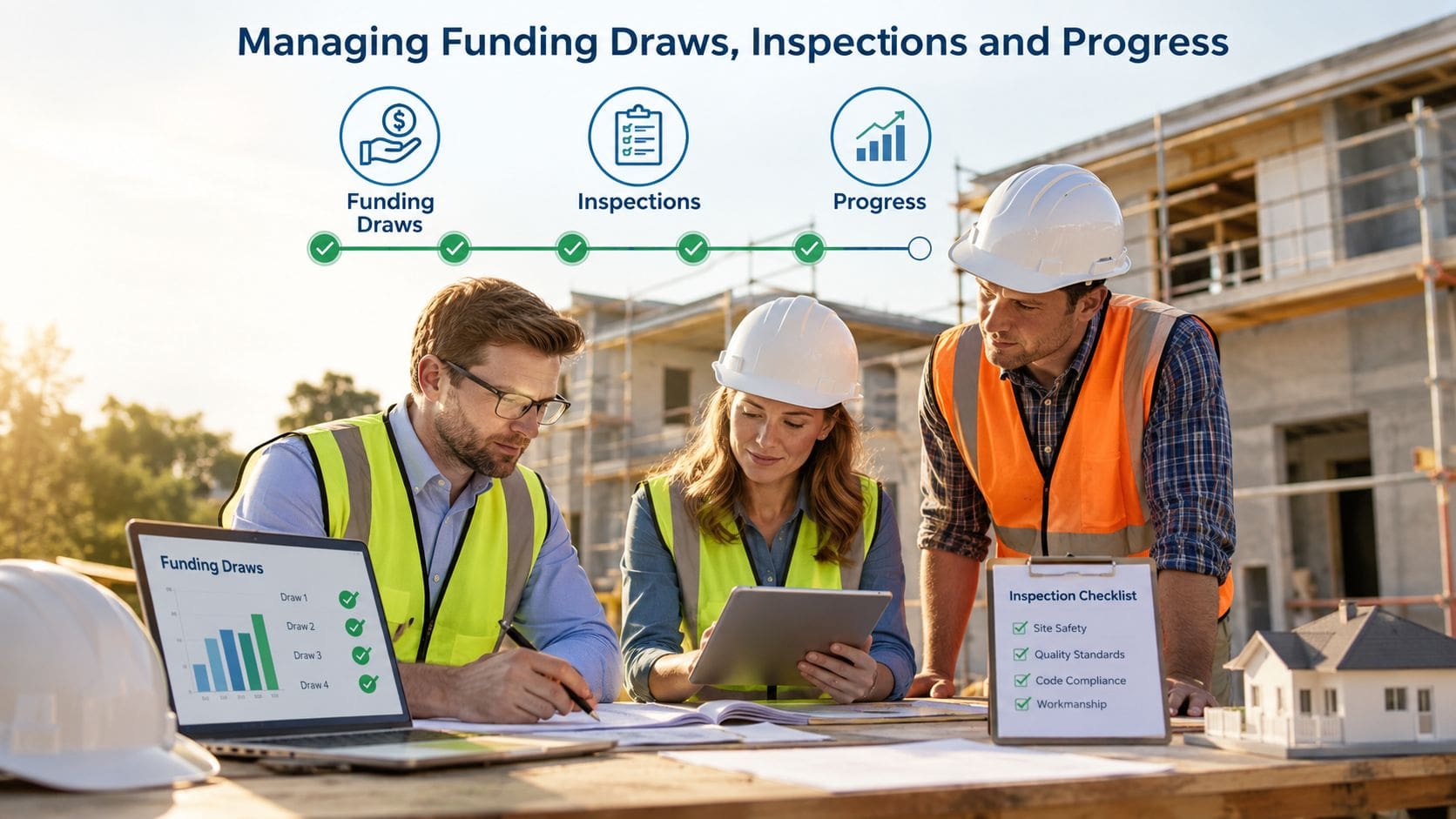
Construction financing works best when you treat draws, inspections, and contractor paperwork as one connected system. New borrowers often think of them as separate tasks. They're not. If one part breaks, cash flow through the project can slow down.
How the draw cycle usually works
A lender typically approves a budget before closing and then uses a milestone schedule to decide when funds can be released. The contractor performs work, submits invoices or draw support, and the lender verifies progress before sending money.
Here's the flow in simple terms:
- Work gets completed according to the approved schedule.
- The borrower or contractor submits a draw request with invoices and supporting backup.
- An inspection confirms progress on site.
- Lien waivers are reviewed so the lender can see who has been paid and who may still have claims.
- Funds are released for the completed phase.
If you want a practical view of how lenders map that sequence, this construction draw schedule resource shows the logic borrowers need to plan around.
A timeline investors can visualize
Think of each draw like a gate on a fenced road. You don't open the next gate because time passed. You open it because the required work is done and documented.
A typical sequence might look something like this:
- Early stage: Site prep, initial work, and foundation-related progress
- Middle stage: Framing and structural advancement
- Later stage: Interior systems, finishes, and final completion items
- End stage: Final inspection and closeout support
The exact milestone names vary, but the pattern stays familiar. Progress first. Verification second. Funding third.
How to avoid draw delays
Borrowers get into trouble when they submit incomplete requests or wait until the last minute to collect waivers.
Use these habits instead:
- Pre-collect paperwork: Ask contractors what documentation they'll provide before the first draw request ever goes in.
- Match invoices to the budget: If your line items don't line up, the lender may send the file back for clarification.
- Schedule inspection windows early: Don't wait until cash is tight to start arranging site verification.
- Track unpaid vendors carefully: Lien issues can jam up future disbursements.
The build doesn't stall because concrete dries too slowly. It stalls because paperwork and site verification fall behind the work.
Analyzing Costs Rates and Closing Timeline
Cost is where many investor decisions become real. A project can look attractive on paper, but the financing structure determines whether the margins survive the construction period.
What rates look like for investor projects
For residential investor construction projects in Texas, rates typically range from 10.99% to 13.99% as of 2026, and those rates are often indexed to the prime rate with a spread of 1% to 2%, according to this Texas investor construction loan guide. The same source notes that interest accrues only on the drawn balance during a 12 to 18 month build phase.
That last point matters. A borrower doesn't usually pay interest on the full committed amount from day one. They pay on what has been disbursed. For a project that ramps up in stages, that structure can help preserve cash flow during the build.
Why draw-based interest changes the math
A new investor may hear a rate quote and focus only on the headline number. Experienced builders also ask, “When does the balance go outstanding?”
That's because carrying cost is tied to usage. If the project spends money in stages, interest tracks those stages instead of assuming the full loan is deployed immediately. On a longer build, that can make the difference between a manageable monthly obligation and a cash squeeze.
Keep your budget thinking separated into three buckets:
- Interest cost: What accrues on disbursed funds during the build.
- Transaction cost: Lender fees, title charges, appraisal costs, legal or closing expenses, if applicable.
- Project carry: Taxes, insurance, utilities, and anything else required to keep the project alive while under construction.
What the closing timeline depends on
Some private lenders target faster closings than conventional institutions, but fast in this space still depends on third-party items being completed. Delays usually come from title, appraisal, missing plans, incomplete budgets, or entity paperwork that isn't ready.
A smoother closing often follows this sequence:
- Initial review: The lender checks the broad shape of the deal.
- Underwriting: Budget, collateral, borrower profile, and exit get tested.
- Third-party work: Title and valuation support move in parallel.
- Closing prep: Final conditions are cleared, loan documents are drafted, and funding is scheduled.
If you want a quick closing, organize the file before the lender asks. That's the part borrowers control.
Comparing Private Hard Money and Conventional Lenders
Many Texas investors finally see why the same project gets a “maybe later” from one lender and a workable term sheet from another.
The basic divide
Conventional construction lending often serves owner-occupants well. It tends to favor stable income documentation, tax returns, and a borrower profile that fits traditional mortgage logic. That's useful if you're building a primary residence and your financial picture is straightforward.
Investor projects are different. The deal may involve an entity borrower, uneven personal income, multiple active projects, or a plan to refinance after completion rather than move into the property. In those situations, a private lender may focus more on the asset, budget, and exit than on conventional income tests.
Most published content about Texas construction financing still leans toward primary-residence loan structures, even though investor-focused ground-up lending often emphasizes After-Completion Value and asset-based underwriting instead, as discussed in this overview of Texas investor construction lending. For a broader investor education angle, this guide on hard money loans versus private lending helps clarify how those categories differ in practice.
When conventional financing fits
A bank-style construction loan may make sense when:
- Your income documentation is clean: W-2 income or easy-to-verify earnings help.
- The project is straightforward: Simpler borrower and property profiles often move better through conventional channels.
- You value one-loan simplicity: Some borrowers want a path that already anticipates post-construction financing.
When private asset-based lending fits
An asset-based private loan may be more practical when:
- You're self-employed: Tax returns may not tell the full story of your liquidity or project strength.
- The schedule matters: Speed can be critical when permits, crews, and contracts are aligned.
- The project drives the decision: The lender evaluates the collateral, budget, construction plan, and intended exit.
- You're building as an investor, not an occupant: The underwriting logic follows investment performance more than household budgeting.
The right loan isn't the one with the most familiar name. It's the one that matches how the deal actually works.
Key Takeaways Next Steps
If you're sorting through construction loans in Texas for the first time, keep the decision simple. Start with the project, not the product name. A loan only works if it matches your build schedule, documentation strength, and exit plan.
A practical checklist
Use this short list before you apply anywhere:
- Confirm the project type: Ground-up build, rehab, repeat builder pipeline, or long-term hold.
- Choose the matching structure: Single-project loan, revolving builder facility, or a path that supports permanent financing later.
- Assemble the core file: Plans, budget, builder information, title support, schedule, and borrower or entity documents.
- Map the draw process in advance: Know who submits draw requests, who gathers waivers, and who coordinates inspections.
- Pressure-test the exit: Sale, refinance, or hold should be realistic before the loan closes.
Three habits that speed approvals
Borrowers often ask how to get approved faster. The answer usually isn't “find a magic lender.” It's preparation.
- Pre-book your inspection rhythm: If you know when major milestones should be hit, you can line up site verification faster.
- Collect lien waiver procedures early: Don't wait until subcontractors are unpaid and everyone is scrambling.
- Standardize your budget format: A line-item budget that matches the lender's review style creates fewer revisions.
Quick answers to common questions
Can a construction loan turn into long-term rental debt
Yes, in many cases the build loan is refinanced after completion once the property is ready for its next phase. Some construction facilities are designed with that transition in mind, especially for investors planning to hold the property.
What happens if the build goes over budget
The borrower usually needs a plan quickly. That can mean bringing additional cash, revising scope, or asking the lender whether any flexibility exists. Cost overruns are easier to handle when the original budget was realistic and well documented.
How do I close faster
Submit a complete package the first time. Most delays come from missing plans, unclear budgets, title issues, or unanswered underwriting questions. The cleaner your file, the easier it is for a lender to make a decision.
Good construction financing isn't only about leverage. It's about creating a funding process your contractor, title company, and future exit can all support without friction.
If you remember one thing, remember this: investor construction financing is operational. It rewards borrowers who plan the paperwork, the budget, the inspections, and the exit before the first nail goes in.
If you're evaluating a Texas ground-up project and want an investor-focused lending partner, Sims Ventures offers asset-based financing for builders and real estate investors, including ground-up construction, bridge-to-DSCR strategies, and advisory support designed around deal execution rather than conventional income hurdles.
