

Your North Carolina Construction Loan Guide for 2026
You're standing on land in North Carolina, maybe a lot outside Raleigh, a tract in the Piedmont, or a coastal parcel you've been turning over for months. The plan is clear in your head, but the financing side is murky, and that's where good projects get delayed, re-priced, or killed before a footing is ever poured. A north carolina construction loan can be the bridge between a strong deal and a stalled one, but only if the structure matches the borrower, the project, and the timeline.
The hard part is that not every lender underwrites construction the same way. A traditional bank may care most about your personal income, tax returns, and debt ratios, while a private lender may care more about the land, the scope of work, and whether the project still makes sense if the borrower is self-employed or acting as their own builder. In North Carolina, that difference matters, because the market includes everything from owner-built infill homes to ground-up rental projects and affordable housing developments, all with different capital needs and approval paths.
Building Your Vision in the Tar Heel State
A good lot in North Carolina can look ready from the road and still be hard to finance. The land may sit in a fast-moving metro, a rural county, or a coastal area with its own permitting realities, but the lender still asks the same question, who is being underwritten, and what outcome are they trying to protect? For an investor or builder, that question often decides whether a project stays on schedule or sits idle while carrying costs keep running.
Public and private capital both operate in the state, but they do not serve the same borrower profile. North Carolina's NC Housing Finance Agency has supported construction tied to affordable rental housing, senior housing, LIHTC, low-interest loans, and tax-exempt bond allocations across many communities statewide housingbuildsnc.com. That matters because it shows real demand for new housing, while also showing that the capital stack and approval path can look very different depending on whether you are building workforce housing, a custom home, or an investment property.
For a private borrower, the problem usually is not the project vision. It is selecting a loan that looks cheap on paper but creates friction in practice. A loan that slows underwriting, demands documentation you cannot easily produce, or will not fund in the draw pattern your project needs can stop the job at the worst possible time. The better financing decision is the one that keeps the site moving, keeps subs scheduled, and keeps carry costs under control.
Where projects get stuck
The same project can be financeable in one channel and nearly impossible in another. A builder with a clean scope and strong collateral can still get shut out if the lender wants a W-2 profile that does not match the borrower's actual business model. That is the owner-builder gap in North Carolina, and it shows up fast when an investor is also serving as their own general contractor.
The practical question is simple. Which capital source will close on this type of deal?
Practical rule: if the lender cannot explain how money moves from closing to first draw to final conversion, the deal is probably going to cost you time.
Four Paths to Construction Funding in North Carolina
North Carolina borrowers usually run into four broad funding paths, and each one serves a different purpose. The mistake is treating them as interchangeable. They aren't. A conventional construction-to-permanent loan, an FHA construction loan, a private hard money loan, and a builder line of credit all solve different problems, and they underwrite very different kinds of risk.
| Loan Type | Best For | Typical LTV/LTC | Underwriting Focus |
|---|---|---|---|
| Conventional construction-to-permanent | Owner-occupants and traditional borrowers | Varies by lender | Personal income, credit, land position, project documentation |
| FHA construction loan | Borrowers seeking government-backed structure | Varies by program | Occupancy, documentation, and program rules |
| Private / hard money loan | Investors, self-employed borrowers, owner-builders | Deal-specific | Collateral strength, project viability, exit strategy |
| Builder line of credit | Active builders managing multiple projects | Relationship-based | Portfolio activity, repeat performance, project cadence |
A conventional construction-to-permanent loan usually fits the borrower who wants one closing and a path into a long-term mortgage. It works best when the borrower has conventional income documentation, clear reserves, and a project that matches a lender's standard box. It's orderly, but it can be rigid.
An FHA construction loan can be useful for borrowers who are building and plan to occupy the home. The structure is more program-driven than investor-driven, so the benefit is often tied to occupancy and eligibility rather than speed or flexibility.
A private or hard money loan is built for borrowers who care more about execution than conforming paperwork. It can make sense when the borrower is self-employed, the project is time-sensitive, or the deal needs a lender who will underwrite the asset instead of the borrower's tax return story. That flexibility is the reason many investors use it for ground-up work.
A builder line of credit is different again. It's about repeatability. For an active builder or investor with multiple jobs in motion, it can provide working capital under one facility instead of forcing a fresh loan request for every project.
The cheapest loan on the term sheet can become the most expensive one if it can't close when your contractor is ready to start.
Navigating the Underwriting Maze
The hardest underwriting problems in North Carolina construction lending usually start with a mismatch between how the borrower earns and how the lender measures risk. Banks tend to want stable personal income, tax returns, and debt-to-income comfort. Private lenders care more about whether the project works, whether the collateral is solid, and whether there is a believable exit.
North Carolina makes that split easier to see because lenders have become stricter where conventional borrowers feel it first. A project that looked fine when rates were lower may no longer fit a bank's box today, especially if the numbers depend on thin cash flow or a narrow refinance path. Underwriters are paying closer attention to debt ratios, repayment strength, and how much room the deal has if the market softens.
Borrower centered versus asset centered
Borrower-centered underwriting asks whether the person behind the loan can personally carry the debt. Asset-centered underwriting asks whether the deal itself justifies the capital. Those are different questions, and they lead to different outcomes for self-employed investors, builders, and owner-builders who know how to run a job but do not fit a conventional income template.
The owner-builder gap shows up here too. A borrower who acts as their own general contractor can be well organized, cost-conscious, and fully capable of delivering the project. Conventional lenders often still treat that file as less predictable because they prefer a separate licensed builder standing between the lender and the budget. That preference is about control, not just paperwork.
If you want a practical way to think about that review process, the framework at Sims Ventures' underwriting guide is a useful reference point. The deal still has to stand on its own. If the file only works because the borrower has perfect documentation, the structure is fragile.
What private lenders tend to reward
Private capital usually rewards clarity. A clean acquisition basis, a realistic budget, a workable timeline, and an exit that makes sense are easier to finance than a broad story with no tight numbers behind it. Private lenders still look for risk, but they structure around it with the asset and repayment path in mind.
That approach matters for deal-focused borrowers who are moving fast or managing their own build. A strong project with imperfect borrower paperwork can still get funded when the collateral and exit are sound. A weak project with polished paperwork usually does not get far.
The cheapest loan on paper can become the most expensive one if it cannot close when the contractor is ready to start.
The Investor and Owner-Builder Playbook
The biggest blind spot in North Carolina construction financing is the owner-builder gap. Most conventional guidance assumes the borrower hires a separate licensed general contractor. Once the borrower becomes the builder, or acts as their own GC on an investment project, the file often gets treated as higher risk because there isn't a fixed third-party builder standing between the lender and the budget.

Most conventional guidance warns that lenders view owner-builder projects as high-risk, often requiring 20–30% cash equity and credit scores above 680 ownerbuilderloans.com. That can work for some borrowers, but it excludes a lot of capable investors who know how to manage trades, control scope, and solve problems on site. If you're self-employed, your tax returns may not tell the full story of how you run projects.
Why owner-builders get punished
The issue isn't just documentation. It's control. A conventional lender wants a licensed builder because it believes that structure reduces surprises, creates accountability, and gives the lender a cleaner path if things go wrong. If you're the investor and the general contractor, the lender sees one person wearing multiple hats, and that often means more scrutiny and more equity tied up.
Private lending changes that conversation. An asset-based lender can look at the property, the renovation or build plan, and the borrower's experience without forcing the deal into a traditional income box. That's why owner-builders often find private capital to be the only realistic path when they need to move quickly and can't wait on an underwriting process built for someone else's profile.
What actually works for this borrower type
The borrowers who get traction here usually present a tight file. They know their scope, they can explain the schedule, and they can show they understand the exit. They're not asking a lender to believe a dream, they're asking the lender to finance a project that already has a logical path to completion.
If you're acting as your own builder, your paperwork has to make up for the missing third party.
Understanding Rates Fees and Project Timelines
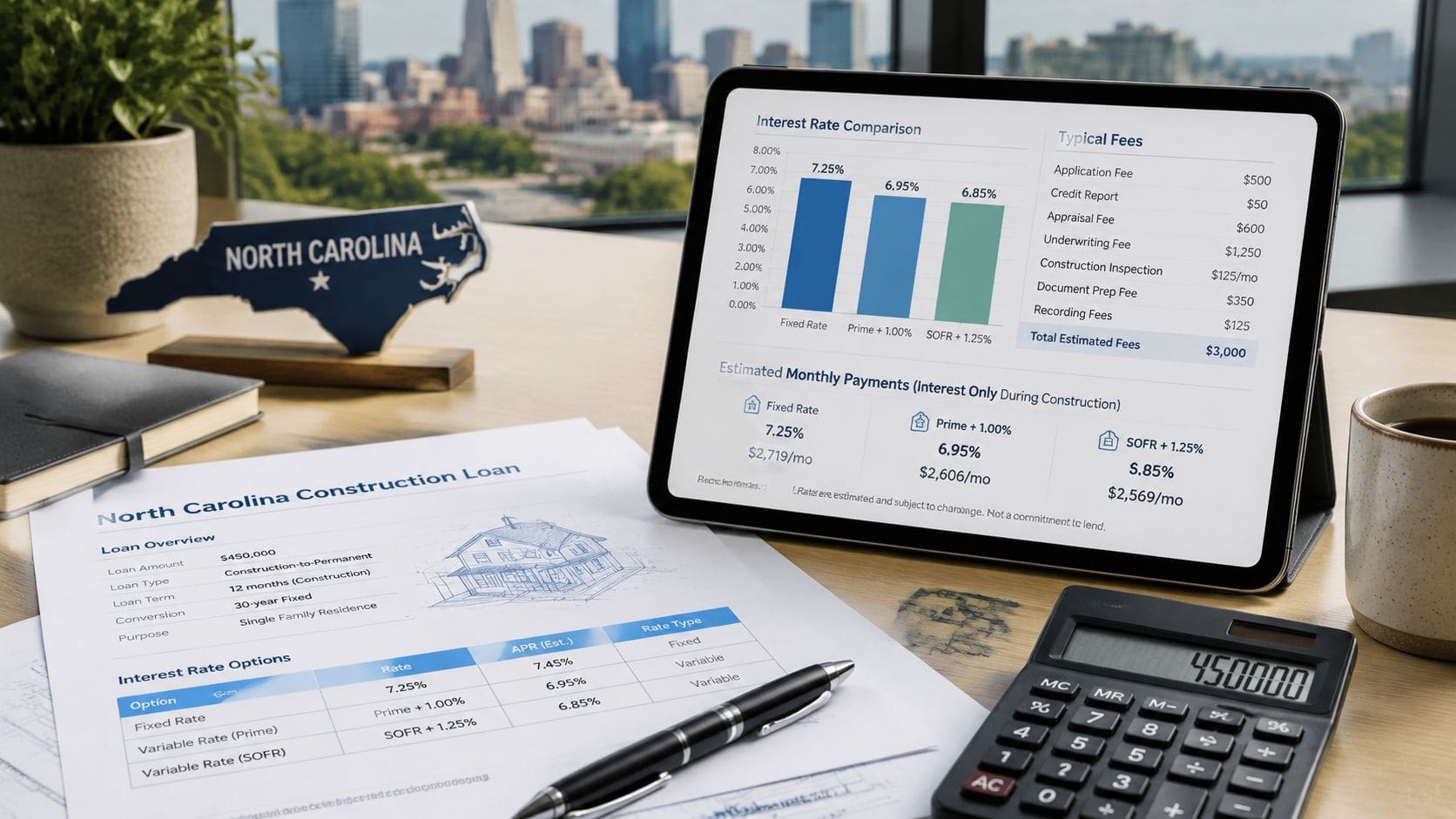
A North Carolina construction loan is rarely priced by rate alone. The total cost is the interest charge, lender fees, and the time your capital stays tied up before the project starts producing value. For speculative single-family construction loans in North Carolina, analysts at NAHB reported an average interest rate of 7.47% in Q4 2025, down from 7.89% the prior year. That is still well above the 3–4% range seen during the low-rate period of 2020 to 2021, so carrying costs continue to shape the economics of every deal.
How draw schedules work
A draw schedule controls when the lender releases money as the work progresses. Funds usually do not arrive in one lump sum. They are tied to milestones such as foundation completion, framing, rough-ins, and final stages, so the lender can confirm progress before approving the next advance. That structure protects both sides, but it also puts pressure on the borrower to manage cash flow between draws.
The practical issue is timing. If a crew finishes a phase and the inspection clears it, the next draw should fund the following phase without forcing the builder to cover the entire job from personal cash. That is why the budget, the scope, and the supporting paperwork need to be clean from the start, especially for an owner-builder who is already carrying more responsibility than a borrower with a separate general contractor.
Speed changes the economics
Timeline is part of the price. A lender that moves slowly can leave the borrower paying for land, labor, and subcontractor commitments longer than planned, which makes an otherwise workable deal much harder to carry. Private lenders often win business because deal-focused borrowers cannot always wait for a committee-driven process that treats every file like a long approval cycle. Many investors also use a construction draw schedule framework before closing, because it shows how the project will be funded from start to finish.
For owner-builders, speed matters for another reason. Conventional lenders often penalize borrowers who act as their own general contractor, since they want more control over who manages the build and how the work gets verified. Asset-based private lenders are usually more flexible here, because they focus on the property, the project plan, and the borrower's ability to execute. In practice, that flexibility can matter more than shaving a small amount off the rate if the alternative is a slower approval, tighter restrictions, or a structure that does not fit the way the deal is being run.
Rate matters, but certainty matters too. A slightly higher rate can be the better trade if it gets the loan closed cleanly, keeps the schedule intact, and lets the work start on time.
Your NC Construction Loan Application Checklist
A strong file doesn't just help you get approved, it helps the lender understand that you're running a real project. The more organized the package, the faster the conversation usually moves. That's especially true for private capital, where clarity can shorten the path from first review to term sheet.
Start with the basics, then add the documents that make the project legible.
- Project control documents: Proof of land ownership, a purchase contract, or a clear path to closing on the lot.
- Scope and budget: A detailed scope of work and a line-by-line cost breakdown. Vague budgets create friction.
- Plans and specifications: Architectural plans, site plans, or any drawings that show the lender what's being built.
- Builder background: A builder resume, project portfolio, or summary of comparable work. If you're the owner-builder, explain your role clearly.
- Exit strategy: Sale, refinance, lease-up, or another documented path to repayment.
- Borrower financials: Personal financial statements and liquidity information for conventional reviews, plus anything else the lender specifically requests.
- Timeline assumptions: Start date, expected duration, and any known permitting or utility issues.
- Comparable support: Market context that shows the completed project can support the planned exit.
A clean application also answers the questions lenders don't always ask out loud. Who is controlling the job? What happens if one trade slips? How does the borrower cover overruns? Those answers don't need to be dramatic, they need to be specific.
If you want the file to move faster, build it like a lender will read it, not like a borrower hopes it will be forgiven.
For a practical way to organize your package before you submit, this pre-approval checklist is a smart starting point.
Choosing a Lender Who Builds Your Business
The right construction lender should make your next project easier to execute, not harder to explain. That means looking past the headline rate and asking how the lender performs when the file gets complicated. A lender that understands North Carolina permit flow, draw timing, and the realities of ground-up work can save you more money than a slightly cheaper loan that misses deadlines or overcomplicates funding.
What to evaluate before you apply
Look at closing speed, documentation flexibility, and whether the lender understands the difference between a conventional homeowner and a deal-driven investor. If you're an owner-builder, ask how they handle that structure specifically. If you're doing repeated projects, ask whether they can support a more scalable capital relationship instead of forcing you back through the same maze each time.
A good lending partner also knows when not to force a deal. If the scope is too thin, the exit is weak, or the budget doesn't survive scrutiny, the right answer is to refine the deal, not rush it. That kind of feedback is useful because it keeps you from funding a problem.
North Carolina construction finance rewards borrowers who are prepared, organized, and realistic about how the work gets done. The lender who understands that is usually the one who helps you close more projects, faster, with fewer surprises. If you're ready to compare financing paths for a ground-up build, fix-and-flip, or owner-builder project, reach out to Sims Ventures and start with the deal itself.
