

Down Payment for Construction Loan Explained
Most conventional construction loans require 20% to 25% down, while construction-to-permanent loans commonly fall around 15% to 25% equity, and FHA construction financing can require as little as 3.5%. The actual number is driven by loan-to-cost (LTC) and loan-to-value (LTV) calculations applied to the total project cost, not the price of the lot.
You may be looking at a parcel, a builder's proposal, and a growing stack of estimates while trying to answer one practical question: how much of your own money needs to be available before the first draw? A project that seems affordable on paper can look very different once the lender includes land, labor, permits, professional fees, reserves, and the value of the completed home.
That's why the phrase down payment for construction loan can be misleading. With a finished home, you usually bring a defined amount to the closing table, receive the keys, and the property immediately serves as completed collateral. With ground-up construction, the lender advances money in stages while the asset is still changing.
The lender therefore evaluates more than your cash balance. It looks at the full cost of the build, the expected value after completion, the builder and plans, and the amount of equity that will remain in the project as work progresses. A $400,000 project, for example, commonly implies about $80,000 to $100,000 in borrower equity when a conventional lender applies a 20% to 25% requirement, although the required cash can differ when land equity or another approved contribution is available. (The Credit People explains common construction-loan down payments and FHA's lower minimum)
The safest way to plan is to treat the down payment as an equity-throughout-the-build requirement, not a one-time percentage.
Introduction to Down Payment Expectations for New Construction
A first-time builder often discovers the problem after the initial budget looks complete. The lot price is known, the contractor has supplied a preliminary estimate, and the future home appears to support the requested loan. Then the lender asks for a larger equity contribution because the calculation includes costs the borrower had left outside the simple “land plus house” estimate.
That surprise is common because construction financing measures the project as a whole. The lender isn't only asking whether you can buy the property. It's asking whether your contribution provides enough protection while the lender funds an unfinished structure through inspections and scheduled draws.
The range most borrowers should understand
For most conventional construction loans, lenders commonly require 20% to 25% of total project cost as the borrower's equity contribution. Some construction-to-permanent frameworks describe requirements in the 15% to 25% range, with certain favorable cases allowing 10% down, depending on credit, project structure, lender policy, and the strength of the completed-value appraisal. (Construction-to-permanent down-payment structures are outlined by The Credit People)
FHA-backed construction financing is the major U.S. exception. Eligible borrowers may qualify with as little as 3.5% down, subject to the program's underwriting and property requirements. That lower entry point doesn't mean the project avoids appraisal, documentation, builder, or draw controls. (FHA construction financing and the 3.5% minimum are discussed by The Credit People)
A standard finished-home mortgage may have down-payment options of 3% to 5%, but construction lenders generally demand more because unfinished collateral creates additional uncertainty. The difference isn't a penalty for building. It reflects the lender's need for a larger cushion if costs rise, schedules slip, or the finished appraisal comes in below expectations.
Practical rule: Budget your equity against the entire project, then ask how much of that equity must be liquid cash at closing.
Why the headline percentage isn't the full answer
The percentage is only the starting point. A lender may recognize the appraised value of land you already own, approved reserves, or other acceptable collateral as part of your equity. Another lender may apply a stricter valuation, exclude certain costs from its calculation, or require additional liquidity even when the mathematical equity appears sufficient.
That's why two borrowers with similar project budgets can receive different cash-to-close requirements. The reliable question isn't, “Is it 20%?” It's, “What total cost will you use, what completed value will you accept, and what forms of equity will you recognize throughout construction?”
Why Construction Loans Require More Equity Than Traditional Mortgages
A traditional mortgage is secured by a completed home that can usually be inspected, valued, insured, and sold on the day the loan closes. A ground-up construction loan begins with a plan, a site, and a budget. The lender must advance capital before the final collateral exists.
That changes the risk calculation. The lender doesn't release the entire construction balance at once. Funds usually move through a draw schedule, with inspections or other completion checks supporting each advance. If the contractor encounters a material problem, the lender may have money committed to a partially finished structure that would be difficult to sell without further investment.
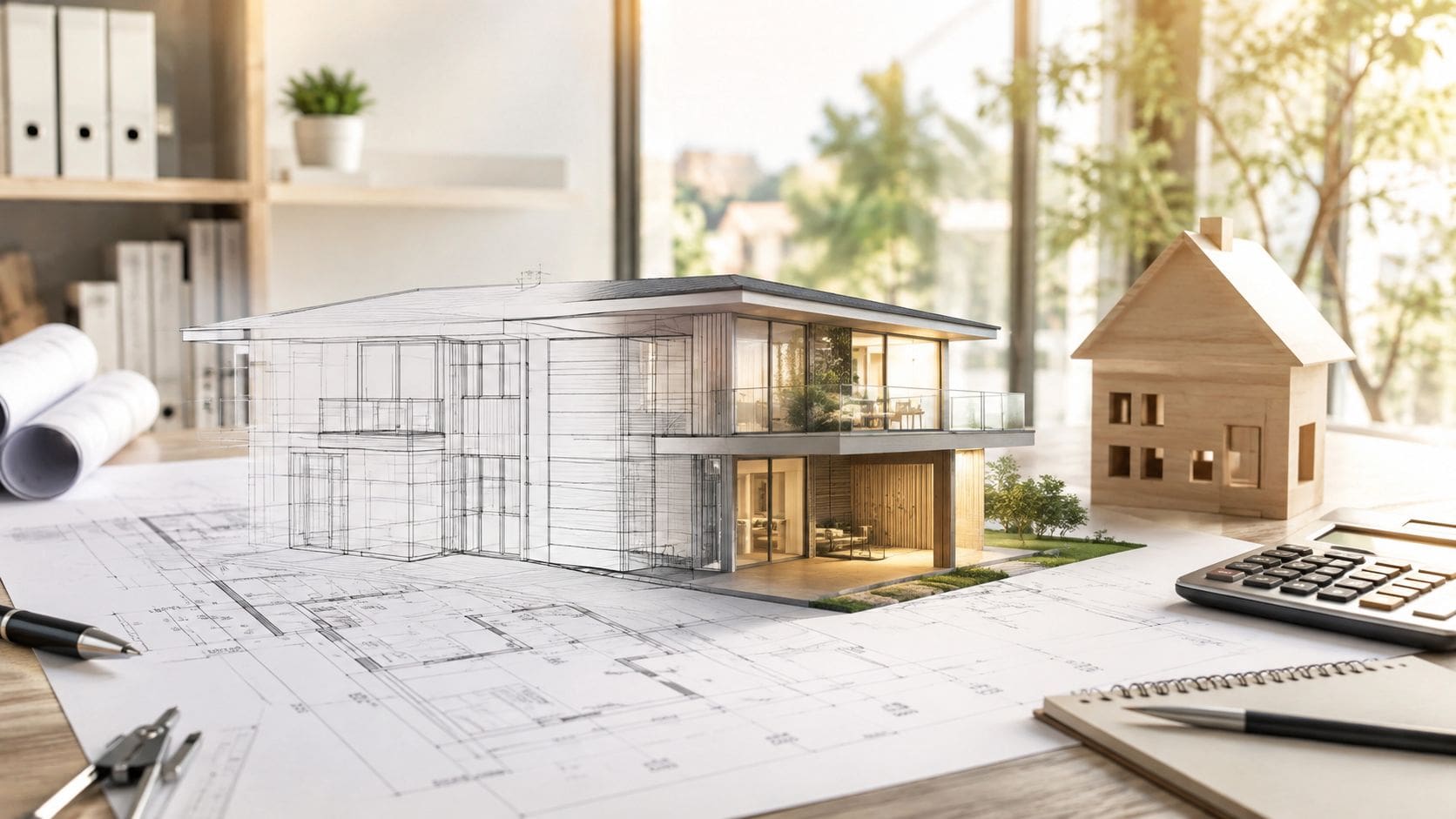
The unfinished-collateral problem
Think of the lender as financing a bridge one section at a time. The lender needs confidence that every completed section leads to a usable, valuable final asset. A finished house offers clearer collateral. An excavation, foundation, or framed shell offers less flexibility if the project stops.
Three risks explain the larger equity cushion:
- Incomplete collateral: The property may have limited marketability before completion.
- Budget movement: Materials, labor, permits, and site conditions can create costs beyond the first estimate.
- Valuation uncertainty: The finished appraisal may not support the projected loan balance.
The borrower's equity helps absorb those risks. If the borrower has meaningful value invested, the lender has more protection against a partial completion, a forced sale, or a budget shortfall. Equity also keeps the borrower financially connected to the project, which lenders view as important when approving a complex build.
Why reserves matter
A construction budget often includes more than visible building materials. It can include land, hard construction costs, architectural and engineering fees, permits, inspections, financing costs, and reserves for unexpected work. The lender may require a contingency reserve or interest reserve inside the approved project structure, but those funds still affect the total cost and the equity analysis.
A borrower who spends every available dollar on the initial closing can create a second problem. Even if the lender approves the loan, the borrower may lack liquidity for an approved change order, an insurance adjustment, a delayed draw, or a cost that the loan doesn't cover.
The familiar 3% to 5% down-payment range for some standard home loans doesn't translate directly to ground-up construction. Those loans secure an existing home, while construction financing must manage the property before it becomes finished collateral. (The Credit People compares construction lending with lower down payments on standard home loans)
A construction lender isn't only measuring whether you can start the build. It's measuring whether you can help carry the project until the collateral is complete.
How Lenders Calculate Your Down Payment Using LTC and LTV
The two ratios that matter most are loan-to-cost (LTC) and loan-to-value (LTV). LTC compares the requested loan with the project's total cost. LTV compares the requested loan with the appraised value of the completed property.
LTC answers, “How much of the budget is the lender financing?” LTV answers, “How much of the completed asset is the lender financing?” A lender commonly sizes the loan using the lower result, so a project must satisfy both tests rather than only the more favorable one.
Build the cost stack first
Your total project cost may include:
- Land: The purchase price or an approved value for land already owned.
- Hard costs: Labor, materials, site work, and construction contracts.
- Soft costs: Design, engineering, permits, legal work, and other professional expenses.
- Financing costs: Interest or approved interest reserves during construction.
- Project reserves: Funds set aside for unexpected costs or required completion needs.
Suppose the complete cost stack is $400,000 and the lender approves an 80% LTC limit. The LTC calculation would support a maximum loan of $320,000, leaving $80,000, or 20% of cost, for borrower equity.
Now suppose the completed appraisal is $375,000, and the lender applies a 70% LTV limit. That valuation test supports only $262,500, which is lower than the LTC result. The borrower would then need to fund the difference between the approved loan and the total cost, subject to the lender's structure, rather than relying on the higher LTC figure.
The example shows why a project can appear financeable from its budget yet require more cash after the appraisal. The cost number tells the lender how much the build consumes. The completed-value number tells the lender how much collateral supports the debt.
Typical leverage benchmarks
| Loan Type | Typical LTC Cap | Typical LTV Cap on Completed Value | Implied Equity Required |
|---|---|---|---|
| Residential ground-up | 75% to 85% | 65% to 80% | Roughly 15% to 35%, depending on the lower test |
| Commercial ground-up | 65% to 75% | Subject to lender and asset underwriting | Roughly 25% to 35% from LTC alone |
Residential spec-home and townhome lenders commonly cap financing around 75% to 85% LTC, implying approximately 15% to 25% equity. Commercial ground-up financing commonly uses tighter 65% to 75% LTC limits, implying roughly 25% to 35% equity.
For a plain-language explanation of how the ratios differ, review this guide to LTV versus LTC calculations. The key point is simple: LTC measures the budget, LTV measures the finished asset, and the lower permitted amount controls the deal.
If you already own the lot, its recognized appraised value may count toward the equity requirement. That doesn't automatically eliminate cash needs, because the lender may still require reserves, closing costs, or additional equity if the completed appraisal is conservative.
Typical Down Payment Ranges by Loan Program and Property Type
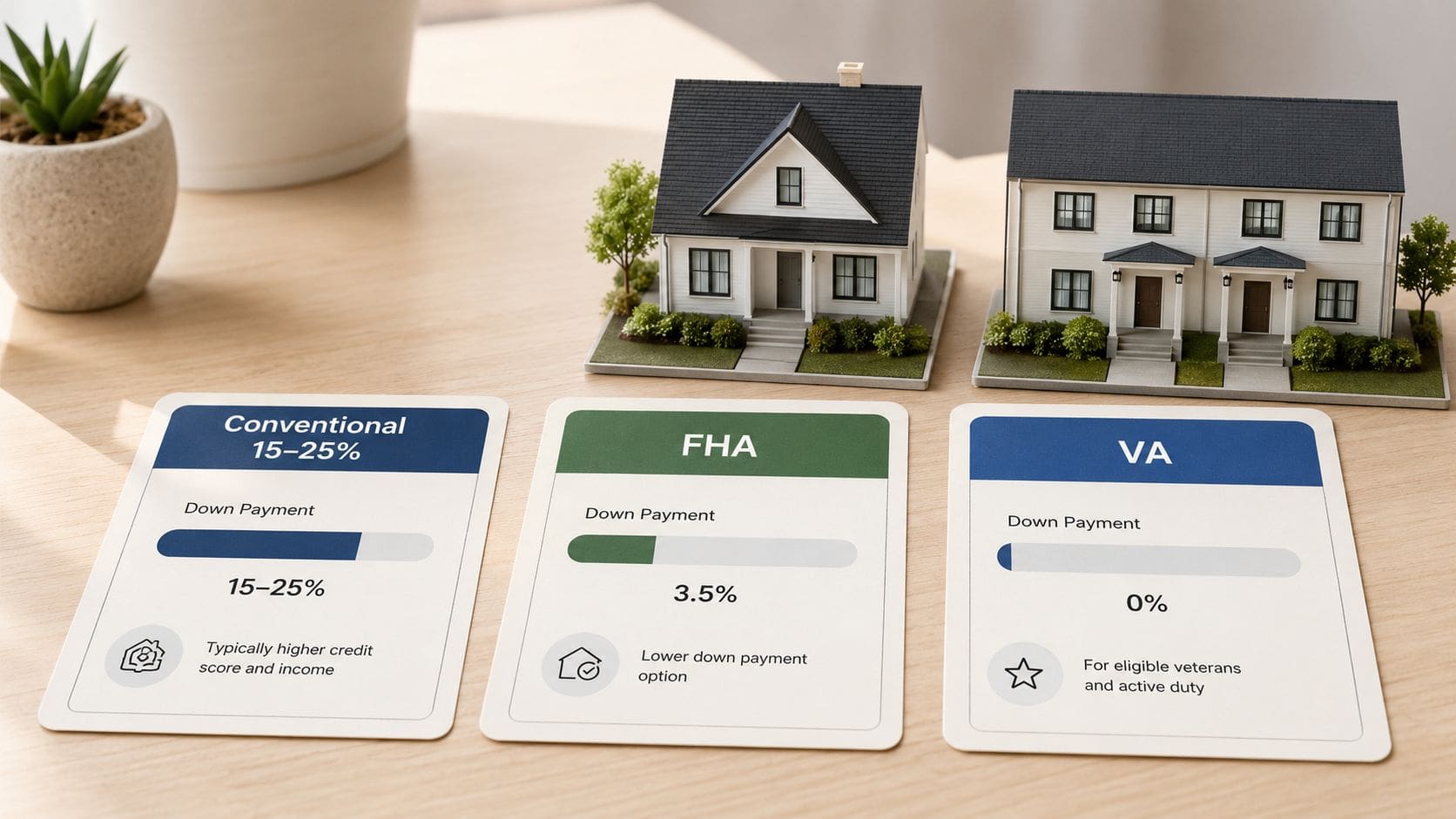
A builder planning a primary residence, an investor developing several units, and a commercial sponsor may all ask about the same “down payment.” Their cash requirements can differ because the loan program, property type, construction budget, and completed value are underwritten differently. The stated percentage is only the starting point. Land already owned, required reserves, and a gap between cost and appraisal can change the amount needed at closing and throughout construction.
Conventional construction financing
Conventional construction loans commonly call for 20% to 25% down. Construction-to-permanent programs may show a broader 15% to 25% equity range, while a strong borrower, qualified builder, straightforward plans, and supportive appraisal may produce a lower requirement, sometimes near 10% under a particular lender's policy. (Construction-to-permanent equity ranges and favorable-case structures are described by The Credit People)
A one-time-close loan can combine land purchase, construction, and the permanent mortgage in one closing. That structure does not remove the equity test. Some lender frameworks require at least 15% down at purchase and 20% equity at completion, so the borrower must plan for the project as a series of funding milestones, not a single deposit.
Review the construction loan requirements before applying. Plans, itemized costs, builder qualifications, projected value, and documentation all affect how the lender measures the contribution.
FHA-backed construction financing
FHA construction financing can require as little as 3.5% down for eligible borrowers. The lower program contribution still depends on an acceptable property, a qualifying borrower, a complete budget, and construction that follows the program's rules. (The Credit People identifies 3.5% as the FHA construction minimum for eligible borrowers)
Separate the program minimum from your actual cash-to-close estimate. Closing costs, approved reserves, prepaid items, land treatment, and a valuation gap can raise the amount you must provide. A guide to master minimum down payments with 24hourEDU can help with standard home-financing comparisons, but construction underwriting still requires project-specific analysis.
Commercial ground-up projects
Commercial ground-up financing generally requires more equity than a conventional owner-occupied build. Common LTC caps around 65% to 75% imply approximately 25% to 35% equity before the lender considers completed valuation, lease-up assumptions, project complexity, and the sponsor's liquidity.
Use these ranges as planning boundaries, not promises. The lender still reviews the cost stack, finished value, builder capacity, exit plan, and cash remaining after closing. In practical terms, your contribution must support the budget and the collateral test, with owned land potentially reducing new cash while reserves and appraisal risk preserve part of the cash requirement.
What Counts Toward Your Equity Beyond Cash
Many borrowers hear “down payment” and assume every dollar must be newly transferred from a bank account. Construction lending can be more flexible than that, because the borrower may already have value invested in the project.
Owned land is the clearest example. If you own the lot and the lender accepts its appraised value, that value may satisfy part of the required equity. The lender may treat the land as your contribution to the project, but it will usually verify ownership, title, liens, valuation, and the relationship between the land value and total cost.

Three forms of project equity
Land equity can reduce the fresh cash needed at closing. If the project costs $400,000 and the lender requires 20% equity, the target equity is $80,000. If the lender recognizes $50,000 of owned-land value, the remaining equity gap may be $30,000, subject to the lender's valuation, lien position, and reserve requirements.
Existing-property equity may also support a transaction when the lender accepts additional collateral or a refinance structure. The property doesn't automatically replace the borrower's contribution, but it can change how the lender measures available security and liquidity.
Staged completion equity matters when the lender requires the borrower to maintain a specific equity position as construction advances. Some lender guidance describes a purchase structure with at least 15% down at closing, while refinance transactions may require at least 15% equity at closing and 20% equity at completion based on appraised value. (AmeriSave describes purchase and refinance equity requirements for construction loans)
What the lender will verify
The lender may ask for documentation showing:
- Ownership and basis: Deed, settlement statement, payoff information, or other evidence of land ownership.
- Current value: An appraisal or valuation method accepted by the lender.
- Project costs: Signed contracts, plans, specifications, permits, and a detailed budget.
- Liquidity: Bank statements or other evidence that reserves remain available.
- Completion support: The ability to cover approved changes, overruns, or costs excluded from the loan.
The important distinction is between equity and liquidity. Land may satisfy an equity test while failing to pay a permit fee or an urgent change order. A lender may therefore recognize the lot and still require cash reserves after closing.
Equity can lower your cash-to-close, but it doesn't make liquidity optional.
Proven Strategies to Reduce Upfront Cash for Your Build
Reducing upfront cash doesn't mean persuading a lender to ignore risk. It means presenting the project so the lender can clearly see the collateral, the budget, and the borrower's contribution.
Start with the assets already in the deal
If you own the land, obtain the lender's valuation approach before assuming the full lot value will count. A title issue, existing lien, conservative appraisal, or mismatch between land value and total project cost can reduce the usable contribution.
Then separate costs into three working categories: costs financed by the loan, costs paid with equity, and costs that must remain liquid after closing. This prevents a common mistake, using every available dollar to satisfy the initial equity test and leaving no reserve for construction friction.
Improve the project's valuation support
A clean plan set and detailed specifications help the appraiser understand what will be built and how the completed home compares with nearby properties. Avoid unnecessary design changes after underwriting, because changes can create both budget uncertainty and questions about the final value.
A credible builder contract, realistic schedule, and complete cost breakdown also help the lender evaluate execution risk. Pre-sales or strong evidence of a planned exit can improve the lender's confidence in demand, but they don't replace a viable budget or acceptable collateral.
Compare structure, not just percentage
A lender offering a higher LTC cap may reduce the equity percentage, but the deal can still fail the LTV test. Ask each lender:
- Which costs are included: Does total cost include land, soft costs, reserves, and financing expenses?
- How land is valued: Will owned land count at cost, appraised value, or another basis?
- When equity is measured: Is the requirement tested at closing, each draw, completion, or all three?
- What happens after a gap: Who funds the difference if the completed appraisal is lower than projected?
- How draws work: What documentation and inspection steps must occur before funds are released?
Market headlines can also distort expectations. In 2026, national homebuying down payments were reported at a 12.8% median, or $23,400, while builder incentives reached record levels early in the year, including reported incentive spending of 7.8% of average sales price for one large builder and 7.5% for another. (Realtor.com reports the 2026 down-payment and builder-incentive figures) Those figures concern broader homebuying and builder-market conditions, not a universal construction-loan rule. They can still affect how borrowers compare buying a finished home with funding a custom build.
For investors considering alternative deal structures, creative real estate financing can provide a useful framework for thinking about collateral, timing, and capital sources. Any structure should be tested against the full budget and the lender's equity requirements.
Planning Your Next Steps Toward Construction Financing
Before requesting terms, build a lender-ready project file. Start with the full cost stack, not only the contractor's headline price. Include the lot, hard costs, soft costs, permits, financing expenses, reserves, and any work you'll pay outside the loan.
Then run two calculations:
- LTC test: Divide the proposed loan by total project cost.
- LTV test: Divide the proposed loan by the conservative completed appraisal estimate.
Use the lower permitted level as your working assumption. Next, list every potential equity source separately, including cash, owned land, existing-property equity, and approved collateral. Mark which assets are immediately liquid and which are only valuation-based contributions.
Your application should also answer practical execution questions. Who is the builder? Are the plans and specifications complete? Does the budget identify allowances and contingency? What happens if the appraisal is below the projected value? How will you fund a cost that falls outside the approved draw budget?
For builders and investors in Georgia, North Carolina, South Carolina, and Texas, asset-based options such as Sims Ventures' ground-up residential construction financing may fit projects where milestone-based draws, collateral strength, and deal structure matter alongside traditional income documentation. The company also provides financing and advisory services for real estate investors, so borrowers can discuss the relationship between equity, construction timing, and the project's exit strategy.
The final readiness test is simple: you should know your total cost, your conservative completed value, your maximum loan under both LTC and LTV, your recognized non-cash equity, and the cash reserve you'll retain after closing. If any of those answers is unclear, the project isn't ready for a reliable cash-to-close estimate.
Sims Ventures provides ground-up residential construction financing for builders and investors in Georgia, North Carolina, South Carolina, and Texas, with draws aligned to verified project milestones. Visit Sims Ventures to discuss your construction budget, equity sources, and financing structure before you apply.
