

Hard Money Construction Loan Guide for Investors
The lot is under contract, the plans are stamped, and the buyer is ready. Then the bank tells you underwriting will take weeks, followed by another review before construction funds can convert into the form your project needs. Your closing date doesn't move just because the lender's process does.
That timing mismatch is why investors turn to a hard money construction loan. Private construction capital can close around the project schedule, but speed isn't free. The question is whether the loan's points, interest, draw mechanics, and exit risk still leave you with a viable deal. The right way to evaluate the financing is to plan the take-out before the first draw, not after the certificate of occupancy.
When a Bank Timeline Breaks the Deal
A repeat builder in Atlanta can have a sound project and still lose it to timing. The builder has the lot under contract, stamped plans, a signed buyer lined up, and a contractor ready to mobilize. The bank's initial answer sounds encouraging, but the underwriting queue requires roughly 75 days, followed by another 30 days for conversion. The purchase contract expires before the capital is ready.
That isn't necessarily a rejection. It's a mismatch between two operating calendars. A conventional construction lender works through documentation, committee reviews, collateral procedures, and conversion requirements. The builder works against a seller's deadline, permit windows, subcontractor availability, and the cost of carrying a site that isn't producing revenue.
A private lender looks at the same transaction through a different lens. The lender still needs title, plans, budget, appraisal support, insurance, permits, and a credible sponsor. But the approval centers more directly on the collateral, the amount required to finish, the borrower's equity, and the plan for repayment. Investors evaluating that mismatch can also review this practical discussion of why traditional bank financing can derail a project timeline.
Practical rule: A loan that closes after the purchase contract expires isn't cheaper financing. It's unavailable financing.
A hard money construction loan can bridge that gap by funding acquisition, construction, or both through a short-term facility. The trade-off is a higher all-in cost and more execution discipline. This guide focuses on how the structure works, what lenders inspect, how underwriting differs from a bank, and how to build a refinance or sale exit before construction begins.
What a Hard Money Construction Loan Actually Is
A hard money construction loan is a short-term, asset-based facility for acquiring land, funding a vertical build, or handling both needs in one closing. The private lender advances capital through construction draws. Repayment comes from a sale, refinance, or another committed take-out after the project reaches its intended endpoint.
These loans operate within the broader private lending market. Industry reporting describes bridge loans used for fix-and-flip and ground-up construction as facilities with terms of 36 months or less, interest-only payments during the term, and a balloon payment at maturity, according to 2026 hard money lending statistics. In 2024, 38% of bridge loans generated had no construction holdback or reserves. That suggests many bridge facilities fund acquisition or refinance rather than pure construction draws. A loan labeled “bridge” is not automatically a full vertical construction facility.
The market is broad rather than confined to a few local lenders. Private-lending data describes a document platform used for more than 92,000 loans totaling over $49 billion. It also processed 4,272 transactions exceeding $2 billion in origination during January 2025. That activity helps explain the specialized procedures private lenders use for appraisals, inspections, draw administration, and asset-based approvals.
The funding mechanics
The lender usually does not wire the entire construction budget on day one. The borrower receives the land or acquisition advance, then requests additional funds as work reaches defined milestones. An inspector verifies completed work, the lender reviews the draw package, and the approved amount is released.
A draw request generally needs current invoices, lien waivers, progress evidence, and confirmation that the budget still supports completion. Missing documentation can delay funding even when the work is finished. Speed has a cost, and borrowers should account for inspection timing and administrative requirements rather than treating the loan as unrestricted cash.
Underwriting also differs from a bank's emphasis on borrower income, global debt service, and conventional credit metrics. A private construction lender focuses on whether the collateral and completed project support repayment, whether the sponsor can execute the build, and whether the exit is credible. That exit should be planned before the first draw, including the refinance terms or sale assumptions needed to repay the facility.
Borrowers still need clean records and organized project accounting. An accounting workflow blog can help structure transaction records, invoices, and cash movement for underwriter review.
How the Money Is Structured
A private construction facility should be priced as a complete capital plan, not judged by its headline rate. Current construction loan rate benchmarks place hard-money bridge and construction pricing around 11.5% to 13.5%, with closing timelines of 2 to 4 weeks, reflecting the premium for speed, asset-based underwriting, and construction execution risk in current construction lending benchmarks.
The rate is only one input. Points apply to the original loan amount, interest accrues as capital is advanced, and the agreement may impose extension charges or fees on an approved line that remains undrawn. A lower stated rate can still produce a higher total cost if the loan carries expensive points, charges interest on the full balance, processes draws slowly, or offers little flexibility when the schedule slips.
LTC and LTV do different jobs
Loan-to-cost, or LTC, measures the share of eligible project cost the lender will fund. Loan-to-completed-value, or LTV, measures the advance against the appraised value after completion. Ground-up programs commonly benchmark around 70% to 85% LTC and 65% to 75% LTV on as-built value as described in hard money construction underwriting guidance.
The tighter constraint controls the facility. A strong budget does not solve a weak completed appraisal, because LTV limits the advance. A high appraisal does not solve an expensive project, because LTC still limits the loan and increases the equity contribution.
Model the complete carry
Build the financing model around every dollar required to reach the planned exit:
- Points: Upfront charges based on the original loan amount.
- Monthly interest: The cost of outstanding principal. The agreement determines whether interest applies only to drawn funds or to the committed balance.
- Interest reserve: Capital set aside for debt service during construction. It protects operating cash flow but increases the amount borrowed.
- Extension cost: A fee charged when the project exceeds its initial maturity.
- Unused-line charges: Fees that may apply to approved but undrawn capital, depending on the agreement.
A loan term may run 9 to 18 months, but the model should test at least one extension scenario before closing. Include points, interest, reserves, inspection-related delay, and extension costs. Then underwrite the refinance or sale take-out before the first draw, using the expected completed value, debt capacity, and timing. Speed reduces schedule risk, but its higher carry can consume the equity cushion that protects the exit.
| Term | Typical Range | What Drives the Number |
|---|---|---|
| Annual interest rate | 11.5%–13.5% | Leverage, experience, collateral, market, and execution risk |
| Construction term | 9–18 months | Project scope, permitting, absorption, and exit timing |
| LTC | 70%–85% | Total cost, borrower equity, budget quality, and lender risk tolerance |
| Completed-value LTV | 65%–75% | As-built appraisal, comparable sales, and projected exit value |
| Bridge duration | 36 months or less | Short-term acquisition, construction, sale, or refinance strategy market definition |
Draw Schedules and Inspection Milestones Explained
A construction loan is only as useful as its draw process. Before closing, require a clear answer on what gets inspected, which documents accompany each request, who approves the release, and how quickly funds move afterward. A vague process becomes a scheduling problem when subcontractors are waiting for payment and the next trade cannot start.
Match every draw to visible work
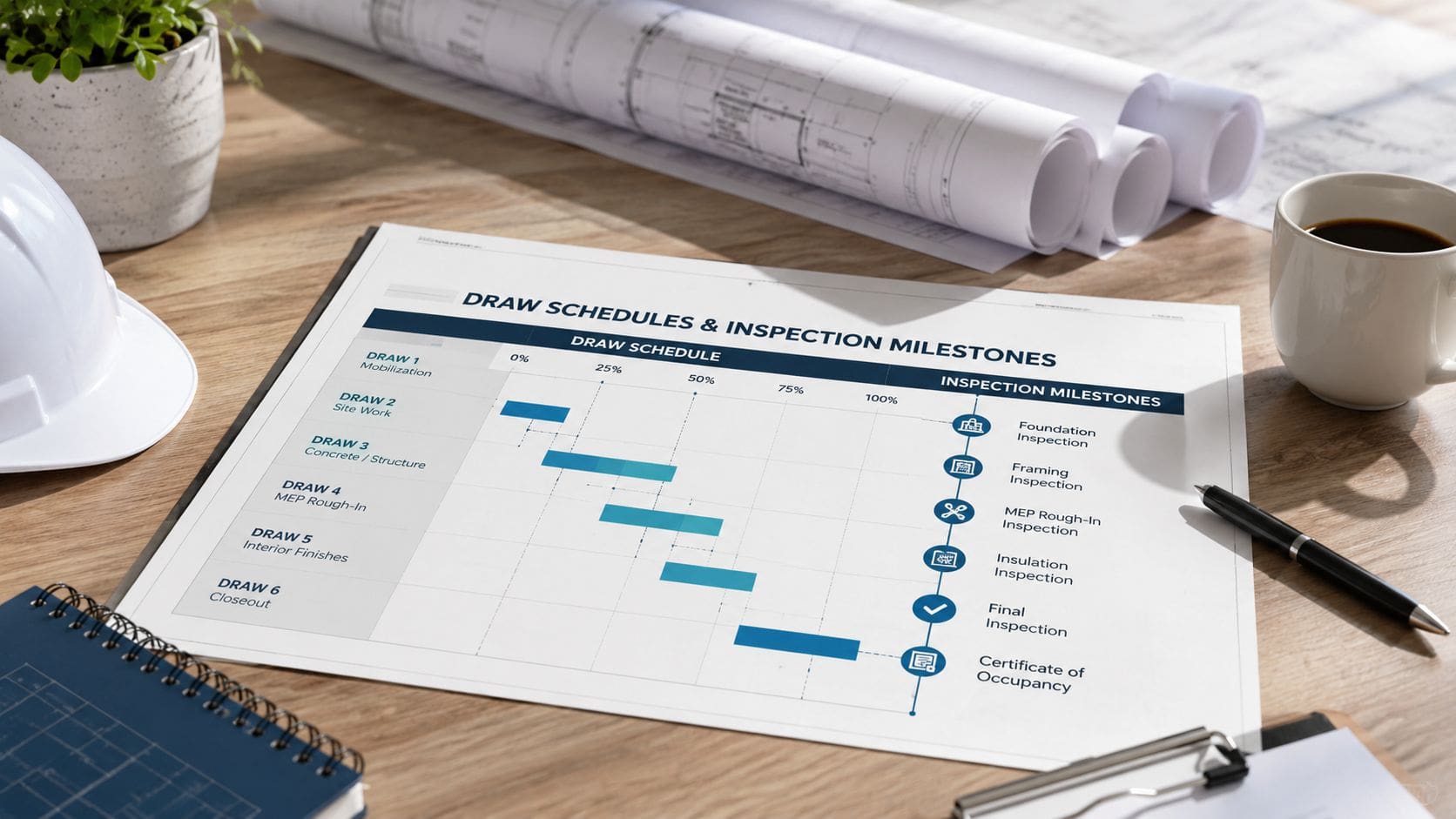
A ground-up schedule commonly divides funding into 4 to 8 draws or 5 to 7 stages, with each release tied to verifiable progress. The sequence varies by project, but a written construction draw schedule should connect the budget, inspection points, required documents, and expected funding date.
- Land and site work: The lender funds acquisition or approved site preparation after title and closing conditions are satisfied.
- Foundation: Excavation, footings, forms, and foundation work must be complete and available for inspection.
- Framing and rough-in: Structural framing, plumbing, electrical, and mechanical rough-ins support the next release.
- Drywall and interior progress: The inspector confirms that rough-in work is complete and materials are installed in line with the budget.
- Finishes: Cabinets, flooring, fixtures, paint, exterior work, and related finish items are verified.
- Final retention: The lender holds back a portion until punch-list work, final inspections, and required completion documents are delivered.
The draw administrator may rely on a third-party inspector, site photographs, invoices, lien waivers, and the contractor's updated budget. Borrowers can review specialized draw inspection services to understand how field verification works, especially on projects with several trades or active sites.
Where draws stall
Delays usually occur between milestones. Weather can hold up the move from foundation to framing. A code-driven change can require rough-in work to be revised. Windows, HVAC equipment, or specialty materials may arrive late, blocking the finishes draw even when much of the property appears nearly complete.
Lenders may retain 10% to 20% until final sign-off, depending on the agreement and project risk. That withheld amount can leave the builder short when final subcontractors need payment. Maintain separate liquidity for payroll, punch-list work, and unexpected completion costs.
The draw plan also affects the exit. Before the first release, test whether the expected completion date still supports the planned refinance or sale, including inspection delays and the cost of carrying unused time. Faster funding can reduce schedule risk, but its higher rate and fees may reduce the equity cushion available to complete the project and refinance successfully. The lender funds completed work, not optimistic projections.
How Underwriting Differs From a Bank
A bank may decline a build that a private lender can fund, even when both review the same plans. Banks usually begin with the borrower's global financial position, documented income, debt service, credit profile, and relationship with the institution. A private construction lender starts with the collateral, cost to complete, completed value, and repayment path.
That does not make the sponsor irrelevant. Ground-up construction requires site work, utilities, foundations, inspections, and tight sequencing. Experience with similar projects gives the lender evidence that the borrower can manage those handoffs. The lender also checks whether the borrower has enough equity and liquidity to cover a gap between draws, an overrrun, or a budget item that was missed.
The exit carries unusual weight
A strong approval package shows how the loan will be repaid before the first draw. Completed-build history, prior lender references, a signed purchase contract, or a credible refinance indication can support that plan. A projected sale price without comparable support is only an assumption. A finished property does not guarantee that a refinance will be available on acceptable terms.
The take-out should be tested against the actual construction schedule. Review the expected completion date, inspection delays, carrying costs, projected value, and the borrower's likely refinance qualification. A lender may fund quickly, but the speed has a price. Higher interest and fees can reduce the equity cushion available for completion and leave less room for a successful refinance.
Market conditions also explain why private underwriting may be more selective than a borrower expects. 1–4 family residential construction and land development loans reached $204 billion in Q1 2008, while the same category stood at $91.2 billion in Q3 2025, about 56% below that peak, according to FDIC Quarterly Banking Profile construction loan data. Across commercial banks, construction and land-development loans totaled $463.0 billion in Q3 2025, down 5.6% year over year. That softer bank lending environment makes a well-supported exit and a realistic completion budget more important.
| Criterion | Hard Money Lender | Bank |
|---|---|---|
| Primary focus | Collateral, cost, completion value, and exit | Borrower financial profile and repayment capacity |
| Leverage | LTC and completed-value LTV caps | Policy-based construction advance and borrower qualification |
| Income documentation | Often secondary to the asset and project | Full income and debt-service review |
| Sponsor evidence | Relevant construction history and execution capacity | Broader financial and credit history |
| Equity | Cash invested in land, costs, or reserves | Required contribution under bank policy |
| Exit | Sale, refinance, or other documented take-out | Permanent debt conversion or conventional repayment structure |
A borrower can be bank-ready because strong income and credit satisfy the bank's global debt-service test, yet still need a tighter budget and exit for private approval. The reverse also happens. A valuable project may suit an asset-based lender while failing the bank's broader repayment requirements. The best application addresses both sides before funding begins: execution capacity and a take-out that still works after the final draw.
Ground-Up Programs and a Builder's Line of Credit
A repeat builder's financing problem changes once the pipeline includes several projects. Reapplying from zero for every home creates duplicated underwriting, repeated document collection, and inconsistent draw administration. A builder's line of credit addresses that workflow by creating a revolving facility sized around an approved pipeline, with each project still subject to its own budget, inspections, and collateral review.
Consider a builder operating across Georgia, North Carolina, South Carolina, and Texas. The builder has two spec homes underway in the Carolinas. Rather than treating the properties as unrelated applications, the lender evaluates the builder's broader capacity, the individual budgets, the projected exits, and the available line. Each home maintains its own draw schedule, and each draw is inspected independently.
One relationship, separate project controls
The line doesn't eliminate project discipline. It changes the starting point for a repeat sponsor who has already demonstrated execution. Subsequent projects can move through underwriting more efficiently because the lender already understands the builder's reporting, contractor relationships, and operating process. Consistent draw administrators also reduce the learning curve between requests.
That structure differs from a single-project hard money construction loan. A project loan is sized around one property and one maturity. A revolving facility supports multiple eligible projects, subject to the lender's line limits and approval conditions. It can be useful for a builder whose land acquisitions and construction starts don't arrive in a single predictable sequence.
Sims Ventures offers a Builder's Line of Credit for builders managing multiple projects, alongside ground-up construction financing. Its stated lending footprint covers Georgia, North Carolina, South Carolina, and Texas, and its closing process commonly targets around 15 days when appraisal, title, and underwriting items are complete. Those are process benchmarks, not guarantees. A project still moves only when the plans, budget, title, insurance, permits, and draw milestones are ready.
The critical question is whether the facility matches the builder's cadence. A line that looks flexible but has restrictive project-by-project approvals may not solve the operational bottleneck. Conversely, a clearly documented facility with independent inspections can give a seasoned builder useful continuity without abandoning collateral controls.
Common Pitfalls and the Refinance Question
The projects that create the most trouble rarely fail because nobody knew construction was expensive. They fail because the budget was optimistic, the permit timeline was treated as certain, or the take-out was assumed rather than arranged.
A lender sees the same failure pattern repeatedly. Hard costs come in above the initial estimate. A permit issue delays mobilization. A change order consumes contingency. An inspection finds work that must be corrected before the next draw. The completed appraisal lands below the projected exit value, leaving the borrower with less refinance capacity or a sale price that no longer supports the original model.
Treat the exit as a construction requirement
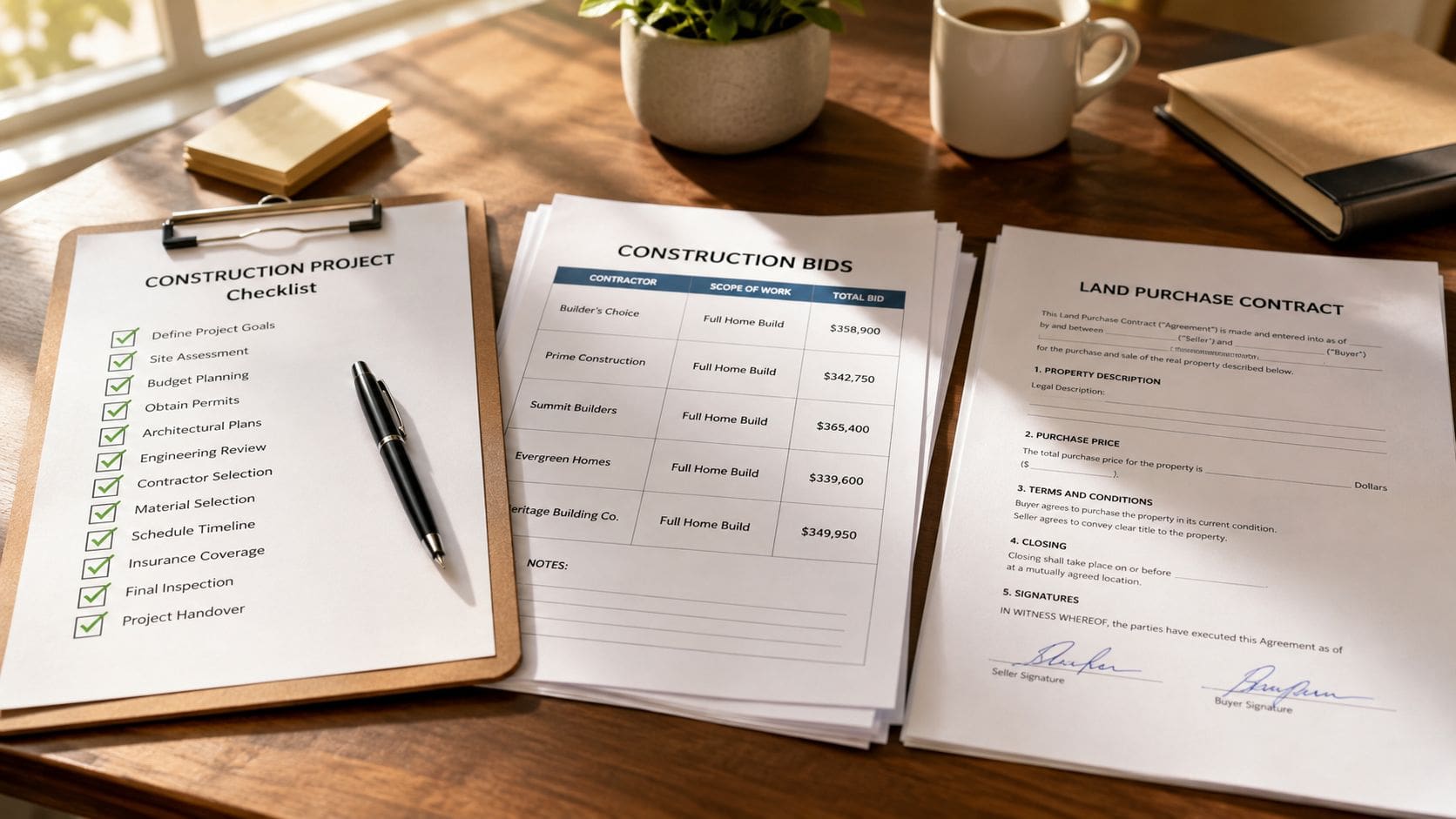
The take-out should be identified before the first draw. That can mean a sale strategy supported by credible buyer demand, a DSCR refinance quote based on realistic stabilized cash flow, a rate-lock window with a conventional lender, or a portfolio refinance commitment. The exact route depends on whether the property will be sold, rented, or held as part of a larger investment plan.
The private loan matures while the project is still exposed to market conditions. Recent construction lending coverage describes private capital becoming more active in completion and bridge-refinance transactions as banks retreat, but that availability shouldn't replace borrower preparation. A lender willing to refinance a completed project today may not offer the same proceeds, valuation, or terms when your maturity date arrives.
Credit conditions for residential construction have also continued tightening in the NAHB survey referenced in current market coverage, while average effective rates reached 11.82% for speculative single-family construction and 12.59% for land-development loans in Q2 2026 in the reported construction lending conditions. The same coverage reports average private CRE loan pricing of 9.76% versus 6.47% for banks in that quarter, illustrating why speed can carry a materially higher cost.
The cost of speed only works when the refinance is already penciled.
Build the exit model alongside the construction budget. Stress the completed value, stabilized income, sale timing, lender fees, and potential extension. A short-term loan can solve an acquisition deadline and still become a bad investment if the borrower reaches completion without a documented path to repay it.
A Practical Checklist Before You Apply
A fast closing depends on a complete file. Before submitting, assemble documents that answer four underwriting questions: do you control the site, can you complete the build, is the finished value supported, and how will the loan be repaid?
Use this working checklist:
- Site control: Provide the purchase contract or recorded proof that you own the lot.
- Detailed budget: Break contractor bids into line items, including cost to complete, allowances, and soft costs.
- Value support: Prepare recent comparable sales that support the completed value.
- Defined exit: Document a sale contract, refinance quote, or portfolio take-out strategy before the first draw.
- Construction team: Show the general contractor's license, relevant build history, and references.
- Risk controls: Provide insurance naming the lender and confirm permits are issued or demonstrably in process.
- Sponsor liquidity: Show the required builder experience and enough equity or liquidity for overruns, reserves, and retained draw amounts.
- Timeline test: Map application, closing, first draw, inspections, completion, and take-out dates. A single estimated finish date is not enough.
The take-out plan deserves the same scrutiny as the construction budget. Confirm the completed-value assumptions, expected income or sale timing, lender fees, extension terms, and refinance documentation before construction begins. A lender may approve the build and still require a lower payoff balance if the finished value or market conditions change.
A ready file also makes loan comparisons more useful. Ask each lender how interest accrues, who performs inspections, what triggers a re-underwrite, how much remains in retention, and which take-out documents must be delivered before closing. A lower rate may be outweighed by slower draws, heavier reserves, or inspection delays that extend the loan term.

Sims Ventures provides ground-up construction loans with milestone-based draws and a Builder's Line of Credit for qualifying builders managing multiple projects across Georgia, North Carolina, South Carolina, and Texas. Review your budget, draw schedule, and take-out plan with the team, then visit Sims Ventures to discuss whether the financing fits your project.
