

Real Estate Entity Structures: Tax and Risk in California
Selecting the best structure for your California property investments can shape everything from tax outcomes to how risk touches your personal assets. This decision matters because entity type directly influences liability protection, tax efficiency, and ownership rights in one of the nation’s most complex regulatory environments. Whether you are comparing a Limited Liability Company, Corporation, Partnership, or a Real Estate Investment Trust, understanding each real estate entity structure will empower you to safeguard your holdings and build lasting financial strategies.
Defining Real Estate Entity Structures
Real estate entity structures serve as strategic frameworks that protect investors, manage tax liabilities, and define ownership parameters for property investments. These legal constructs are critical mechanisms that determine how properties are owned, managed, and transferred within California’s complex regulatory environment.
The primary types of real estate entity structures include:
- Limited Liability Company (LLC): Offers personal asset protection and flexible tax treatment
- Corporation: Provides strict liability separation and potential tax advantages
- Partnership: Enables multiple investors to share ownership and responsibilities
- Real Estate Investment Trust (REITS): Allows collective property investment through publicly traded securities
Each entity structure carries unique legal and financial implications. The Internal Revenue Service (IRS) defines real property as land and permanent improvements, which significantly impacts how these entities are taxed and structured. Investors must carefully evaluate their specific investment goals, risk tolerance, and tax strategies when selecting an appropriate entity structure.
The selection process involves analyzing multiple factors including liability protection, tax efficiency, management complexity, and potential future growth scenarios. Real estate investors in California must navigate state-specific regulations that can further complicate entity selection, making professional legal and tax consultation essential.
Pro tip: Consult with a California-based tax attorney or certified public accountant who specializes in real estate investments before finalizing your entity structure to ensure comprehensive compliance and optimal financial strategy.
Major Entity Types and Key Differences
California offers multiple real estate entity structures, each with distinct characteristics that impact taxation, liability protection, and operational flexibility. California business entities range from sole proprietorships to complex corporate arrangements, requiring careful evaluation based on individual investment strategies.
The key real estate entity types include:
- Limited Liability Company (LLC): – Provides personal asset protection – Offers flexible tax treatment
- Corporation:
- Strict legal separation between personal and business assets
- More complex regulatory requirements
- Potential for issuing stock
- Partnership:
- Enables shared ownership and responsibilities
- Varies in liability structure
- Real Estate Investment Trust (REIT):
- Allows pooled real estate investments
- Provides liquidity through public trading
Each entity structure presents unique advantages and challenges. Corporations offer robust liability protection and potential for significant capital raising, while LLCs provide more flexible management and tax strategies. Partnerships allow collaborative investment approaches with varying levels of individual investor involvement and risk exposure.

Selecting the appropriate entity requires deep understanding of your specific investment goals, risk tolerance, and long-term financial objectives. Factors such as tax implications, management complexity, and potential future growth scenarios must be carefully weighed.
Here’s a concise comparison of key real estate entity structures in California:
| Entity Type | Typical Uses | Management Flexibility | Investor Suitability |
|---|---|---|---|
| LLC | Rental properties, small portfolios | High, member-managed possible | Solo or small groups |
| Corporation | Large-scale real estate operations | Lower, formal structure | Multiple or institutional |
| Partnership | Joint ventures, family investment | Varies by partnership type | High-trust collaborators |
| REIT | Publicly traded property investment | Board-managed, regulated | Passive, portfolio diversifiers |
Pro tip: Conduct a comprehensive financial analysis with a professional advisor to determine the most advantageous entity structure for your specific real estate investment portfolio.
Legal and Tax Framework in California
The legal and tax landscape for real estate entities in California presents a complex regulatory environment that demands strategic navigation. Doing business in California requires comprehensive understanding of state-specific tax laws, filing obligations, and compliance requirements that can significantly impact investment strategies.
Key legal and tax considerations include:
- State Tax Jurisdiction:
- Applies to entities generating financial gains
- Triggered by sales, property, or payroll thresholds
- Specific filing requirements for different entity types
- Taxation Structures:
- Corporations pay franchise taxes
- LLCs have unique tax classification options
- Partnerships have pass-through taxation rules
- Compliance Requirements:
- Annual reporting obligations
- State-specific registration mandates
- Ongoing financial disclosure requirements
Public Law 86-272 provides limited protection for out-of-state entities, but California’s business entity regulations are particularly nuanced. Real estate investors must carefully evaluate their specific entity structure to optimize tax efficiency and maintain legal compliance.
The financial implications of entity selection extend beyond simple tax considerations. Each structure carries unique reporting requirements, potential liability exposures, and operational constraints that can dramatically impact long-term investment performance. Professional guidance becomes crucial in navigating these complex regulatory waters.
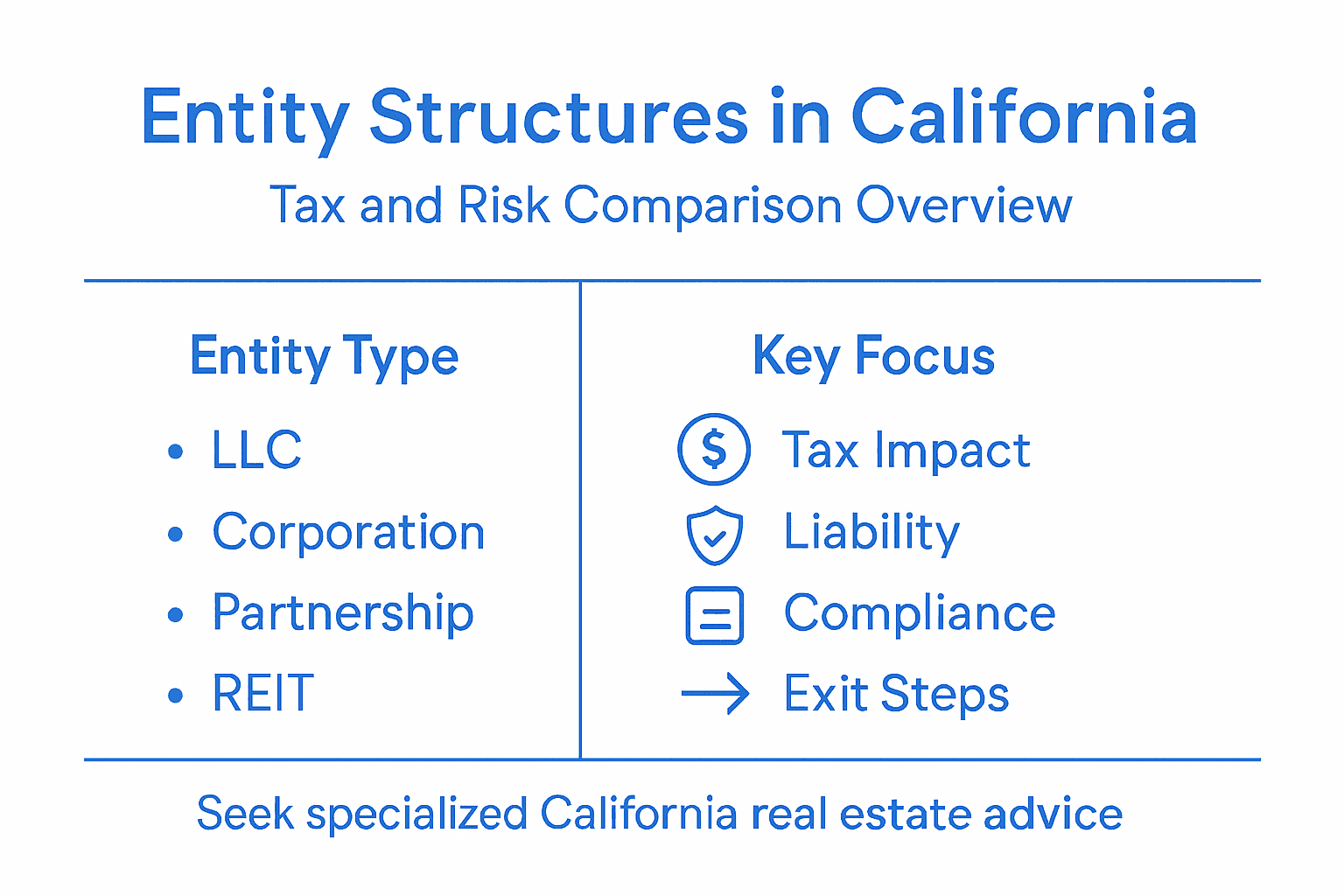
Below is a summary of major regulatory and tax considerations by entity type:
| Entity Type | Primary State Taxation | Annual Compliance Focus | Exit Complexity |
|---|---|---|---|
| LLC | Franchise tax, fee on gross receipts | Statement of Information, tax filings | Moderate, filing required |
| Corporation | Franchise tax, double taxation risk | Board minutes, annual reports | High, strict dissolution steps |
| Partnership | Pass-through, state returns | Partnership agreement updates | Low to moderate |
| REIT | Corporate plus special REIT rules | SEC and state disclosures | High, liquidation protocols |
Pro tip: Consult with a California-certified tax professional who specializes in real estate entities to develop a comprehensive compliance and tax optimization strategy tailored to your specific investment portfolio.
Asset Protection and Liability Exposure
Asset protection represents a critical strategic consideration for real estate investors in California, where legal complexities can dramatically impact personal financial security. Homeowner protection resources underscore the importance of understanding liability risks and implementing robust protective strategies across different real estate entity structures.
Key asset protection mechanisms include:
- Limited Liability Company (LLC):
- Separates personal assets from business liabilities
- Provides strongest individual investor protection
- Flexible management and tax treatment
- Corporate Structures:
- Creates legal separation between shareholders and corporate assets
- Shields personal wealth from business-related legal claims
- Offers structured governance mechanisms
- Insurance Strategies:
- Professional liability coverage
- Property damage protection
- Umbrella liability policies
California’s real estate regulatory changes increasingly emphasize individual accountability, making proactive risk management more crucial than ever. Investors must carefully evaluate their entity structure’s ability to mitigate potential legal exposures while maintaining operational flexibility.
Understanding the nuanced relationship between entity structure and liability protection requires sophisticated analysis. Different investment scenarios demand tailored approaches, with some strategies offering more comprehensive protection than others. Professional legal counsel becomes essential in navigating these complex risk management landscapes.
Pro tip: Conduct an annual comprehensive risk assessment with a California-based legal professional specializing in real estate to ensure your current entity structure provides maximum asset protection.
Tax Efficiency, Compliance, and Cost Segregation
Tax efficiency represents a critical strategic lever for real estate investors seeking to maximize returns and minimize liability in California’s complex regulatory environment. Property tax policies play a pivotal role in shaping investment strategies and determining long-term financial performance.
Key strategies for tax optimization include:
- Cost Segregation:
- Accelerates depreciation of property components
- Reduces current tax liability
- Improves short-term cash flow
- Compliance Mechanisms:
- Precise documentation of property improvements
- Detailed tracking of asset classifications
- Regular assessment of tax strategy effectiveness
- Withholding Requirements:
- 3 1/3 percent withholding on real estate sales
- Potential alternatives based on calculated gain
- Strict adherence to state reporting standards
California’s tax regulations mandate specific withholding and reporting protocols that investors must carefully navigate. Understanding these nuanced requirements becomes essential for maintaining tax efficiency and avoiding potential penalties.
Successful tax optimization requires a holistic approach that integrates entity structure, investment strategy, and comprehensive financial planning. Sophisticated investors leverage detailed cost segregation studies to disaggregate property components, enabling more aggressive depreciation strategies that can significantly reduce tax burden.
Pro tip: Engage a certified tax professional specializing in real estate cost segregation to conduct an annual comprehensive review of your tax strategy and identify potential optimization opportunities.
Formation Steps, Common Pitfalls, and Exits
Navigating the complex landscape of real estate entity formation in California requires strategic planning and meticulous attention to legal and regulatory requirements. Business formation steps demand comprehensive preparation and expert guidance to minimize potential risks and optimize investment potential.
Critical formation considerations include:
- Initial Planning:
- Develop comprehensive business plan
- Assess long-term investment objectives
- Evaluate potential risk exposures
- Legal Documentation:
- Select appropriate entity structure
- Register with California Secretary of State
- Obtain necessary tax identification numbers
- Compliance Requirements:
- Secure required business permits
- Establish robust record-keeping systems
- Maintain ongoing regulatory compliance
Common pitfalls during entity formation can significantly derail investment strategies. Investors frequently encounter challenges such as improper entity selection, inadequate documentation, and failure to understand complex tax implications. These mistakes can result in unexpected liability exposure and reduced financial flexibility.
Closing a California business entity requires systematic dissolution procedures that protect investors from lingering tax obligations. Successful exit strategies demand careful planning, including final tax return filings, creditor notifications, and formal operational wind-down processes.
Pro tip: Engage a California-based business attorney specializing in real estate entities to conduct a comprehensive review of your formation and exit strategy documentation before finalizing any critical decisions.
Navigate California Real Estate Risks with Confidence
Choosing the right real estate entity structure is more than a technical decision. It directly affects your tax efficiency, liability protection, and long-term growth potential. If you are facing challenges around selecting an optimal structure or managing complex compliance requirements detailed in this article, you are not alone. Many investors struggle to balance asset protection with tax optimization under California’s evolving regulations.
At Sims Ventures, we understand these pain points deeply. Our specialized financing and strategic advisory services help you structure entities and optimize deal and capital strategies tailored to your unique investment goals. Whether you are focused on minimizing liability through an LLC or maximizing tax advantages with a corporation, we partner with you every step of the way to turn complexity into clarity. Explore our expert insights on Real Estate Investment and discover how our solutions can empower your next move.
Act now to secure your investment future. Visit Sims Ventures to learn how our partnership approach brings more than funding—it brings a strategic advantage for stability and growth.
Frequently Asked Questions
What are the primary types of real estate entity structures available?
Real estate entity structures include Limited Liability Companies (LLC), Corporations, Partnerships, and Real Estate Investment Trusts (REITs). Each offers different benefits and legal implications regarding ownership and tax treatment.
How do I choose the right real estate entity structure for my investment?
Selecting the appropriate entity structure depends on factors such as liability protection, tax efficiency, management complexity, and your long-term financial goals. Consulting a legal or tax professional is advisable to ensure the best fit for your needs.
What are the tax implications of different real estate entity structures?
The tax implications vary: LLCs may have flexible tax treatment, Corporations face franchise taxes, Partnerships utilize pass-through taxation, and REITs operate under specific corporate tax rules. Evaluating these differences is crucial for tax planning.
How can real estate investors protect their assets in California?
Asset protection for real estate investors can be achieved through structures like LLCs and Corporations, which separate personal liability from business obligations. Insurance strategies, such as umbrella policies, also play a vital role in mitigating risk.
