

Real Estate Growth Strategies Guide for Maximizing Returns
Every experienced investor reaches a point where sustained growth relies less on instinct and more on strategic clarity. Market shifts in the United States, as highlighted by recent industry forecasts, bring new challenges for portfolio planning and capital allocation. This guide walks through proven steps to align financing, entity structure, and deal execution so you can pursue your growth targets with precision and remain competitive in evolving markets.
Quick Summary
| Key Insight | Explanation |
|---|---|
| 1. Assess Financing Needs Clearly | Understand your financial position and growth trajectory to determine required capital. A clear plan prevents mismatched financing solutions. |
| 2. Choose the Right Entity Structure | Select an entity that aligns with liability protection and capital needs. The wrong structure can incur unnecessary costs and complications. |
| 3. Optimize Execution Processes | Utilize systems for deal tracking and standardized workflows to enhance capital deployment and ensure quicker closings. |
| 4. Regularly Monitor Performance | Establish metrics to evaluate each asset’s performance against assumptions, allowing for timely course corrections in strategy. |
| 5. Document Assumptions and Lessons | Keep thorough records of assumptions, progress, and deal outcomes to inform future decisions and improve operational discipline. |
Step 1: Assess Financing Needs and Growth Goals
Before you pursue capital, you need clarity on exactly what you’re building toward and how much you actually need. This foundation determines everything that follows—from deal structure to partnership conversations.
Start by mapping your current portfolio and projecting three years forward. What properties do you hold? What are their cash flows today? Which deals are in your pipeline? This baseline reveals your financial position and creates realistic scenarios for growth.
Next, define your growth trajectory with specificity. Are you scaling from 5 properties to 12? Expanding from single-family rehabs to small multifamily projects? Moving into commercial development? Your answer shapes which financing vehicles work best. Vague goals lead to mismatched capital solutions.
Calculate your financing gap by mapping these elements:
- Down payment requirements for planned acquisitions
- Construction or renovation costs (include contingencies)
- Working capital for operational gaps between project phases
- Bridge capital for holding periods before refinance or sale
- Reserve reserves for unforeseen challenges
Take time to understand where real estate transaction trends and capital requirements are shifting. Market conditions affect both deal availability and financing availability.
Align your growth goals with realistic timelines. Aggressive expansion requires different capital structuring than steady-state operations. Be honest about whether you’re funding short-term liquidity needs or building long-term capacity.
Your financing ask should match your operational capacity—overlevering creates stress that compounds quickly.
Consider how different financing options fit your goals. Some investors leverage conventional mortgage products for stability. Others use bridge financing for velocity and flexibility. Your specific situation determines the optimal mix. When evaluating strategic funding structures, think about timing, exit strategy, and cash flow requirements.
Document your assumptions. Interest rate environment, deal timeline, exit assumptions—write them down now. These become your evaluation criteria when comparing offers.
Pro tip: Build a simplified spreadsheet showing your current net worth, projected acquisitions by quarter, estimated cash needs by month, and your target financing amount—this clarity accelerates conversations with capital partners and keeps you disciplined.
Step 2: Structure Entities and Secure Strategic Capital
Your entity structure is not a legal formality—it’s a strategic tool that shapes your tax burden, liability protection, and ability to raise capital. The right structure attracts partners and lenders. The wrong one costs you thousands annually.

Start by evaluating your core objectives. Are you prioritizing liability protection across multiple properties? Building a structure that allows passive investors to participate? Positioning for eventual institutional capital? Your answer narrows the options significantly.
Common entity choices include LLCs, partnerships, and Delaware Statutory Trusts, each with distinct advantages. LLCs offer flexibility and liability protection for single investors or smaller groups. Partnerships work well when you’re bringing in co-investors with defined roles. Real estate entity structures used by institutional investors demonstrate tax efficiency and capital access benefits worth studying.
Here’s a comparison of common entity structures for real estate investors:
| Structure Type | Key Benefit | Typical Use Case |
|---|---|---|
| LLC | Liability protection | Individual investors, small groups |
| Partnership | Tax flexibility | Teams with defined co-investor roles |
| Delaware Stat. Trust | Capital access | Institutional or multi-asset portfolios |
| REIT | Dividend efficiency | Large portfolios focused on income |
Consider these structural elements:
- Separate entities for each property phase (acquisition, development, stabilized hold)
- Multi-tiered structures to segregate assets and limit liability cascades
- Master entity frameworks that allow portfolio-level leverage and efficiency
- Investor-friendly provisions that encourage capital partnership
Tax efficiency matters enormously. An LLC taxed as a partnership passes income through to your personal return, avoiding double taxation. A REIT structure suits portfolios generating primarily dividend income. Timing and state selection affect your overall burden.
Your entity structure should enable growth without creating operational complexity that slows decision-making.
When you’re ready to secure capital, your entity structure either accelerates or impedes the process. Lenders understand standard structures instantly. Unusual configurations create friction and slower underwriting. Structured capital solutions that combine entity selection with strategic partnerships show how professional investors align structure with funding goals.
Document your selection rationale now. You’ll need to explain it to accountants, attorneys, and potential capital partners. Clarity signals sophistication.
Pro tip: Structure your entities before you close your first deal under that vehicle—retrofitting existing properties into new entities creates tax complications and transfer costs that could have been avoided with upfront planning.
Step 3: Optimize Deal Execution and Capital Deployment
Execution separates successful investors from those who plan well but stumble in implementation. You need systems that move capital efficiently from approval to closing while maintaining rigorous quality control.
Start by creating a centralized tracking system for your deal pipeline. Know where every project sits at all times—due diligence phase, underwriting, closing preparation, post-close management. Real-time visibility reveals bottlenecks and keeps stakeholders aligned.
Build standardized workflows for recurring tasks. Due diligence checklists, document collection, underwriting templates, closing coordination—consistency reduces errors and accelerates timelines. When your process is predictable, you execute faster and lenders trust you more.
Optimize your capital deployment timeline by considering these elements:
- Staging capital draws to match project milestones, not arbitrary schedules
- Pre-positioning funds to close deals quickly when opportunities appear
- Coordinating with lenders on funding mechanics to eliminate delays
- Tracking actual spend against projections to catch overruns early
Data drives better decisions. Implementing real-time analytics for capital deployment enables you to see project performance, identify allocation inefficiencies, and redeploy capital to higher-returning opportunities.
Timing matters as much as structure. Markets move quickly. Hesitation costs deals. But speed without discipline creates mistakes that cost far more. Balance velocity with verification—move decisively once due diligence confirms the opportunity.
The deals you execute flawlessly build your reputation far more than the deals you plan perfectly.
Leverage modern technology to streamline execution. Many top investors use AI-driven due diligence and advanced deal optimization to reduce processing time while improving accuracy. You don’t need every tool available, but you need the ones that address your bottlenecks.
Document lessons from each completed deal. What took longer than expected? Where did assumptions miss reality? This feedback loop is how you improve execution over time.
Pro tip: Assign one person ownership of each deal’s timeline and metrics—a single point of accountability drives urgency and prevents details from slipping through organizational cracks.
Step 4: Monitor Results and Refine Growth Tactics
Building a portfolio is not a set-and-forget exercise. Markets shift. Properties underperform expectations. Capital becomes available or constrained. You need systems that track what’s working and what needs adjustment.
Start with clear performance metrics for each deal and your overall portfolio. Cash-on-cash return, cap rate, appreciation trajectory, operational efficiency—define what success looks like before you need to evaluate it.
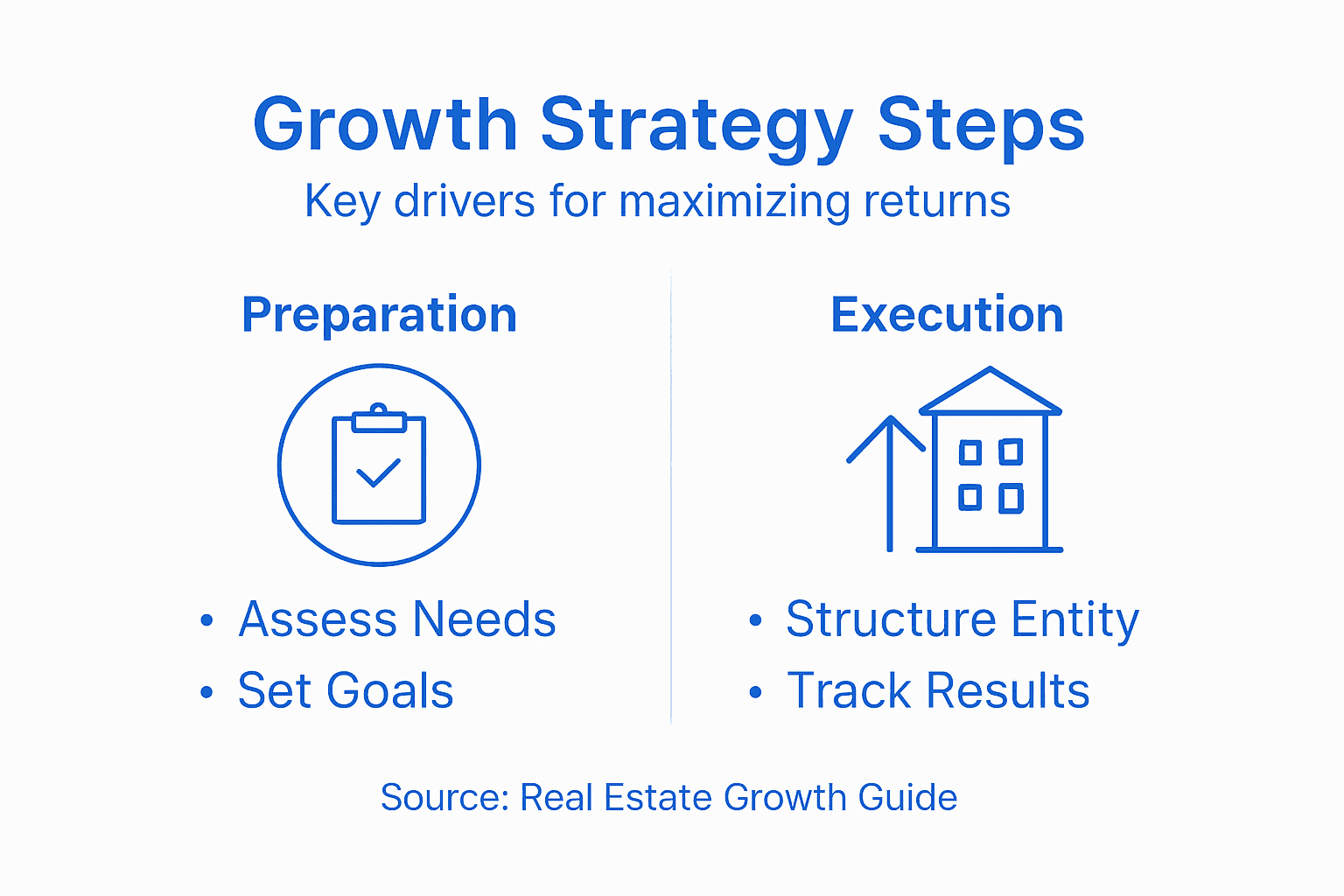
Track actual results against your original assumptions monthly. Where did projections miss reality? Did renovation costs exceed estimates? Are tenants more stable than you expected? Is the neighborhood appreciating faster? These gaps reveal where your analysis needs refinement.
Create a simple monitoring dashboard that shows:
Below is a summary of essential portfolio performance metrics and what they reveal:
| Metric | Measures | Strategic Insight |
|---|---|---|
| Cash-on-cash Return | Income vs. cash invested | Operational income efficiency |
| Debt Service Coverage | Net income vs. debt | Loan risk and leverage buffer |
| Vacancy Rate | Occupancy stability | Demand and management performance |
| Year-over-year Growth | Value or rent change | Asset and market trend analysis |
- Current cash flow from each property
- Debt service coverage ratio for leveraged assets
- Year-over-year appreciation and rent growth
- Vacancy rates and tenant retention
- Capital deployed versus remaining dry powder
Set quarterly reviews where you step back and ask tough questions. Is this asset still aligned with your strategy? Should you hold, refinance, or sell? Are newer market opportunities worth redeploying capital from existing holdings?
The best investors course-correct constantly based on real data, not on ego attachment to original decisions.
Refinement means being willing to change direction. If a market shifts and your properties no longer meet your return threshold, selling might be smarter than holding. If a property manager is underperforming, replacing them drives value faster than hoping they improve.
Document what you learn from each deal cycle. Which property types performed best? Which markets stayed resilient? Which assumptions consistently proved wrong? This institutional knowledge becomes your competitive advantage over time.
Share results with your capital partners quarterly. Transparency builds trust and demonstrates operational discipline. Partners who see rigorous monitoring and honest assessment trust you with larger checks.
Schedule an annual strategic review. Look at your portfolio holistically. Are you still pursuing the right asset classes? Should you shift geographic focus? Do your financing structures still optimize returns? Growth requires periodic repositioning.
Pro tip: Build monthly reporting that takes two hours to complete, not twenty—sophisticated investors use simple KPIs and focus on interpretation, not spreadsheet perfection.
Drive Your Real Estate Growth with Expert Financing and Strategic Support
If you are navigating the complexities of real estate growth strategies such as entity structuring, capital deployment, and rigorous deal execution you know how critical it is to align your financing with your operational goals. The challenge lies in building a capital structure that protects your assets while fueling expansion and ensuring every step from due diligence to post-closing management is seamless. At Sims Ventures we understand the importance of matching your growth trajectory with tailored financial solutions and disciplined execution to avoid overleveraging or missing key market opportunities.
Explore how our partnership approach in Real Estate Investment: Maximize Your Profits empowers you with innovative financing combined with strategic advisory. From structuring entities to optimizing capital flow we help you transform your growth plans into operational success. Take control of your portfolio today by visiting Sims Ventures to discover how our specialized support creates a strategic advantage every step of the way. Don’t wait until hesitation costs you deals or growth momentum. Connect with us now and move forward with certainty.
Frequently Asked Questions
What are the first steps to assess my financing needs for real estate growth?
To assess your financing needs, start by mapping your current portfolio and projecting growth for the next three years. Calculate your financing gap by considering down payment requirements, construction costs, working capital, and reserves for unexpected challenges.
How can I determine the best entity structure for my real estate investments?
Evaluate your core objectives to determine the best entity structure based on liability protection and tax efficiency. Consider options like LLCs for flexibility or partnerships for defined co-investor roles to align with your growth strategies.
What should I include in my deal execution process?
Ensure your deal execution process includes a centralized tracking system for deal progression and standardized workflows for recurring tasks. This approach helps maintain quality control and accelerates timelines, allowing for efficient capital deployment.
How do I monitor and refine my real estate investment strategies?
Monitor your investments by tracking key performance metrics such as cash-on-cash return and vacancy rates. Conduct quarterly reviews to assess whether your assets align with your strategic goals and make adjustments as needed to optimize returns.
What are some essential performance metrics to track in my real estate portfolio?
Key metrics include cash-on-cash return, debt service coverage ratio, and year-over-year growth. By tracking these metrics monthly, you can identify underperforming assets and pivot your strategy accordingly to maximize returns.
Recommended
- 7 Key Real Estate Best Practices for Success in 2026
- What Is Commercial Real Estate and Why It Matters
- How to Structure Real Estate Deals for Maximum Returns
- Real Estate Financing Tutorial: Secure Strategic Success
- 7 Smart Examples of Property Investment Strategies – ULI & LISA Mallorca Property Blog
- 7 Essential Dubai Real Estate Investment Tips for Success
