

Why Invest in Real Estate Funds for Strategic Growth
Finding the right investment vehicle can feel daunting when your growth hinges on balancing risk, return, and control. Many mid-sized American real estate investors and property developers hesitate to join real estate funds due to common misconceptions about minimum investments or management transparency. Understanding the fundamentals behind real estate funds and separating myth from fact empowers you to spot hidden advantages, access diversification, and build partnerships that drive strategic success across diverse property markets.
Defining Real Estate Funds and Common Myths
Real estate funds are pooled investment vehicles where multiple investors contribute capital to purchase, develop, or manage properties. Unlike buying a single rental property on your own, a real estate fund operates as a managed portfolio. The fund manager handles property selection, acquisition, due diligence, and day-to-day operations, while investors receive returns based on their stake in the fund. Think of it like this: instead of being the landlord managing ten properties yourself, you’re one of many owners in a professionally managed portfolio of fifty properties across multiple markets. Real estate funds come in various structures, including real estate investment trusts (REITs), private equity funds, debt funds, and development funds, each with different risk profiles and return expectations.
Misunderstandings about real estate funds often prevent solid operators from capitalizing on them. The first major myth is that real estate funds require enormous minimum investments. While some institutional funds do require six or seven-figure commitments, many partnerships designed for mid-sized investors accept entry points between $25,000 and $250,000. Another common misconception is that funds mean losing control entirely. In reality, depending on the fund structure, you may maintain significant input through advisory boards or preferred equity positions where your capital receives preferential returns before other investors. A third myth suggests real estate funds are too complex or opaque. The best fund managers, particularly those who understand the needs of property developers and investors like yourself, provide transparent quarterly reporting, detailed deal documentation, and regular communication about portfolio performance and challenges. When you’re exploring residential real estate investing opportunities in 2026, understanding fund structures becomes critical to identifying whether pooled capital aligns with your growth strategy.
Here’s where many investors miss the real value: funds offer something you cannot easily replicate alone. A skilled fund manager with established relationships can access off-market deals, negotiate better terms through purchasing power, and manage portfolio risk across multiple properties and markets. This reduces concentration risk, which is exactly what happens when you’re personally overextended in a single market or property type. The operational burden shifts from you to professionals who specialize in property management, tenant relations, and capital optimization.
Pro tip: Before committing to any real estate fund, request detailed documentation on the manager’s deal sourcing process, historical returns across market cycles, and their specific role in day-to-day operations, not just annual performance summaries.
Types of Real Estate Funds and Investment Strategies
Real estate funds come in several distinct flavors, each designed for different investor profiles and market conditions. Core and core-plus funds focus on stabilized properties generating steady cash flow with minimal operational risk, making them ideal for conservative investors seeking consistent returns. Value-add funds purchase underperforming properties, implement operational improvements or renovations, then sell or refinance at higher valuations, typically targeting 15 to 25 percent returns over three to five years. Opportunistic funds take on greater risk by investing in development projects, distressed assets, or emerging markets where returns can reach 30 percent or higher but where capital may be illiquid for longer periods. Debt funds, another category, provide bridge or mezzanine financing to developers, offering fixed returns with lower volatility than equity positions. Understanding which structure aligns with your risk tolerance and liquidity needs is fundamental before deploying capital.
Your investment strategy within a fund depends on your capital availability, time horizon, and return objectives. Many mid-sized operators combine multiple fund types to create a balanced approach. You might place a portion of excess capital in a core fund generating quarterly distributions while simultaneously participating in a value-add opportunity where you can also contribute operational expertise or deal sourcing. Some investors structure their participation through building real estate wealth with niche specialization opportunities where funds focus on specific asset classes like multifamily, industrial, or hospitality. Others pursue the build-to-rent model, which combines development and long-term hold strategies within a single fund structure. The key is matching fund characteristics to where you want your capital working.
Timing matters significantly when selecting which fund to enter. Market conditions, interest rates, and local supply-demand dynamics all influence whether a value-add strategy or core-plus approach makes sense. A seasoned fund manager monitors these variables continuously and adjusts deployment accordingly. Rather than chasing the highest projected returns, focus on managers with documented track records through multiple market cycles, transparent communication about downside scenarios, and alignment between their interests and yours. When you’re investing alongside experienced operators who have skin in the game, you benefit from their market expertise and deal sourcing advantages.
Pro tip: Compare funds not just on projected returns but on the manager’s experience during market downturns, their strategy for addressing underperforming properties, and the percentage of their personal capital invested alongside yours.
Here’s a summary showing how different real estate fund types match varying investor needs:
| Fund Type | Typical Return Range | Liquidity Level | Best For |
|---|---|---|---|
| Core | 4–7% per year | High (quarterly) | Conservative investors |
| Core-Plus | 7–10% per year | Moderate (quarterly) | Income & growth seekers |
| Value-Add | 15–25% over 3–5 yrs | Low (illiquid period) | Risk-tolerant investors |
| Opportunistic | 20%+ over 5+ years | Low (long lock-up) | Growth-focused investors |
| Debt Funds | 6–10% fixed | Moderate (quarterly) | Stability-focused funds |
How Real Estate Funds Operate and Generate Returns
Real estate funds generate investor returns through multiple mechanisms that work simultaneously across a portfolio. The primary source is rental income, where properties generate monthly cash flow from tenants. A fund manager collects this rent, covers operating expenses like maintenance and property taxes, then distributes the remainder to investors, typically quarterly. The second major return stream comes from property appreciation. When a fund purchases a property for $2 million and five years later refinances or sells it for $3.2 million, that $1.2 million gain gets distributed to investors. Value-add strategies accelerate this appreciation by improving properties through capital investments or operational enhancements. The third return mechanism involves leverage and refinancing. Fund managers use debt strategically, purchasing properties with 60 to 75 percent financing. When properties appreciate or rental income increases, refinancing can pull out cash while maintaining or reducing the debt ratio, distributing that capital return to investors. These three mechanisms combined create the total return profile you analyze when evaluating a fund opportunity.

The operational structure itself differs from owning property solo. A fund maintains professional management companies handling tenant relations, maintenance, and compliance. This professionalism reduces vacancy rates and extends property life, protecting your returns. The fund also concentrates buying power. When a manager purchases twenty properties instead of one, vendors offer better pricing on bulk purchases, contractors provide better terms for larger projects, and lenders offer more favorable interest rates. That purchasing efficiency flows directly to investor returns. Additionally, funds diversify across markets and property types, meaning a downturn in one market or asset class doesn’t devastate returns. You participate in financing strategies that work in high-rate markets, where experienced managers structure debt and equity to optimize returns regardless of interest rate conditions.
Return timing varies by fund type and strategy. Core funds generate steady quarterly distributions of 4 to 6 percent annually plus appreciation over time. Value-add funds typically hold properties three to five years, then return capital plus profits in a single distribution. Opportunistic and development funds may take longer before returning capital but target higher total returns. Understanding this timing is critical because you need capital available when opportunities align with your growth objectives. The best funds communicate monthly or quarterly about portfolio performance, occupancy rates, rental trends, and any challenges. This transparency lets you track whether projections are tracking and understand how fund managers are protecting your capital when markets shift.
Pro tip: Request a detailed waterfall analysis showing exactly how profits are split between the fund manager and investors at different return thresholds, ensuring the manager’s incentives truly align with maximizing your returns.
Legal Structures, Tax Benefits, and Compliance Requirements
Real estate funds operate under specific legal structures that protect investors while defining their rights and tax treatment. The most common structure for private real estate funds is the limited partnership (LP), where the fund manager acts as the general partner managing operations and investors become limited partners contributing capital. This structure offers liability protection: your personal assets remain shielded from fund debts or legal claims, and you’re not personally liable for fund obligations beyond your investment amount. Another prevalent structure is the limited liability company (LLC), which provides similar liability protection while offering more flexibility in profit distribution and management. Some funds use real estate investment trusts (REITs), which are publicly traded entities offering liquidity but subject to different tax treatment and regulatory requirements. Understanding which structure a fund uses matters because it directly affects your tax obligations, liability exposure, and distribution rights.
Tax benefits represent a significant advantage of real estate fund investment. The primary benefit comes from depreciation, where the fund writes off the building’s value over 27.5 years (for residential) or 39 years (for commercial) property, creating paper losses that reduce taxable income without actual cash outflow. You receive depreciation deductions proportional to your investment, directly reducing your tax liability in profitable years. Cost segregation studies accelerate these deductions by identifying building components that depreciate faster, front-loading tax benefits to early years. Real estate funds can also employ 1031 exchanges, deferring capital gains taxes when selling appreciated properties and reinvesting proceeds into similar properties. These tax advantages explain why experienced investors prioritize fund participation alongside direct property ownership. However, tax treatment varies based on fund structure and your investor classification, making professional tax guidance essential before committing capital.
Compliance requirements protect both investors and fund managers. Funds must register with the Securities and Exchange Commission (SEC) or qualify for exemptions, depending on investor count and offering size. They must provide detailed private placement memorandums disclosing risks, fee structures, and manager backgrounds. Additionally, funds comply with anti-money laundering (AML) regulations and perform know-your-customer (KYC) verification on all investors. State regulations may impose additional requirements for fund operations and investor protection. When structuring entities and negotiating contracts through partnerships, fund managers must ensure all documentation meets regulatory standards. Quarterly and annual reporting requirements keep investors informed while maintaining compliance records. These safeguards, though administratively demanding, exist to protect your capital and ensure funds operate with transparency and integrity.
Pro tip: Consult your CPA or tax attorney before investing to understand how depreciation benefits apply to your specific tax situation and whether the fund structure aligns with your overall tax strategy across all your real estate holdings.
Risks, Diversification, and Sector-Specific Opportunities
Every investment carries risk, and real estate funds are no exception. The primary risks fall into several categories. Interest rate risk affects property values and refinancing ability: when rates spike, property valuations compress because investors discount future cash flows more heavily. Market risk appears when local economies weaken, reducing tenant demand and rental rates. Liquidity risk matters because fund capital typically locks up for years, so you cannot access funds during personal emergencies. Manager risk is real: poor decision-making, underperformance, or ethical lapses directly harm your returns. Leverage risk amplifies losses when funds use significant debt and rental income drops, forcing asset sales at unfavorable prices. Understanding these risks upfront prevents surprises and helps you evaluate whether a fund’s risk profile matches your tolerance.
Diversification within funds reduces these risks significantly. A well-constructed fund spreads capital across multiple properties, preventing any single asset failure from devastating returns. Geographic diversification matters too: a fund operating in five states survives local downturns better than one concentrated in a single market. Asset class diversification provides additional protection. A portfolio mixing multifamily, industrial, and office properties behaves differently across economic cycles. Multifamily performs well when employment weakens because people downsize to cheaper housing. Industrial thrives during e-commerce growth. Office faces secular headwinds but anchor-tenant properties maintain value. By combining these asset classes within one fund, managers smooth returns across market environments. When building a portfolio in challenging markets, diversification becomes your primary defense against unexpected conditions.
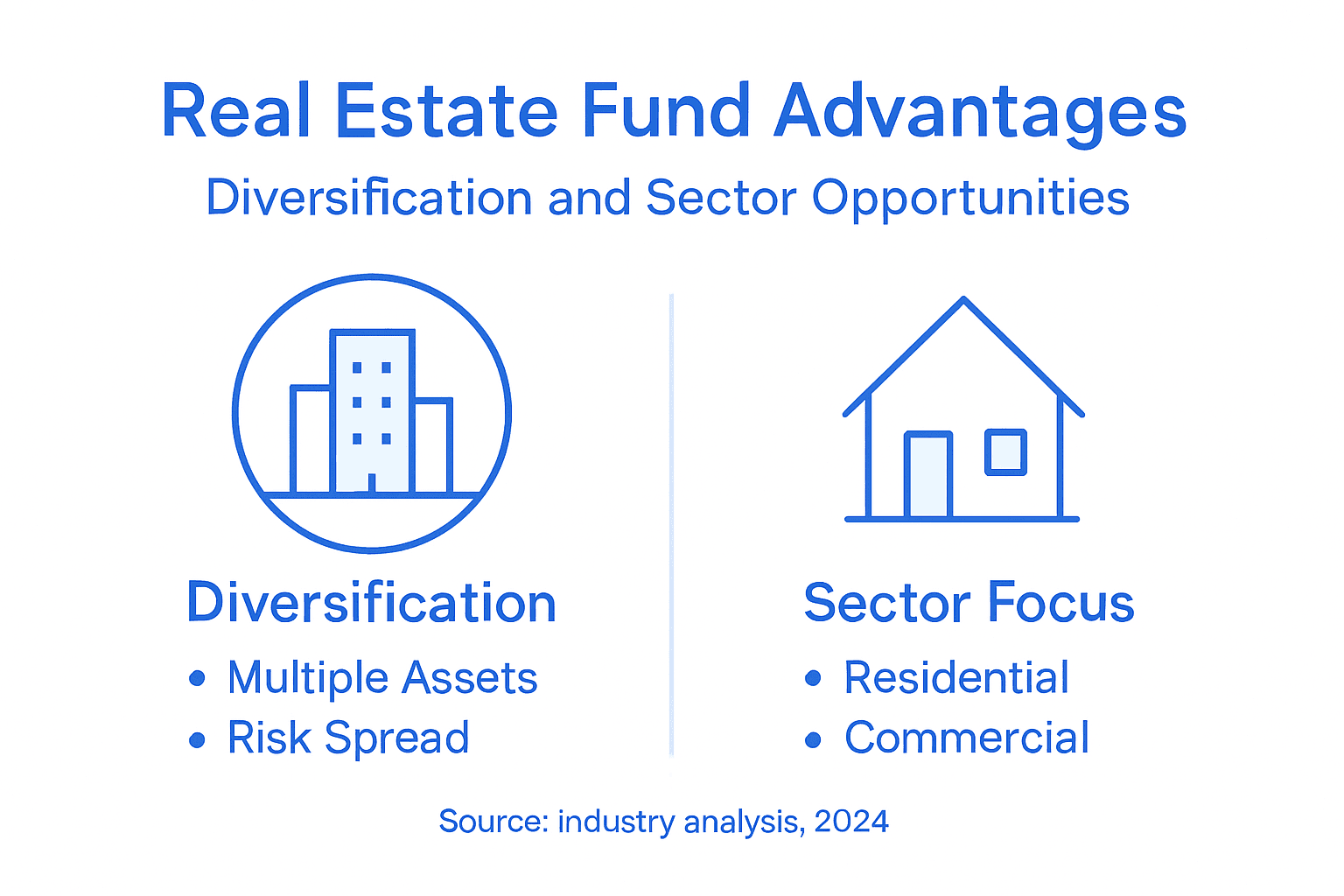
Sector-specific opportunities let you capitalize on particular market dynamics without managing those properties yourself. Multifamily funds benefit from housing supply constraints and demographic shifts toward renting. Industrial funds capitalize on supply chain restructuring and the e-commerce boom. Healthcare funds target aging populations and rising medical service demand. Student housing funds leverage university enrollment growth and parent demand for professionally managed properties. Hospitality funds offer volatility but strong upside during economic expansion. Each sector responds differently to interest rates, employment, and consumer behavior, so matching your market outlook to sector exposure sharpens returns. A developer with strong operational expertise in one sector might allocate conservatively to that sector through a fund while gaining exposure to other sectors through different funds, creating balanced growth.
Pro tip: Screen potential funds by requesting stress test scenarios showing how returns would perform if interest rates rise 200 basis points, occupancy drops 15 percent, or local market conditions deteriorate, ensuring you understand downside risk before committing capital.
Comparing Real Estate Funds to Direct Ownership
Direct property ownership and fund investment represent fundamentally different approaches to real estate, each with distinct advantages and tradeoffs. When you own property directly, you control every decision: tenant selection, renovation timing, refinancing strategy, and sale timing. You capture 100 percent of the profits after debt service and expenses. You also claim depreciation, cost segregation, and 1031 exchange benefits entirely for yourself. Hands-on control appeals to investors who enjoy operational involvement and believe they can outperform professional managers. However, direct ownership demands significant time commitment. You manage tenant issues, coordinate repairs, handle vacancies, and deal with unexpected capital expenditures. You concentrate risk in single properties or markets unless you actively develop a large portfolio. Financing requires personal guarantees and credit review for each property. This model works exceptionally well when you have deep expertise in a particular market or asset type.
Fund investment flips this equation. You sacrifice direct control but gain professional management, diversification, and passive income. Fund managers handle tenant acquisition, lease negotiations, maintenance coordination, and property improvements. You receive quarterly distributions without involvement beyond reviewing reports. Capital requirements are lower because you own a fractional share rather than bearing full property cost. Diversification happens automatically across multiple properties, markets, and sometimes asset classes. When building multifamily investment property portfolios, many operators discover that combining direct ownership of their best deal opportunities with fund participation in other asset classes or markets creates optimal balance. This hybrid approach lets you apply your expertise where it matters most while leveraging professional managers elsewhere. Fund investments also offer liquidity upon fund termination, typically five to seven years, compared to the months required to sell direct property.
For clarity, here’s a direct comparison of fund investment vs. direct property ownership:
| Feature | Real Estate Fund | Direct Ownership |
|---|---|---|
| Control Over Property | Limited to none | Full personal control |
| Diversification | Across many properties | Often single or few assets |
| Time Commitment | Minimal (passive) | High (active management) |
| Capital Requirement | Lower per investment | Full purchase price needed |
| Risk Exposure | Shared across investors | Concentrated on owner |
The decision ultimately depends on your situation and objectives. If you have deep expertise in one sector, strong operational capabilities, and significant capital, direct ownership of selective properties often delivers superior returns. You control execution and capture full profits. However, most mid-sized investors benefit from blending approaches. Deploy capital toward direct deals where you see clear competitive advantages, then allocate remaining capital to funds targeting complementary assets or markets. This strategy reduces concentration risk while letting you apply your operational strengths where they create the most value. Fund participation also solves the time constraint problem: you cannot personally manage thirty properties, but you can own fractional interests in a fund holding thirty properties through professional management. Consider your time availability, expertise depth, capital constraints, and energy level when deciding between direct ownership, fund investment, or both.
Pro tip: Model total returns including fees, time investment, and tax benefits for both direct ownership and comparable fund opportunities over a five-year holding period, accounting for your specific cost of capital and operational capacity.
Unlock Strategic Growth with Expert Real Estate Fund Solutions
Investing in real estate funds presents unique challenges such as understanding complex fund structures, managing risk, and aligning your investment goals with market conditions. This article highlights common pain points like navigating fund types, ensuring transparency, and optimizing diversification to protect your capital and maximize returns. When you face decisions about fund entry timing, risk tolerance, and balancing direct ownership with pooled investments, having a trusted partner who offers both capital and strategic insights is crucial.
At Sims Ventures, we empower real estate investors and home builders to overcome these challenges with our specialized financing and comprehensive advisory services. We assist you in structuring entities, performing rigorous due diligence, optimizing deal and capital structuring, and managing post-closing execution. Our partnership approach transforms funding from a transaction into a strategic advantage. Explore how you can advance your real estate growth confidently by visiting our Real Estate Investment: Maximize Your Profits page. To take the next step toward securing expert financial solutions tailored for your strategic growth, visit Sims Ventures and start building your future today.
Frequently Asked Questions
What are real estate funds?
Real estate funds are pooled investment vehicles where multiple investors contribute capital to purchase, develop, or manage properties. A fund manager oversees the portfolio, allowing investors to benefit from returns without the day-to-day management responsibilities.
How do real estate funds generate returns?
Real estate funds generate returns through rental income, property appreciation, and strategic use of leverage. Fund managers collect rental income, distribute profits after expenses, and potentially increase property values through improvements and refinancing.
What types of real estate funds are available?
There are several types of real estate funds, including core funds (stable properties), value-add funds (underperforming properties), opportunistic funds (higher risk and potential returns), and debt funds (financing for developers). Each type has varying risk profiles and return expectations.
What are the advantages of investing in real estate funds compared to direct property ownership?
Investing in real estate funds provides diversification across multiple properties and markets, lower capital requirements for individual investments, and professional management. This approach allows for passive income without the time commitment associated with direct property ownership.
Recommended
- Future of Residential Real Estate Investing Opportunities 2026
- Real Estate Investing for Today’s Market Conditions 2026
- Building Real Estate Wealth with Niche Specialization 2026
- 7 Latest Real Estate Technology Trends Shaping 2025-26 2026
- Real Estate Tips for Buyers & Sellers – Homes2MoveYou.com
- Index Funds Advantages: Smarter Wealth Building – Finblog
