

Financing Options Guide 2026: Unlock Strategic Funding Success
Every successful real estate investment begins with a clear-eyed look at your own financial landscape. In an industry where growth hinges on timing and precision, overlooking your initial readiness can limit both access to capital and partnership opportunities. By prioritizing a methodical assessment of your resources and focusing on financial readiness, you position yourself to take advantage of financing solutions and strategic alliances that drive sustainable success in the evolving American real estate market.
Step 1: Assess Your Financial Readiness
Assessing your financial readiness is the crucial first step in unlocking strategic funding success for your real estate investment journey. This process helps you understand your current financial landscape and identify potential opportunities or areas requiring improvement before pursuing significant funding.
To effectively assess your financial readiness, start by conducting a comprehensive self-evaluation using structured tools and frameworks. The Consumer Financial Protection Bureau offers a financial well-being assessment that provides targeted insights into your financial health. This tool helps you understand key metrics such as:
- Your current savings and emergency fund capacity
- Debt-to-income ratio
- Credit score and credit history
- Income stability and predictability
- Investment portfolio diversity
Dig deeper by analyzing your financial literacy levels across multiple dimensions. Understand your strengths and potential knowledge gaps in areas like investment strategies, risk management, and financial planning. Utilize resources from Stanford’s Initiative for Financial Decision-Making to benchmark your financial knowledge against broader demographic trends.
By systematically evaluating your financial readiness, you create a solid foundation for attracting strategic funding partners who value thorough preparation and self-awareness.
Pro tip: Schedule a quarterly financial review to track your progress and continuously refine your financial readiness strategy.
Step 2: Identify Custom Financing Pathways
Identifying custom financing pathways is a strategic process that transforms your real estate investment potential by matching specialized funding solutions to your unique project requirements. This critical step moves you beyond generic lending approaches toward tailored financial strategies that align precisely with your investment goals.
To effectively navigate financing options, start by understanding the nuanced landscape of contract financing methods available to real estate investors. These pathways include performance-based payments, progress payments, loan guarantees, and advance payment structures that can be customized to your specific project needs. Key considerations for selecting the right financing pathway include:
- Project complexity and risk profile
- Investment timeline and cash flow requirements
- Specific property type and development stage
- Your personal financial strength and credit history
- Potential return on investment metrics
Real estate investors should approach custom financing by developing a comprehensive funding strategy that goes beyond traditional bank loans. This means exploring alternative lending sources such as private lenders, crowdfunding platforms, and specialized real estate investment funds that offer more flexible terms tailored to unique project characteristics.

Here’s how different financing pathways compare for real estate investments:
| Financing Pathway | Flexibility of Terms | Typical Use Case | Potential Risks |
|---|---|---|---|
| Bank Loan | Standardized, moderate | Multi-unit residential projects | Stringent approval |
| Private Lender | Highly negotiable | Quick closings, unique properties | Higher interest rates |
| Crowdfunding Platform | Variable, project-specific | Small commercial developments | Investor coordination |
| Real Estate Fund | Fixed but scalable | Large-scale investments | Limited control |
Strategic financing is not about finding money—it’s about finding the right money for your specific investment landscape.
Carefully evaluate each potential financing pathway by conducting thorough due diligence, comparing interest rates, understanding repayment structures, and assessing the long-term implications for your investment portfolio.
Pro tip: Build relationships with multiple financing sources to create negotiating leverage and access diverse funding options for your real estate investments.
Step 3: Structure Strategic Partnerships and Entities
Structuring strategic partnerships and entities represents a critical inflection point in your real estate investment journey, transforming individual opportunities into scalable, legally robust investment frameworks. This step goes beyond basic collaboration, creating intentional structures that protect your assets, optimize tax strategies, and position your investments for long-term success.
To develop effective partnership structures, leverage strategic partnership frameworks that help you design governance models and select compatible investment partners. Your partnership architecture should address critical components such as:
- Equity distribution and ownership percentages
- Decision-making protocols
- Risk allocation mechanisms
- Performance expectations and accountability measures
- Exit strategies and dissolution procedures
Establishing the right legal entity is fundamental to protecting your investment interests. Real estate investors typically choose from structures like limited liability companies (LLCs), limited partnerships, or joint venture agreements, each offering distinct advantages in terms of liability protection, tax treatment, and operational flexibility.
Key entity structures and their real estate investment impact:
| Entity Structure | Liability Protection | Tax Benefits | Management Complexity |
|---|---|---|---|
| LLC | High | Pass-through taxation | Moderate |
| Limited Partnership | Moderate | Flexible for investors | Complex |
| Joint Venture | Customizable | Dependent on agreement | High |
Your partnership structure is the foundation that will either support or undermine your entire investment strategy.
Carefully document all partnership agreements, ensuring clarity around roles, responsibilities, financial contributions, and potential conflict resolution mechanisms. Consult with legal and tax professionals who specialize in real estate investments to validate your proposed entity structure.
Pro tip: Always draft partnership agreements when expectations are aligned and relationships are strong, not after disagreements emerge.
Step 4: Negotiate and Secure Optimal Terms
Negotiating and securing optimal terms represents the critical pivot point where your strategic planning transforms into tangible financial opportunity. This step demands a combination of preparation, tactical communication, and strategic thinking to ensure your real estate investment secures the most advantageous possible terms.
Master the art of negotiation by understanding core negotiation techniques that help you systematically approach deal structuring. Your negotiation strategy should encompass several sophisticated approaches:
- Establishing clear minimum acceptable terms
- Identifying your zone of potential agreement
- Understanding both parties’ underlying motivations
- Developing multiple scenario outcomes
- Maintaining professional composure throughout discussions
Preparation is the foundation of successful negotiations. Before entering any discussion, compile comprehensive research on market rates, comparable deals, and potential leverage points. This means gathering detailed financial information, understanding the other party’s potential constraints, and developing a nuanced understanding of the deal’s broader context.
Negotiation is not about winning, but about creating mutual value that propels both parties toward their strategic objectives.
Prioritize transparency and collaborative problem-solving during negotiations. Your goal is not to defeat the other party, but to craft an agreement that provides sustainable benefits for all stakeholders involved in the real estate transaction.
Pro tip: Always have a clearly defined walk-away point that protects your investment interests while remaining open to creative compromise.
Step 5: Verify Funding Integration and Compliance
Verifying funding integration and compliance represents the critical safeguard that transforms your strategic financial planning into a legally sound and operationally robust investment framework. This step ensures that every aspect of your funding arrangement meets regulatory standards and maintains the highest levels of financial integrity.
Navigate the complex landscape of financial compliance by understanding federal funding management protocols. Your verification process should systematically address multiple critical dimensions:
- Documenting all funding sources and agreements
- Confirming regulatory alignment
- Tracking financial reporting requirements
- Establishing audit-ready documentation
- Maintaining transparent transaction records
Comprehensive documentation is your primary defense against potential compliance challenges. This means creating meticulous records that not only satisfy legal requirements but also demonstrate your commitment to financial transparency and operational excellence.
Compliance is not a destination, but an ongoing journey of financial discipline and strategic vigilance.
Prioritize proactive compliance by working closely with legal and financial professionals who specialize in real estate investment regulations. Their expertise can help you anticipate potential compliance issues and develop robust mitigation strategies before they become problematic.
Pro tip: Implement a quarterly compliance review process that treats regulatory alignment as a dynamic, evolving aspect of your investment strategy.
Unlock Real Estate Funding Success with Expert Support
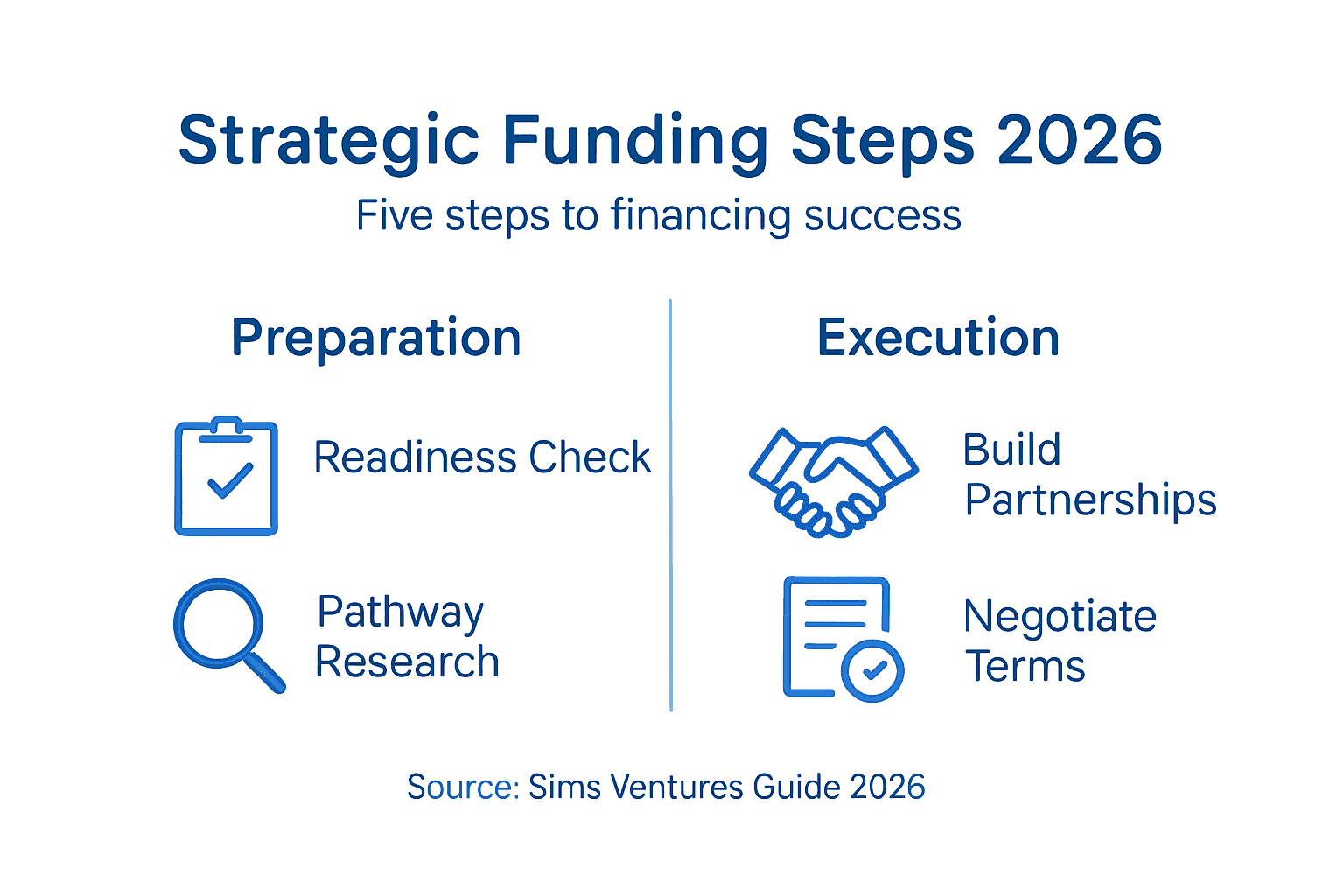
Facing the challenges of strategic funding requires more than just securing capital. As highlighted in the “Financing Options Guide 2026,” understanding your financial readiness, identifying custom financing pathways, and structuring strategic partnerships are key steps that demand expert guidance and tailored solutions. You need a partner that understands these nuances to help you navigate complex negotiations and ensure compliance while optimizing your investment returns.
At Sims Ventures, we specialize in empowering real estate investors like you with integrated financing and strategic advisory services designed for today’s dynamic market. Whether you are structuring entities, negotiating contracts, or conducting due diligence, we help you build a solid foundation for success. Discover how our approach can maximize your profits by exploring our Real Estate Investment: Maximize Your Profits resources and learn more about partnering for growth at Sims Ventures.
Take control of your investment future now by connecting with Sims Ventures and transforming funding challenges into strategic opportunities.
Frequently Asked Questions
How do I assess my financial readiness for real estate investments?
To assess your financial readiness, start by conducting a self-evaluation to understand your current financial landscape. Use structured tools to analyze your savings, debt-to-income ratio, credit score, income stability, and investment portfolio diversity.
What financing pathways should I consider for my real estate project?
You should explore custom financing pathways that align with your investment needs, such as performance-based payments, private lenders, or crowdfunding platforms. Developing a tailored funding strategy can help you find solutions that fit your specific project requirements.
How can I structure effective partnerships for my real estate initiatives?
Create clear partnership agreements that outline equity distributions, decision-making protocols, and exit strategies. Establishing well-defined roles and responsibilities protects your investment and fosters collaboration among partners.
What negotiation tactics should I use to secure optimal financing terms?
Use clear negotiation techniques to establish your minimum acceptable terms and understand both parties’ motivations. Preparing thorough research on market rates and comparable deals can give you leverage to secure better financing conditions.
How can I ensure compliance with funding requirements in my real estate transactions?
To ensure compliance, systematically document all funding sources and agreements while confirming regulatory alignment. Establish a protocol for tracking financial reporting and maintaining transparent records to prepare for any audits.
