
Builder Line of Credit: Scale Your Builds in 2026
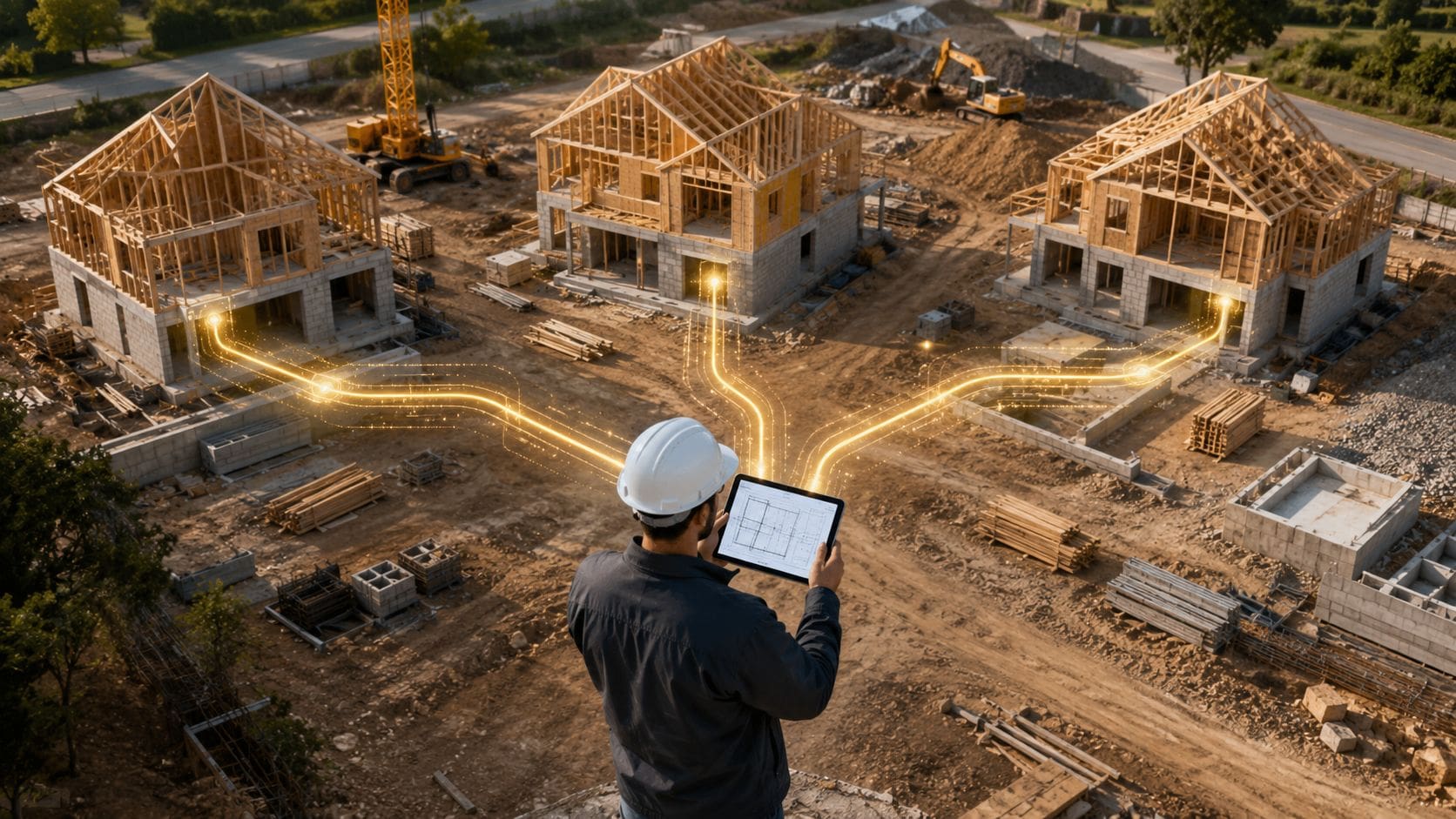
If you're building in Atlanta, Charlotte, Charleston, or across Texas, you may already have the hardest part figured out. You can source lots, price a build, manage trades, and move product. What slows you down usually isn't field execution. It's the lag between seeing the next opportunity and getting capital lined up.
That lag creates a ceiling. One house sells, but the payoff doesn't translate cleanly into the next start. A lot becomes available, but the financing process takes longer than the contract window. Your crews are ready, your subs are lined up, and your pipeline is real, yet your growth still feels stop-and-go.
A builder line of credit is built for that exact problem. It isn't just another loan product. Used correctly, it's an operating tool that helps a growing builder keep projects moving without reopening the entire underwriting file every time a new deal shows up.
The Growth Trap Every Successful Builder Faces
A builder in Atlanta gets two specs finished, both sell fast, and a good infill lot hits the market three days later. The trades are ready. The numbers work. The seller wants a quick close. What slows the deal is not construction knowledge or demand. It is the time it takes to line up fresh financing for the next start.
That is the growth trap. Early on, one-loan-per-project feels manageable because volume is low and each closing gets full attention. Once the business gains traction, that same financing process starts working against you. More leads, more lot opportunities, and more buyer demand should create momentum. Instead, every new project can trigger another application, another document chase, another approval cycle, and another closing timeline.
Builders get stuck in high-growth markets because speed matters on both sides of the business. You need to buy lots quickly, keep crews working, and start the next house before cash from the last one fully clears through the system. In Georgia, North Carolina, South Carolina, and Texas, that timing gap can cap growth long before demand does.
A builder line of credit matters for a simple reason. It improves capital velocity. For a growing builder, that is often the difference between taking the next deal and watching it go to a better-capitalized buyer.
What the bottleneck looks like on the ground
The problem usually shows up in operations before it shows up on a financial statement.
- Equity gets trapped: Cash is tied up in completed homes, model inventory, or projects close to sale while the next lot needs funding now.
- Crews lose continuity: Gaps between starts create scheduling problems, and reliable subs move to builders with steadier volume.
- Sellers choose speed: A builder with slower financing loses contracts, even when the pricing is right.
- Admin starts to pile up: Repeating the same underwriting package across multiple projects eats time that should go to acquisitions and execution.
I see builders misdiagnose this all the time. They assume they need tighter job costing or better field coordination. Sometimes they do. More often, the choke point is the financing structure.
Builders rarely run out of opportunity first. They run out of capital speed.
Traditional construction financing treats each house like a separate event. A growing builder runs a pipeline, not a series of isolated one-off jobs. If capital resets from zero every time a new lot comes up, growth turns into stop-and-go motion. You can still build a good business that way. It is much harder to scale one.
For builders feeling that pressure now, this breakdown of why traditional bank financing can derail your project timeline explains the timing problem in practical terms.
What a Builder Line of Credit Actually Is
A builder line of credit gives a growing builder one financing facility that can support multiple homes at the same time. Instead of underwriting each address as a separate event, the lender approves a broader relationship, then allocates capital across eligible lots or units inside that facility.

For a builder trying to keep crews busy in Georgia, the Carolinas, or Texas, that changes the pace of the business. The goal is not just to fund construction. The goal is to keep capital moving fast enough that lot takedowns, starts, and sales do not fall out of sync.
The core structure
At the practical level, a builder line of credit is an asset-backed credit facility built for repeated use across a pipeline of residential projects. Approved properties draw against the line as work moves forward and documented costs are incurred. As homes sell or refinance, the outstanding balance is reduced and borrowing capacity opens back up for the next project.
That revolving feature is what makes it different from one-off construction debt. A single-project loan solves for one house. A builder line of credit solves for production rhythm.
The facility is usually secured by the underlying real estate and tied to budgets, scopes, draw controls, and project eligibility standards. That matters because the lender is underwriting operating discipline as much as collateral. Builders with tight reporting and consistent execution usually get more usable financing than builders with the same margins but weak controls.
What it is not
A lot of builders hear "line of credit" and picture a generic business line from a bank. That is the wrong frame.
It is not an unsecured working capital line
An unsecured business line can help cover payroll, marketing, or short-term overhead. It is not built to fund vertical construction across several addresses with inspection-based draws, title work, lien control, and lot-level collateral management.
It is not a stack of bigger single-home loans
A larger construction loan still behaves like a one-property instrument if every new start requires a fresh approval, a fresh closing, and a fresh round of paperwork. That structure can work for an occasional custom build. It slows down a builder trying to run several starts at once and keep acquisition decisions tight.
Practical rule: If every new lot sends you back to the front of the credit process, the financing is limiting your production speed.
Why it matters in high-growth markets
In fast-moving markets, speed has real monetary value. A builder who can add approved projects under an existing facility can move on infill lots, small developments, and scattered-site opportunities before slower capital sources finish their review.
That creates an operating advantage. Crews stay scheduled. Purchasing stays more predictable. Sales proceeds from completed homes can roll into new starts faster instead of sitting idle while the next loan is assembled.
Builders who scale well usually stop viewing a BLOC as just another loan product. They use it as part of the operating system of the business, right alongside estimating, construction management, and acquisitions.
How the Draw and Repayment Cycle Works
A builder line of credit changes the daily rhythm of the business. Instead of stopping at each new address to set up fresh financing, you work inside one facility that is already built for repeat starts, repeat draws, and repeat paydowns.
It starts with one master facility
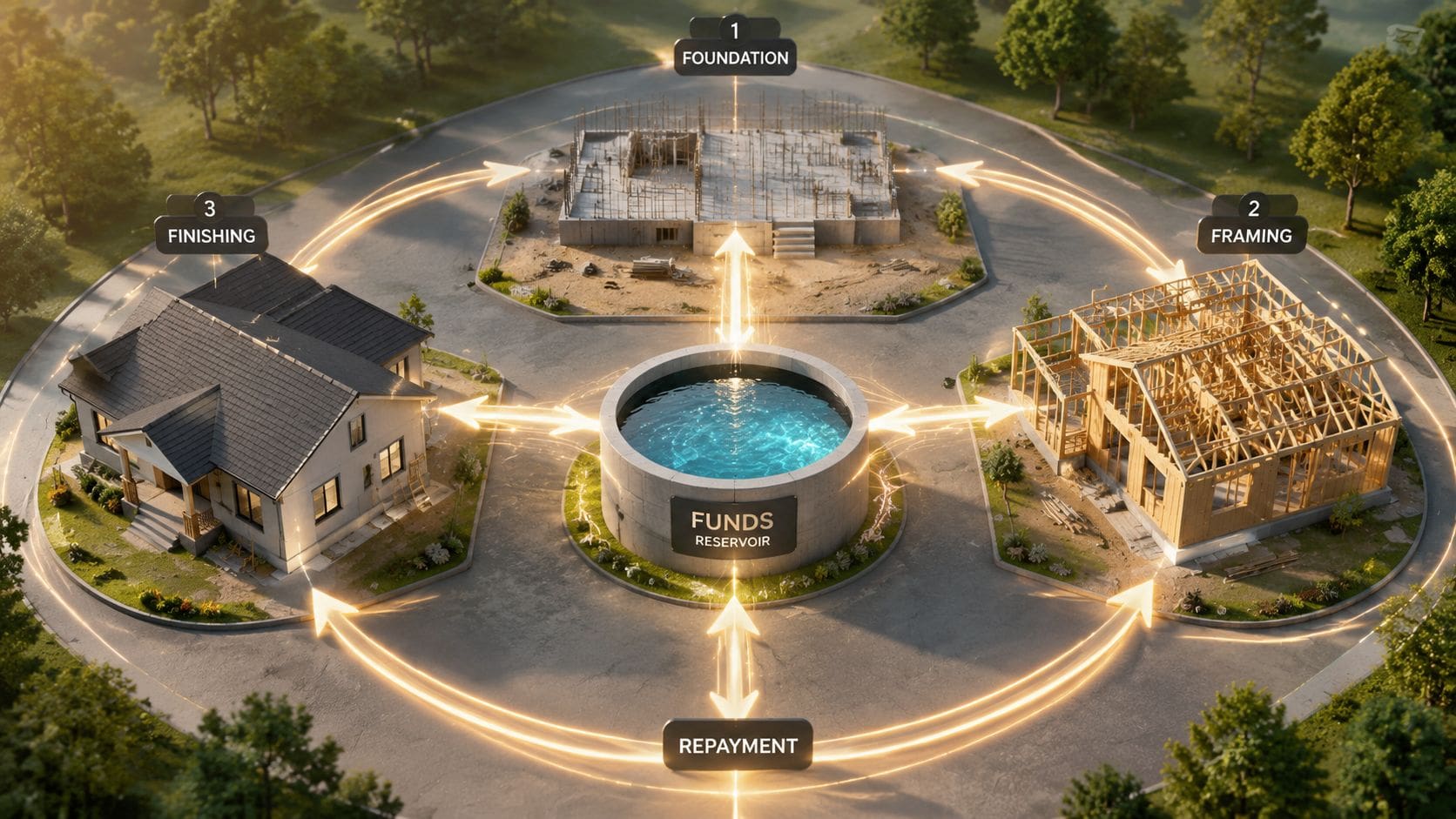
The process usually begins with a master lending agreement that sets the line amount, eligible project types, collateral rules, draw procedures, and repayment terms. Once that framework is in place, the question shifts from loan approval to fit. Does this lot, this budget, and this exit fit the facility you already have?
That matters in fast-growth markets like Georgia, North Carolina, South Carolina, and Texas, where good lots do not wait around while financing catches up.
For builders running several homes at once, this structure works more like an operating account for vertical construction than a series of disconnected project loans. If you want a clearer view of how that fits into a broader ground-up construction lending strategy, the key point is simple. The upfront setup does the heavy lifting so future starts can move faster.
Projects draw against the line as work progresses
Once a project is approved under the facility, funds are advanced in stages based on work completed, documented costs, or both, depending on the structure. The builder submits a draw request with the backup the lender requires. If the package is clean and the job is where the budget says it is, funds move.
The cycle usually looks like this:
Project activation
A lot or unit is added under the master facility and tied to an approved budget, timeline, and exit.Early construction
Initial draws may cover site work, foundation, permits, or other approved startup costs.Vertical build
Additional draws follow major milestones such as framing, mechanicals, and close-in work.Finish and completion
Final advances support punch-out, completion, and the path to sale or refinance.
A well-run facility can keep this process tight. Draw requests are reviewed against the approved scope, and sold homes pay down the outstanding balance, which restores borrowing capacity for the next start inside the same line.
Why the repayment cycle matters
Repayment speed is not just an accounting detail. It drives production capacity.
When a finished home sells, those proceeds reduce the balance on the line. That creates room to start the next house without rebuilding the financing stack from zero. In practice, sales velocity and build velocity start feeding each other.
That is the primary advantage.
A one-off construction loan ends when the house sells. A builder line of credit keeps working. In a market where crews are booked, subcontractors need scheduling certainty, and infill opportunities disappear fast, that revolving paydown structure helps keep capital in motion instead of trapped in paperwork.
Where builders get tripped up
This type of financing rewards clean execution. It also exposes sloppy operations fast.
Common slowdowns include:
- Incomplete draw packages: Missing invoices, unsupported change orders, or stale budget reports delay funding.
- Loose milestone reporting: If the field status does not match the request, reviews slow down and lender confidence drops.
- Weak project tracking: Builders need current visibility into starts, budget burn, pending sales, and remaining line availability.
- Soft exit discipline: Finished homes that sit too long tie up capacity and slow the next wave of projects.
The builders who scale well treat draw management as part of production control. They know which jobs are ready for funding, which jobs are close to payoff, and how much room is opening on the line before the next lot is even ready to break ground.
Comparing Your Construction Financing Options
Not every builder needs the same capital structure. A single custom home, a small infill run, and a growing spec pipeline are different businesses even if they all involve residential construction.
The useful comparison isn't "Which loan is best?" It's "Which loan matches the way you build?"
Financing options for builders at a glance
| Feature | Builder Line of Credit | Single Construction Loan | Traditional Bank Loan |
|---|---|---|---|
| Primary use | Running multiple projects under one facility | Funding one specific build | Funding one or more projects under tighter conventional standards |
| Best fit | Builders focused on volume, repeat starts, and pipeline management | Builders handling an isolated project or occasional build | Borrowers who fit conventional credit boxes and can tolerate longer processes |
| Speed to close | Built for repeat use after facility setup | Often faster than bank financing for a single deal | Commonly slower and more document-heavy |
| Multiple active projects | Yes. That's the point of the structure | No. Each project usually needs its own loan | Sometimes, but not with the same operational flexibility |
| Draw flexibility | Designed around repeat draws across active jobs | Draws tied to one project only | Often more rigid and inspection-driven |
| Underwriting emphasis | Asset quality, project viability, execution capacity | Deal-level strength and exit plan | Broader focus on borrower income, documentation, and policy fit |
| Administrative burden per new project | Lower once the line is in place | Repeats with every new build | Usually high |
| Cash-flow velocity | Strong for builders recycling capital from sales into new starts | Moderate | Often the weakest fit for fast-moving builders |
Where a single construction loan still makes sense
A one-off construction loan can be the right tool when you're doing one project, testing a market, or taking on a build outside your usual pattern. It keeps the file contained and the scope simple. If you don't expect overlap between projects, the extra structure of a line may be unnecessary.
For builders looking at ground-up construction financing, a single-project loan often works well when the goal is execution on one address rather than scaling a full pipeline.
Where the builder line pulls ahead
The builder line wins when repeatability matters. If you already know you'll move from one project to the next, a revolving facility usually creates less drag. You spend less time reopening financing and more time controlling land, starts, and sell-through.
The bigger your pipeline gets, the more expensive financing friction becomes.
The bank trade-off
Traditional bank financing can work for some borrowers, but it often fits best when timing is flexible, documentation is straightforward, and the builder doesn't need fast pivots. Many growing builders don't operate under those conditions. They need to react quickly to lot opportunities, keep crews busy, and move from payoff to restart without a long reset.
Qualifying for a Builder Line of Credit
A builder line of credit isn't designed for someone with a vague idea and no execution history. It's built for builders and investors who already know how to move a project from acquisition through sale or refinance. The qualification process reflects that.
Private lenders usually care less about whether you fit a conventional employment profile and more about whether the projects make sense, the collateral is sound, and you can finish what you start.
What lenders usually want to see
The strongest applicants tend to bring a combination of experience, structure, and clarity.
- A real operating entity: Most lenders want the borrowing party set up properly, usually through an LLC or similar entity structure.
- A credible track record: That can be prior new construction, successful rehab execution, or repeat project management in the same markets.
- A clear build plan: Lenders want to understand what you're building, where, how you'll budget it, and what the exit looks like.
- Strong collateral: The lots, the project economics, and the finished value story all matter.
- Organized reporting: If you can't show budgets, timelines, and status updates clearly, the line becomes harder to manage from day one.
Why underwriting looks different from a bank
Historically, construction loan portfolios have been a primary driver of bank failures because of their "notoriously high loss rates", which is why many private lenders lean on asset-focused underwriting rather than traditional income verification, as discussed in this SSRN paper on construction lending risk. In plain terms, lenders in this space often focus on the deal, the collateral, and projected cash flow instead of relying mainly on personal tax returns.
That matters for self-employed builders. If your income is lumpy on paper but your projects are solid and your execution is proven, an asset-based structure can fit the way your business operates.
What hurts an application
Good builders get declined or delayed for preventable reasons. The usual issues are:
- Too many moving parts at once: If the proposed pipeline is much larger than your proven capacity, the lender sees execution risk.
- Weak budget discipline: Sloppy cost assumptions signal future draw friction.
- Unclear exits: Selling some projects and renting others can work, but the plan needs to be coherent.
- Scattered markets: Building in too many disconnected areas can make oversight harder.
A builder line of credit is easier to approve when the story is boring in the right way. Repeatable product, clear budget, proven operator, definable exits.
How Top Investors Use a BLOC to Dominate a Market
The best use of a builder line of credit isn't abstract. It shows up in specific moments when a builder can move faster than everyone else without blowing up cash flow.
The Austin infill developer
An infill builder in Austin spots three neighboring teardown lots. Buying one lot is manageable with ordinary financing. Buying all three at once is where the opportunity gets interesting because controlling the cluster changes the whole economics of the project.
With single-deal financing, the builder often has to sequence the acquisitions. That creates risk. The first lot closes, the second gets delayed, and the third goes to another buyer. The site plan becomes compromised before vertical construction even begins.
With a builder line of credit, the builder has a better shot at controlling all three opportunities inside one financing relationship. That doesn't mean every lot gets funded blindly. It means the builder has a facility designed for multiple active projects, which gives them a realistic way to secure land position, stagger starts, and time draws according to actual construction progress.
The Charleston rehab operator who stops waiting on payoffs
A Charleston investor starts out doing a couple of flips a year. The projects make money, but every cycle has dead time. One property is nearly finished, another deal appears, and the investor can't act cleanly because capital is still tied up waiting for sale proceeds to hit and a new loan to close.
Once that investor shifts into a line structure, the business changes shape. They can run multiple rehabs in parallel, request draws as work progresses, and recycle capacity as projects sell. The result isn't magic. It's smoother overlap between acquisition, rehab, listing, and redeployment.
That same logic applies to builders in Georgia, North Carolina, South Carolina, and Texas who are trying to move from occasional projects into a real pipeline.
What separates strong operators from busy operators
A line doesn't reward chaos. It rewards builders who can repeat a process.
The operators who use it well usually do three things consistently:
- They standardize product: Similar build plans, similar budgets, similar neighborhoods.
- They manage starts deliberately: They don't light up every lot at once just because capacity exists.
- They watch the pipeline weekly: Pending sales, draw timing, and new acquisitions are managed together.
For investors also thinking beyond construction into longer-term portfolio growth, this look at using private money to scale a rental portfolio connects well with the same capital recycling mindset.
The line itself doesn't create an advantage. The advantage comes from using revolving capital to compress the time between one successful project and the next one.
Activate Your Growth Engine with Sims Ventures
A builder line of credit starts to matter when your backlog is healthy, your crews are ready, and your capital structure is the only thing slowing starts. That is the point where financing stops being an administrative task and becomes an operating system. Builders who want to grow in GA, NC, SC, and TX need that system to keep pace with lot purchases, vertical progress, draw timing, and closings that rarely land on a perfect schedule.
Sims Ventures is one option for builders and investors who need asset-based lending with a line structure, ground-up construction financing, and lender input that matches active project flow. The practical question is simple. Can the facility help you keep jobs moving without forcing you back into a one-project approval cycle every time you want to start the next build?

The right lending conversation should feel concrete, not theoretical.
Bring your current project list, recent build history, target submarkets, and a realistic schedule for starts, draws, and exits. A good lender can usually tell you quickly whether a revolving facility fits your operation or whether a single-project loan still makes more sense for where you are right now.
If you are ready to review a builder line of credit for projects in Georgia, North Carolina, South Carolina, or Texas, connect with Sims Ventures to discuss your pipeline, deal structure, and financing options.
