

Cap Rate Real Estate Investing Explained with Examples
You're comparing two rental properties in the Southeast. Both appear to produce similar rents, both sit in familiar neighborhoods, and both look workable at first glance. Then you notice the asking prices are far apart. One property may offer a stronger income yield immediately, while the other depends on future rent growth, renovations, or a favorable refinance.
That's where cap rate real estate investing becomes practical. Cap rate gives you an early pricing lens before you spend hours modeling debt, repairs, or an exit. It doesn't tell you whether a deal is automatically good, but it can quickly reveal whether the price makes sense for the income the property produces.
Introduction to Cap Rate Clarity for Investors
Suppose one property generates stabilized net operating income of $70,000 and is listed for $1 million. Another produces roughly the same NOI but is listed for $1.25 million. The first property implies a stronger income yield at acquisition. The second may still work if it has superior location, lower operating risk, or more dependable growth, but you shouldn't treat the two prices as equivalent because the rents look similar.
Cap rate helps you ask the first important question: How much property income am I receiving for the price I'm paying?
That question matters before financing because debt can make a weak purchase look attractive on paper. A loan may reduce the cash required at closing, but it doesn't fix an inflated valuation or an overstated NOI. If the property's income doesn't support its price, borrowing can magnify the problem rather than solve it.
A disciplined investor uses cap rate as a screening lens, then tests the result against operating performance, market evidence, debt capacity, and exit assumptions. The sequence matters. Start with the property's income. Then examine price. After that, determine whether the financing structure supports the cash flow.
Practical rule: Cap rate is a filter, not a verdict. It tells you which deals deserve deeper underwriting.
The examples in this guide use plain language and repeatable math. You'll see how NOI drives the ratio, how value moves when the cap rate changes, why stabilized and pro forma income can tell different stories, and how lenders connect property value with DSCR underwriting.
That last connection is especially important for investors in Georgia, North Carolina, South Carolina, and Texas. From an asset-based lending perspective, the property has to make sense both as an investment and as collateral. A strong cap rate may support value, but the lender still needs to understand whether the property's cash flow can carry the proposed debt.
What Cap Rate Really Means for Rental Investors
Think of cap rate like the yield on a savings account, but with a property instead of cash. If an account produces annual interest relative to the amount deposited, a rental produces annual operating income relative to its value.
The comparison has limits. A rental requires management, maintenance, insurance, taxes, and attention to physical condition. Its income can change, and its value can move with local demand. Still, the analogy makes the central idea intuitive: cap rate measures income in relation to price before financing.
The income used in the calculation is net operating income, or NOI. Start with recurring property revenue, such as rent and other ordinary operating income. Subtract normal operating expenses required to keep the property functioning, including items such as management, repairs, utilities paid by the owner, insurance, property taxes, and routine administrative costs.
NOI generally excludes the owner's loan payments because cap rate is an unlevered measure. It also excludes personal income taxes, financing-specific costs, and the investor's expected appreciation. Capital expenditures require careful treatment because a property's physical needs can materially affect the quality of the stated NOI.
Cap rate is a stabilized, unlevered valuation metric calculated as Net Operating Income divided by property value. JPMorganChase's cap rate explanation describes the metric and its role in real estate valuation.
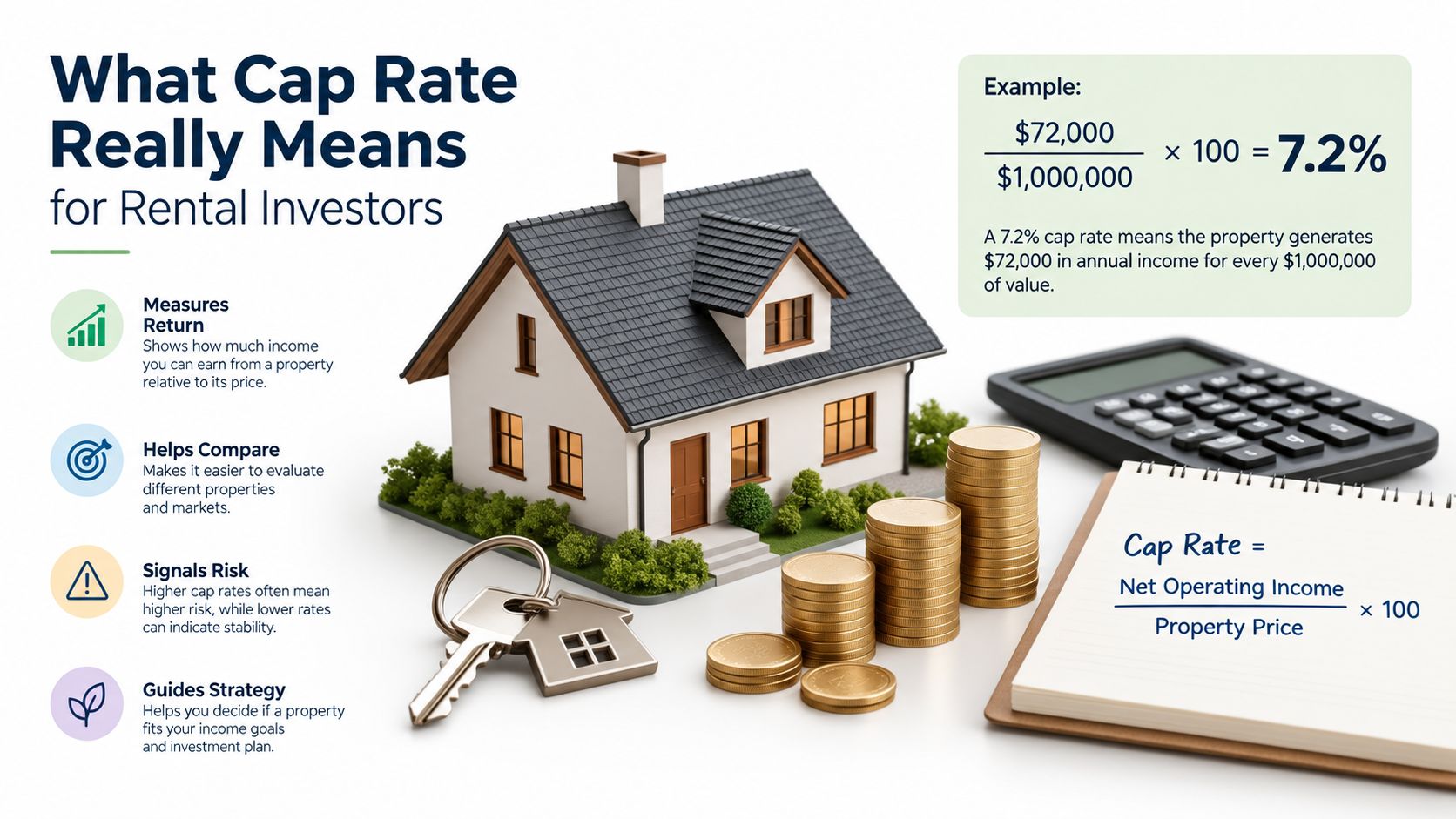
Why debt stays outside the ratio
A property purchased with cash and the same property purchased with debt can have the same cap rate. The asset produces the same NOI, and its market value is unchanged by the buyer's personal financing choice.
Your financing still matters enormously. Interest, principal repayment, reserves, and lender requirements determine cash flow to equity and debt-service coverage. Cap rate answers a different question from DSCR.
It also gives you a rough signal about pricing and perceived risk. A higher cap rate usually means the buyer is receiving more current income relative to price, while a lower cap rate may reflect stronger demand, lower perceived risk, better location, or greater confidence in future income. Those are interpretations, not automatic rules.
A cap rate can therefore be attractive for the wrong reason. A high figure may come from vacancy, deferred maintenance, unstable tenants, or expenses that the seller has understated. The ratio becomes useful only when the NOI is realistic and the property is compared with similar assets.
How to Calculate Cap Rate and Estimate Value
A rental property generates $60,000 in annual NOI and is offered for $1 million. The first calculation is simple:
Cap rate = NOI ÷ property price
Divide $60,000 by $1 million to get a 6% cap rate. This is the property's unlevered income yield. It excludes loan payments, principal repayment, closing costs, renovation spending, and the investor's other capital requirements.
To estimate value from a target market cap rate, reverse the formula:
Value = NOI ÷ cap rate
With $60,000 of NOI capitalized at 6%, the indicated value is $1 million. At a higher required cap rate, the indicated value falls. At a lower rate, it rises. That relationship connects income assumptions to pricing before you evaluate financing or an exit.
Start with credible NOI. Review the how to calculate NOI on a rental guide for context on identifying property income and operating expenses. Separate recurring operating costs from debt service, capital improvements, and owner-specific expenses.
The valuation effect of a small rate change
A change of 100 basis points can materially alter the price of the same income stream. A property producing $250,000 of NOI is worth about $3.57 million at a 7.0% cap rate and about $4.17 million at a 6.0% cap rate, a roughly 17% value increase from 100 basis points of compression. This capitalization-rate analysis provides the referenced example and explains the inverse formula.
NOI did not increase in that illustration. Buyers accepted a lower yield. For a Southeast rental investor, that shift can raise the acquisition price, increase the equity required, change the loan-to-value decision, and make an exit dependent on continued cap-rate compression. Debt underwriting still requires DSCR analysis because cap rate does not measure the property's ability to cover loan payments.
| NOI | Cap Rate | Indicated Value | Takeaway |
|---|---|---|---|
| $60,000 | 6.0% | $1,000,000 | Lower cap rates support higher values |
| $60,000 | 7.0% | About $857,143 | Higher cap rates reduce indicated value |
| $250,000 | 7.0% | About $3.57 million | Income supports a lower value than at 6.0% |
| $250,000 | 6.0% | About $4.17 million | Compression materially increases value |
Build a worksheet with gross income, operating expenses, NOI, purchase price, and market cap rate. Keep actual NOI, stabilized NOI, and projected exit NOI on separate lines so current performance does not blend with assumptions.
For a quick screening pass, the Sims Ventures cap rate calculator can test the connection between income, price, and yield. Use its result as a starting point, then verify rents, expenses, reserves, financing, and DSCR in the property underwriting.
Worked Examples Across Property Types
The same formula can produce very different investment conclusions depending on the property and business plan. The following examples show how to organize the analysis without treating a quoted cap rate as a complete return forecast.
Georgia single-family rental
A Georgia investor evaluates a house with annual rent of $42,000. Operating expenses, including management, insurance, taxes, repairs, and a vacancy allowance, total $14,000. The resulting NOI is $28,000.
At a $400,000 purchase price, the cap rate is 7%. That figure describes the stabilized income yield before debt. It doesn't include the investor's loan payment, renovation budget, closing costs, or future appreciation.
If the property requires substantial work, the investor should also examine the cost basis after renovation. A cap rate calculated only from the contract price can overstate the yield on the total capital invested. The property may be inexpensive relative to current income, yet unattractive after required repairs.
Carolinas small multifamily
Now consider a small multifamily property in the Carolinas. Current annual rental income is $96,000, and recurring operating expenses are $36,000, producing $60,000 of in-place NOI. At a $1 million price, the in-place cap rate is 6%.
The seller's projection may show higher NOI after vacant units are leased and rents are adjusted. That projected figure can be useful, but it's pro forma NOI, not current performance. An investor should calculate both versions and ask how much of the projected improvement requires time, capital, tenant turnover, or favorable market conditions.
A deal that works only at stabilized NOI may need bridge financing, reserves, and a clear path to permanent debt. A deal that works on current NOI has a different risk profile, even if both properties advertise the same eventual cap rate.
Texas flip versus stabilized hold
A Texas investor compares two strategies for a property with similar acquisition economics. The flip plan focuses on purchase, construction, resale timing, and after-repair value. The stabilized-hold plan focuses on the property's completed NOI and the value supported by an appropriate market cap rate.
A flip may not have a meaningful cap rate at acquisition because the property isn't operating as a stabilized rental. Applying a projected post-renovation NOI to the purchase price can create a misleading figure if the investor plans to sell rather than hold.
For the hold strategy, calculate the completed property's recurring income and operating expenses after repairs. Then compare the resulting cap rate with the total basis, not just the contract price. The interpretation changes again if the investor refinances after stabilization.
A quoted cap rate describes an income relationship. Your strategy determines whether that relationship is relevant to the decision.
Across all three examples, the important distinction is between in-place income, stabilized income, and projected income. Keep those figures separate. Otherwise, a property can appear safer and more profitable than its actual operations support.
Market Benchmarks and Cap Rate Compression Explained
A rental investor in the Southeast may see two similar properties priced at very different yields. The difference can reflect location, tenant demand, building condition, property type, lease structure, financing conditions, and expected income growth. Cap rate is therefore a screening lens, not a universal score.
A long-run CBRE aggregation covering office, retail, multifamily, industrial, and hotel properties from Q1 2001 through Q4 2022 recorded an average cap rate of 6.29%, a standard deviation of 1.12%, and an observed range of 4.88% to 8.87%. JPMorganChase's historical cap rate summary presents these figures as a broad cross-property and cross-cycle reference.
That range is context, not a target. A single-family rental in a Southeast submarket should be compared with similar local assets and income profiles before a national blended figure is used. The benchmark helps investors recognize how pricing has shifted across property types and market cycles.
Compression and expansion in plain language
Cap rate compression occurs when buyers apply a lower cap rate to the same NOI. Because value equals NOI divided by cap rate, the lower denominator raises indicated value. An owner may therefore see a higher valuation without materially increasing property income.
Cap rate expansion has the reverse effect. Buyers require a higher yield, so the same NOI supports a lower value. Higher required returns, weaker demand, operating uncertainty, or concern about future income can all contribute.
A 100-basis-point change can materially alter a deal screen. If NOI stays constant while the cap rate compresses, value rises. That higher value may improve apparent terms at refinance or sale, but it can also leave a buyer paying more for the same cash flow. If debt service does not fall with the price change, DSCR underwriting still depends on NOI and loan terms, not the headline cap rate.
Recent market data shows why one national figure is insufficient. The CBRE U.S. Cap Rate Survey H1 2026 reported that the all-property average cap rate was nearly flat amid continued uncertainty. A JPMorganChase summary of the survey reported that between Q4 2024 and Q4 2025, multifamily cap rates were unchanged nationally, while office rose by 0.2%, retail rose by 0.1%, and industrial fell by 0.1%. The H1 2026 cap rate survey provides the market-level reference.
For Southeast investors, test several cap-rate assumptions against purchase price, DSCR, and exit value. A deal that works only after compression may depend on favorable market pricing rather than durable operations. This guide to what's a good cap rate offers further context for judging whether a yield fits the asset's risk, income quality, and financing plan.
Limitations Pitfalls and How Lenders Use Cap Rates
Cap rate is a screening lens, not a complete return measure. It excludes debt service, so it cannot show how much cash remains after mortgage payments. It also leaves out selling costs, tax effects, major capital improvements, and changes in property value.
The larger risk often appears before the formula. An investor may accept seller-reported revenue without checking collections, assume optimistic occupancy, understate repairs, or omit management costs because the owner self-manages. Those choices inflate NOI and make the cap rate look stronger without improving the property.
The NOI quality test
Classify income as in place, normalized, or projected, then test the assumptions behind it.
- Revenue verification: Match scheduled rent with actual collections and lease terms.
- Expense normalization: Include recurring costs even when the current owner reports unusually low spending.
- Maintenance review: Identify deferred work that could reduce cash flow after closing.
- Capital planning: Separate ordinary operating expenses from larger replacements and improvements.
- Tax awareness: Consider whether ownership or reassessment could change expenses.
A temporarily favorable expense history can create an appealing cap rate. Durable NOI requires income that can persist after acquisition.
Why lenders look beyond cap rate
Lenders may use cap rate to discuss collateral value, but DSCR determines debt capacity. DSCR compares property cash flow with required debt service. If NOI supports the requested payment with little cushion, the lender may reduce proceeds, change terms, or require another structure, even when the going-in cap rate looks attractive.
The connection becomes clear in a bridge-to-DSCR strategy. Short-term financing can fund acquisition or renovation while the property is stabilized. After operations are established, the investor must test whether actual cash flow supports longer-term DSCR debt.
A 100-basis-point cap-rate change can also reshape the financing decision. If NOI stays constant, compression raises indicated value. That may improve apparent borrowing power at a refinance or sale, while increasing the price paid for the same income. Debt service still depends on loan terms, so a higher valuation does not automatically create stronger coverage.
Sims Ventures offers asset-based financing for rental properties, bridge-to-DSCR pathways, refinances, and related investment strategies in Georgia, North Carolina, South Carolina, and Texas. Investors reviewing the relationship between income, debt, and valuation can use this rental property cash flow analysis.
Lender perspective: Cap rate informs the value conversation. DSCR determines whether the proposed debt fits the property's cash flow.
Use both lenses before making an offer. A high cap rate supported by fragile NOI may provide weaker debt coverage than a lower cap rate backed by stable operations.
Your Practical Cap Rate Screening Checklist
Cap rate becomes valuable when it turns into a repeatable process. Use the following screen before ordering extensive diligence or committing to a financing structure.
Start with the income
Write down actual gross income, recurring operating expenses, and resulting NOI. Keep seller figures separate from your own normalized estimate. If the property needs work, calculate current NOI and stabilized NOI independently.
Test the price
Calculate the going-in cap rate using the purchase price. Then reverse the equation with a market-supported cap rate to estimate indicated value. If the asking price requires an unusually low cap rate, identify the specific reason, such as location quality, income durability, or documented upside.
Stress the assumptions
Change the cap rate assumption in your valuation worksheet. A 100 basis point movement can materially change indicated value, as the valuation example from JPMorganChase's cap rate explanation demonstrates. Test the impact on loan proceeds, required equity, refinance proceeds, and sale value.
Confirm debt capacity
Estimate debt service and compare it with realistic NOI. Don't assume that a strong cap rate automatically creates enough DSCR for the loan you want. If the property is not stabilized, map the bridge period, renovation milestones, lease-up plan, and transition to permanent debt.
Build a one-page deal sheet
Your template should contain:
- Income: Scheduled rent, other income, vacancy allowance, and collected revenue.
- Expenses: Taxes, insurance, repairs, management, utilities, and reserves.
- NOI cases: In-place, normalized, and stabilized.
- Value cases: Conservative, base, and stronger market cap assumptions.
- Financing: Loan amount, debt service, DSCR, cash required, and refinance conditions.
- Exit: Expected NOI at sale, exit cap assumption, selling costs, and remaining debt.
The goal isn't to predict the future perfectly. It's to see which assumptions control the outcome and whether the deal still works when conditions become less favorable.
For a rental in Georgia, North Carolina, South Carolina, or Texas, gather the rent roll, operating history, repair budget, and proposed debt terms before requesting financing. Then discuss the structure with a lender or advisor who can evaluate cap rate, collateral, DSCR, and the transition from acquisition to stabilization together.

Sims Ventures provides DSCR purchase and refinance loans, bridge-to-DSCR financing, fix-and-flip loans, construction financing, and real estate consulting for investors in GA, NC, SC, and TX. Review your next property's NOI, cap-rate sensitivity, and debt capacity with the team by visiting Sims Ventures.
