

LTV Ratio Real Estate Explained for Smart Investors
You've found a property that looks like a strong investment. The seller accepts your offer, the renovation budget appears manageable, and the projected exit still leaves room for profit. Then the lender asks one question that changes the conversation: What's the LTV?
Two investors can submit offers on nearly identical properties and receive different loan amounts, pricing, or approval conditions. The difference may come from the loan-to-value ratio, the lender's view of the property value, the debt already secured by the property, or the way the project's future value is calculated. LTV isn't just a formula on an approval sheet. It's a quick measure of your equity cushion, the lender's exposure, and how much flexibility remains if the deal takes longer or costs more than expected.
For investors, understanding LTV ratio real estate means understanding how financing decisions get made. The ratio affects purchase financing, refinance proceeds, bridge structure, construction draws, reserves, and the viability of your exit plan. A strong deal can become difficult to fund when the headline LTV looks acceptable but the total debt stack creates a much higher effective exposure.
The useful approach is to treat LTV as a design tool. Calculate it correctly, identify which value belongs in the denominator, and then structure the loan so the financing fits the strategy. The sections below use plain-language analogies, worked calculations, and investor-focused examples for rentals, bridge-to-DSCR financing, ARV-based flips, and ground-up construction.
Introduction Why LTV Decides Your Deal Before You Do
A rental investor finds a property listed below comparable sales. The appraisal supports a higher value, and the requested loan looks reasonable against that value. Another investor brings a similar property to the same lender, but the appraisal comes in lower and a second lien remains on the title. On paper, both borrowers may describe their deals as “about seventy percent.” In underwriting, they aren't the same transaction.
The first borrower has a larger equity cushion and more room to absorb a valuation adjustment. The second borrower may have less usable equity than the first number suggests because every lien affects the property's total debt exposure. That difference can influence proceeds, reserves, pricing, and whether the lender is comfortable with the planned exit.
At its simplest, LTV compares the loan amount with the property value:
LTV = Loan amount ÷ Property value × 100
A lower result generally means the borrower has more equity protecting the collateral. A higher result means the lender has more exposure to a decline in value and the borrower has less room before the property becomes difficult to refinance or sell.
Current U.S. mortgage data illustrates why this ratio matters beyond one transaction. The average LTV for mortgaged properties fell to 42% in the second quarter, from 43% in the prior quarter and 46% a year earlier, the lowest level since at least 2010, according to National Mortgage News coverage of average LTV. That figure implies roughly 58% average borrower equity, which shows how LTV can also serve as a broad indicator of borrower resilience.
The mistake I see most often is treating LTV as a pass-or-fail number. Experienced underwriting looks at what created the ratio, which value supports it, what debt sits behind it, and whether the loan will remain workable at exit. A ratio that works for a stabilized rental may not work for a renovation project, and a ratio that looks conservative on one property may become aggressive when combined with portfolio-level obligations.
What LTV Really Measures and How It Differs From LTC ARV and CLTV
LTV measures a property's debt relative to its value. If a property is worth $400,000 and the mortgage balance is $300,000, the calculation is:
$300,000 ÷ $400,000 = 75% LTV
The remaining 25% represents the borrower's equity position before considering selling costs, unpaid expenses, or other liens. Think of the equity as a shock absorber. A property with more equity can usually withstand a valuation decline better than a property financed close to its full value.
The denominator matters as much as the loan amount. For a stabilized rental purchase or refinance, the value usually comes from the property's current appraised value. For a flip or construction deal, the lender may need to evaluate both current value and the value expected after the planned work.
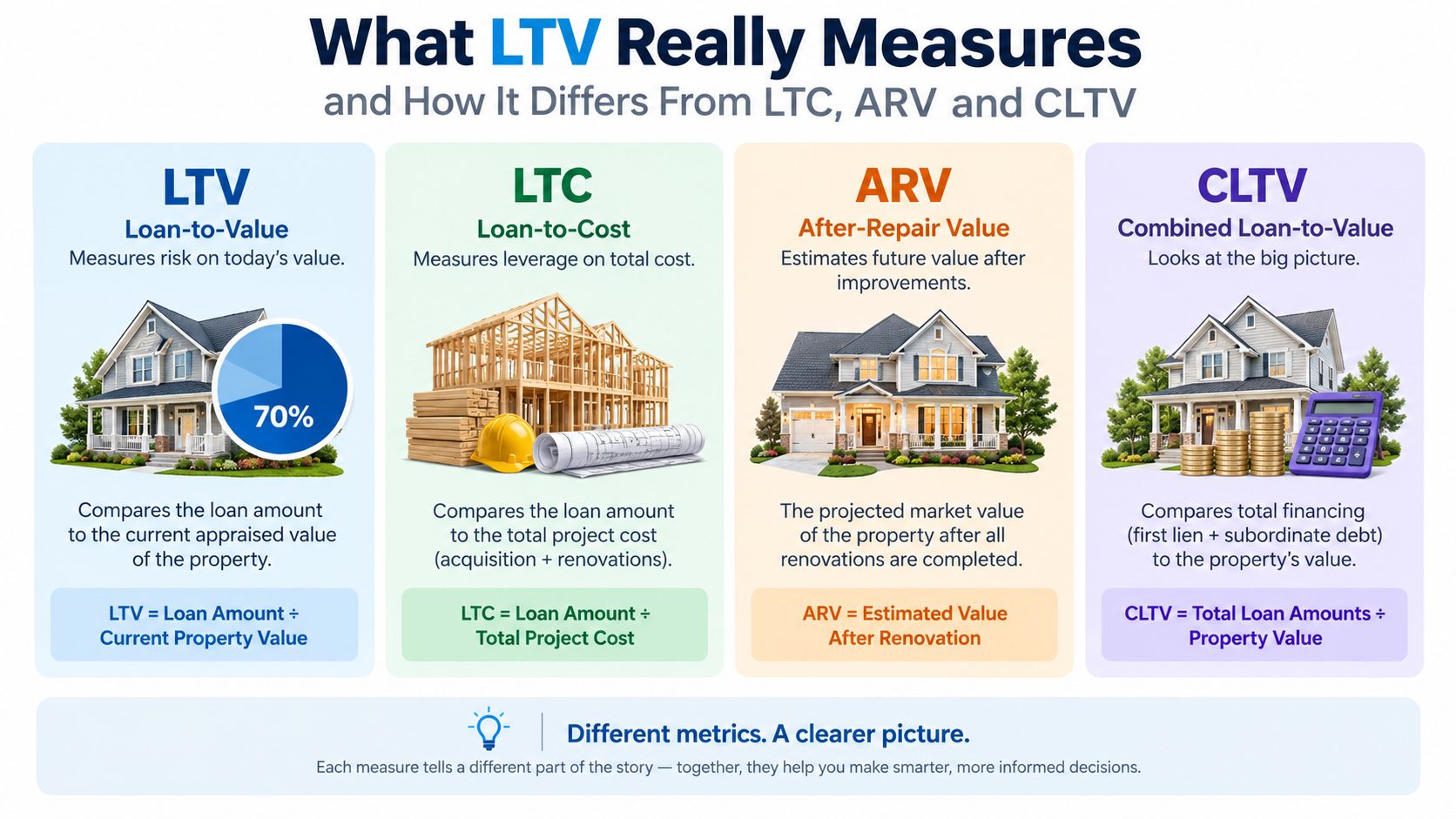
Four ratios with four different jobs
LTV, or loan to value, compares the loan with the property's current or appraised value. It answers, “How much debt is secured by this asset relative to what the asset is worth?”
LTC, or loan to cost, compares the loan with the project's total cost. For a renovation, that may include acquisition and eligible rehabilitation expenses. For construction, it may include the lot and construction budget. LTC answers, “How much of the money going into the project is financed?”
LTARV, or loan to after-repair value, compares the loan with the projected value after improvements. It answers, “How much debt will exist relative to the completed property's expected value?” That forecast depends on the appraisal, scope of work, comparable sales, and execution.
CLTV, or combined loan to value, adds multiple liens together before dividing by value. A first mortgage of $240,000 and a second lien of $40,000 on a $400,000 property create combined debt of $280,000, or 70% CLTV. Looking only at the first lien would understate the borrower's total exposure.
LTV is equity in reverse. The higher the ratio, the smaller the borrower's cushion.
Investors often confuse LTV and LTC because both describe financial structure. The practical distinction is simple: LTV focuses on the asset's value, while LTC focuses on the money required to create or acquire the asset. A property bought below market may produce a favorable LTV immediately, while a construction project can have little current value relative to its total planned cost even if its completed value supports the final loan.
For a deeper side-by-side explanation, review LTV versus LTC in real estate investing. The right ratio depends on the strategy, the stage of the project, and the lender's repayment analysis.
How to Calculate LTV With Worked Examples for Every Investor Strategy
The formula is easy. The underwriting judgment comes from choosing the correct loan balance and value basis. The following examples use hypothetical deal inputs to show how the calculation changes across common investor strategies.
| Deal Type | Loan Amount | Value Basis | Calculated LTV |
|---|---|---|---|
| Rental purchase | $300,000 | $400,000 current value | 75% |
| Cash-out refinance | $300,000 | $400,000 appraised value | 75% |
| Fix-and-flip | $280,000 | $400,000 ARV | 70% |
| Ground-up construction | $360,000 | $500,000 completed value | 72% |
Rental purchase
Suppose a rental property appraises for $400,000 and the proposed loan is $300,000.
$300,000 ÷ $400,000 = 75% LTV
That leaves a 25% equity position based on the appraised value. If the purchase price is lower than the appraisal, the investor may have a stronger value cushion, but the lender will still review the purchase contract, appraisal, property condition, cash flow, borrower experience, and closing costs.
Cash-out refinance
Assume the same property is worth $400,000 and the refinance loan is $300,000. The new LTV is again 75%. If the existing mortgage balance is $260,000, the gross difference between the new loan and the old balance is $40,000 before closing costs, escrows, reserves, and other deductions.
The important point is that cash-out proceeds don't come from a separate source. They come from increasing the debt secured by the property, subject to the permitted LTV and the lender's other requirements.
Fix-and-flip using ARV
A borrower plans to purchase and renovate a property. The lender estimates the after-repair value at $400,000 and proposes a total loan of $280,000.
$280,000 ÷ $400,000 = 70% LTARV
That ratio doesn't tell the entire story. The lender may also calculate LTC using the acquisition price plus eligible renovation costs. If the project costs $350,000 in total, the same $280,000 loan equals 80% LTC.
The loan therefore has two views: one against the completed value and one against the money invested in the project. A deal can fit one test and fail the other.
Ground-up construction draw
For a new build, assume the completed appraisal supports a value of $500,000 and the planned facility totals $360,000.
$360,000 ÷ $500,000 = 72% completed-value LTV
The lender may also examine LTC based on the lot and construction budget. Draws are typically released as work reaches verified milestones, so the borrower's effective exposure changes during construction. A delayed draw, cost overrun, or lower completed appraisal can reduce the remaining cushion even when the initial calculation looked acceptable.
Before submitting a deal, calculate the ratio at purchase, after improvements, at stabilization, and at the planned exit. Include every lien and test both current value and the value basis relevant to the strategy.
Typical LTV Thresholds by Loan Type and What They Signal to Lenders

There is no single “good” LTV for every investment property. A stabilized rental, short-term bridge loan, ARV-based flip, and ground-up build each create different execution risks. Lenders therefore apply different tests, much like using different measuring tools for different projects.
| Loan Type | Common Underwriting Focus | What the LTV Level Signals |
|---|---|---|
| DSCR rental | Current-value LTV plus property cash flow | Whether the collateral and rental income can support the debt |
| Bridge loan | As-is LTV, sometimes paired with an exit-value test | How much protection exists during the short-term valuation and execution gap |
| Fix-and-flip | LTC and LTARV | Whether the project budget and completed value both support the loan |
| Construction loan | LTC, completed-value LTV, draws, and reserves | How completion, budget, and market-value risks are being controlled |
| Commercial property | LTV plus property cash flow and repayment source | How much repayment depends on collateral versus income |
| Multifamily property | LTV, operating performance, and stabilization assumptions | Whether asset value and ongoing operations can withstand weaker results |
An 80% LTV often marks an important underwriting boundary. At that level, the borrower has less equity protecting the collateral than with a lower loan balance. Regulatory capital frameworks use LTV bands as risk drivers, with lower bands generally receiving more favorable treatment and higher bands receiving sharply higher risk weights. The Basel Committee standards summarized by KPMG explain how risk weights can increase as real-estate debt rises, particularly when repayment depends on property cash flow.
Historical mortgage data shows why lenders monitor the ratio closely. Average LTV for first-time buyers rose from about 85% in the late 1970s and 1980s to 94% in 2006, then eased to about 90% in 2009, according to Federal Housing Finance Agency historical research. The same research reported average jumbo purchase LTV of 78.2% from 1986 through 2005. The average reached 80% to 81% in 1995, then declined to 74.7% to 75.3% by 2005.
Property type changes the meaning of the ratio. Commercial LTV was reported at 59.6% in Q2 2026, while multifamily LTV was 63.3%, as discussed in commercial real estate lending fundamentals. An investor should not apply one residential benchmark to every asset class.
Construction adds another planning layer. The borrower must understand not only the equity required at closing, but also how equity and loan proceeds are assigned across each draw. A detailed guide to down payments for construction loans can clarify that structure better than a generic LTV rule.
How LTV Shapes Pricing Covenants and Your Options as a Borrower
LTV affects more than the maximum loan amount. It can influence the lender's capital requirement, the pricing offered to the borrower, the reserves requested, and the flexibility available if the exit changes.
Regulatory capital frameworks generally assign lower risk weights to lower-LTV real-estate exposures and increase those weights as borrowing moves into higher bands. The change can be non-linear. A modest increase in borrowing may push a loan into a less favorable risk tier, raising the lender's capital cost and reducing the proceeds or pricing flexibility available to the borrower.
That logic explains why two loans with similar property values may receive different terms. A collateral-dependent loan may be analyzed differently from one whose repayment depends heavily on property cash flow. The Banque de France and Basel-related research summarized in the mortgage LTV risk analysis describes LTV as a standard mortgage-risk measure and connects higher borrowing with smaller equity cushions and greater sensitivity to falling property values.

The terms that may move with leverage
A lender may respond to higher effective LTV through:
- Pricing: The interest rate or points may reflect the additional collateral exposure.
- Reserves: The lender may require more liquidity for interest, taxes, insurance, repairs, or operating shortfalls.
- Covenants: The loan documents may establish minimum value, debt-service, completion, or reporting requirements.
- Credit enhancement: The structure may require mortgage insurance, additional collateral, a guaranty, or staged funding.
- Proceeds: The lender may reduce the loan amount so the transaction remains within an acceptable risk band.
LTV also affects your options after closing. A high-ratio borrower may have less capacity for a cash-out refinance, less room for a second lien, and less protection against appraisal volatility. If the property value falls, the borrower can reach an uncomfortable position before the payment itself becomes unaffordable.
Underwrite the exit at the same time as the loan. A ratio that works at closing may not provide enough room for refinancing, sale costs, or a delayed project.
For investors, the target isn't always the highest possible LTV. More borrowing preserves cash for other acquisitions, but it also increases debt service and reduces flexibility. Lower borrowing may require more equity upfront while improving the borrower's ability to absorb delays, negotiate a refinance, or hold through a slower sale.
Smart Ways to Improve Effective LTV and Structure Deals for Sims Ventures Programs
You can improve a deal's effective LTV without treating “bring more cash” as the only solution. The better approach is to improve the relationship between total debt, verified value, project cost, and exit timing.
The first lever is acquisition basis. Buying below supported market value can create a stronger starting cushion, but only when the appraisal and comparable sales support the value. A low contract price by itself doesn't prove that the property is worth more.
The second lever is sequencing. A bridge-to-DSCR structure can fund acquisition or stabilization work, then transition to longer-term rental debt once the property is complete and producing supportable cash flow. That pathway can prevent the investor from forcing a permanent refinance before the asset is ready.
For a flip, separate the purchase LTV from the LTARV and LTC tests. Limit scope changes, document completed work, and request draws that match actual progress. The goal is to make the completed value credible while preventing the outstanding balance from getting ahead of the project.
Construction borrowers should treat draws as a control system for their debt, not merely a payment schedule. A ground-up facility with milestone-based funding can keep debt aligned with verified work, while contingency reserves and a realistic budget protect the borrower from avoidable equity calls.
Match the structure to the program
- DSCR purchase or refinance: Use current appraised value, existing liens, projected debt service, and cash-out needs to set a sustainable target.
- ARV-based fix and flip: Support the resale value with relevant comparables, keep acquisition and rehabilitation costs organized, and test the exit against a slower sale.
- Ground-up construction: Track lot basis, construction costs, completed value, draw timing, and remaining equity after each milestone.
- Builder's Line of Credit: Review aggregate exposure across projects. A property may show a comfortable standalone LTV while the portfolio carries more concentrated exposure than expected.
Current housing equity data reinforces the need to look beyond the headline first lien. In Q1 2026, 43.3% of mortgaged properties were equity-rich, defined as 50% LTV or lower, while 3.2% were seriously underwater, defined as 125% LTV or higher, according to ATTOM's home equity and underwater report. The spread illustrates how valuation changes, second liens, and stacked debt can alter real borrower exposure.
Sims Ventures offers asset-based financing for rental properties, fix-and-flip projects, ground-up construction, bridge-to-DSCR pathways, and builder credit structures. Investors should evaluate each option against the property's value basis, project stage, repayment source, and intended exit rather than choosing solely by headline terms.
Putting LTV to Work Across Georgia North Carolina South Carolina and Texas
LTV becomes useful when you apply it before making an offer, not after a lender has already questioned the structure. In Georgia, North Carolina, South Carolina, and Texas, investors should validate local comparable sales, appraisal support, construction costs, rental assumptions, and the liquidity of the planned exit. The same financing level can carry a different practical risk when the valuation evidence or resale audience changes.
Use this execution checklist:
- Before the offer: Calculate current-value LTV, LTC, LTARV, and CLTV where applicable. List every lien and identify the exact exit.
- During underwriting: Provide valuation support, a complete budget, draw schedule, reserve plan, and documentation for projected rental or resale performance.
- During construction or renovation: Recalculate effective debt after each draw, change order, and updated valuation.
- Before the exit: Stress-test the refinance or sale using conservative proceeds assumptions and confirm that the debt stack still fits the target debt usage.
Asset-based financing can be especially relevant when property cash flow, collateral, and project execution tell a clearer story than conventional income documentation. Investors comparing options for private money lenders for real estate should ask how the lender calculates value, which liens are included, when draws fund, and what happens if the exit takes longer.
Mastering LTV turns a restriction into a planning advantage. Calculate the ratio early, engineer the debt stack deliberately, and make sure the property can support the loan at every stage.
Sims Ventures provides asset-based financing for rental purchases and refinances, ARV-based flips, bridge-to-DSCR transitions, and ground-up construction across Georgia, North Carolina, South Carolina, and Texas. Visit Sims Ventures to discuss your property value, effective LTV, project budget, and exit strategy with a lending team that can help structure the next step.
