

Collateral Based Lending for Real Estate Investors
You're staring at a deal that should be simple. The property cash flows, the seller wants to move fast, and your broker says the bank needs more time for tax returns, pay stubs, and a stack of forms that can easily push you past the contract deadline. That's the moment collateral based lending stops sounding abstract and starts looking like a practical way to get a deal funded.
Collateral based lending means the lender underwrites the asset first. The property, and sometimes related collateral, drives the loan decision more than your W-2 income or tax return profile. That doesn't mean the borrower doesn't matter, but the lender's first question is whether the collateral can support the advance if the loan has to be repaid from the asset itself.
That shift is part of why secured lending has expanded so much in modern private credit. A 2025 Bank for International Settlements working paper shows secured direct lending rose from near zero in the early 2000s to about USD 370 billion by end-2024, while unsecured balances were just over USD 300 billion. Secured loans also made up more than 50% of total outstanding direct lending, up from less than 10% in the 2000s, which tells you this is no longer a side door product, it's a core structure in the market. Bank for International Settlements working paper
For real estate investors, that matters because speed, asset quality, and exit strategy often matter more than a perfect personal income file. If you're comparing ways to finance a rental, bridge a renovation, or fund a build, it helps to think in terms of the lien, the collateral, and the repayment path, not just the label on the loan.
What Collateral Based Lending Actually Means for Investors
A lot of investors first hear about collateral based lending when a conventional bank deal starts slipping. The purchase is good, the numbers make sense, but the lender keeps asking for more documentation that has little to do with the property itself. A private lender takes a different path, looking at the asset, the equity cushion, and the exit first, then deciding whether the file is strong enough to close.
That's why people often confuse it with “easy money.” It isn't. It's a different kind of underwriting, where the lender is comfortable moving faster because the collateral gives them a clear recovery path if something goes wrong. The borrower's income still matters in some situations, but the income file doesn't sit in the driver's seat the way it does in conventional financing. If you want a broader overview of that structure, this asset-based mortgage loan guide is a useful companion read.
Asset first, borrower second
Think about a duplex you want to buy and stabilize. A bank may focus on your returns, your schedule C, or how messy last year was. A collateral-based lender looks at the property's value, the deal's margin of safety, and whether the loan can be repaid through sale, refinance, or stabilized cash flow.
That's why this style of lending is common in investor deals that need flexibility. It also fits the growing use of asset-led financing in business-purpose real estate, where the loan is designed around the asset rather than consumer-style underwriting. If you're trying to understand how the property itself supports the structure, smart building operations can matter too, especially in multifamily situations where utility usage affects operating efficiency. A practical example is smart metering for multi-family buildings, because tighter operating control can improve how a stabilized asset is viewed by a lender.
Practical rule: If the deal works only when the lender ignores the property, it probably isn't a collateral-based deal. If the deal works because the property can stand on its own, you're in the right lane.
Collateral based lending is best understood as a deal-first form of credit. You're not asking, “Can I get a loan because my personal file is pristine?” You're asking, “Can this asset support financing on terms that let me execute quickly and exit cleanly?”
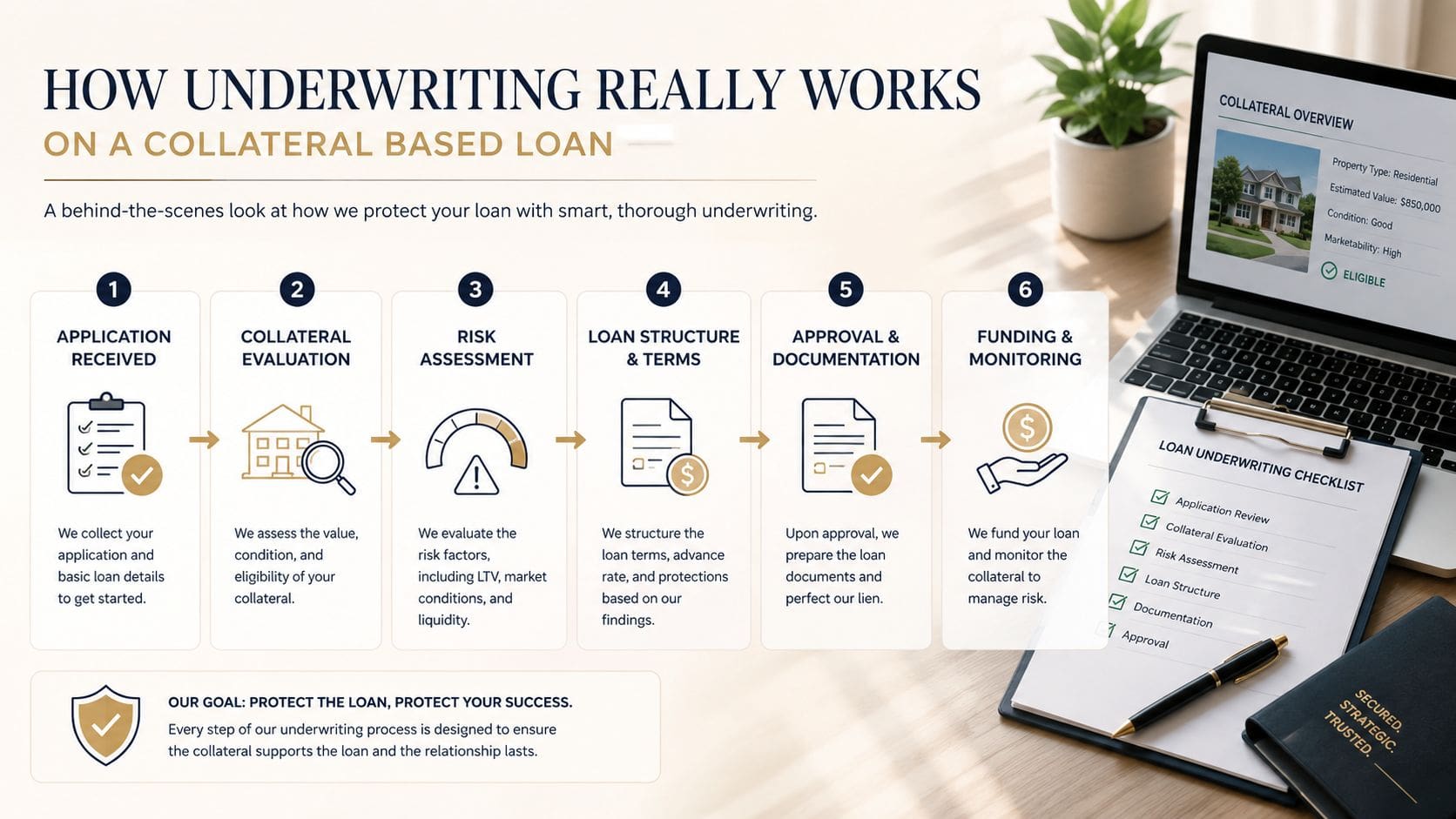
How Underwriting Really Works on a Collateral Based Loan
Underwriting starts the way a cautious lender would inspect a house. First, they look at the structure, then the foundation, then the pieces that can fail under stress. In a loan file, that means value, equity, title, borrower liquidity, and exit plan come before the final approval.
What the lender sizes first
The first number that matters is the loan-to-value ratio, or LTV. It compares the loan amount to the property's value, and it tells the lender how much cushion exists if the asset has to be sold. The World Bank study in the brief shows that collateralized loans often carry conservative coverage, with a median loan-to-collateral value of 60%, which implies the collateral value is about 167% of the loan value. In practice, that kind of cushion is what makes a lender comfortable moving quickly. World Bank study
From there, the lender checks whether the asset fits the program. Common categories include single-family rentals, multifamily, mixed-use, raw land, and completed commercial properties. The documentation stack usually follows the same order. Appraisal or broker price opinion first, then the purchase contract or refinance request, then the rent roll or scope of work, title commitment, insurance binders, entity documents, and proof of liquidity. That sequence is intentional, because each item reduces uncertainty before the lender commits capital.
What happens after approval
After close, the lender still cares about control. That's why post-close terms often include interest reserves, draw schedules for construction, prepayment language, and a clear recourse position on the asset. Those terms don't just protect the lender. They also tell you how much breathing room you have if the project runs long or the exit takes longer than planned. For a deeper look at how lenders evaluate those moving parts, see real estate underwriting guidance.
Basel-style credit risk rules also show why valuation timing matters. Collateral gets recognized only after supervisory haircuts are applied, and for collateral marked to market daily, the effective liquidation horizon is 20 business days. Slower revaluation increases the haircut through a formula tied to the days between revaluations, which means the lender recognizes less secured value when the asset is harder to refresh. Basel collateral haircut rules
A lender isn't asking whether the deal looks fine on a good day. The real question is whether the collateral still works after delay, noise, and a messy exit.
Collateral Based Lending Compared to DSCR and Bank Financing
The easiest way to separate these products is to ask what each lender trusts most. A conventional bank leans on borrower income and file depth. A DSCR lender leans on the property's debt service coverage. A collateral-based lender leans on the asset's value, liquidity, and downside protection.
That difference changes everything from speed to paperwork. Bank financing usually takes the longest because the lender wants a full picture of your personal financial strength. DSCR sits in the middle, because the lender cares mostly about whether the rental income can service the debt. Collateral based lending is the most asset-driven of the three, which can make it better for transitional deals, short holds, or borrowers whose income profile doesn't line up neatly with the opportunity.
| Feature | Collateral Based Lending | DSCR Loan | Conventional Bank Loan |
|---|---|---|---|
| Underwriting focus | Property value, equity, liquidity | Property cash flow | Borrower income and credit profile |
| Best fit | Bridge, renovation, construction, transitional assets | Stabilized rental properties | Long-term holds with strong income documentation |
| Documentation burden | Moderate to high, but asset-led | Moderate, focused on rent and reserves | Highest, with tax returns and broader income review |
| Speed to close | Usually faster when third-party items are ready | Often faster than banks, slower than hard-asset bridge | Usually slowest |
| Flexibility | Higher on structure and exit | Moderate | Lower |
| Typical use case | Asset-backed execution | Stabilized buy-and-hold | Traditional qualifying borrowers |
DSCR is useful when the rental is already behaving like a rental. The brief notes that DSCR pricing has been normalizing, with average rates moving from 8.73% in January 2024 to 7.76% by February 2025, while average loan sizes rose from $329,294 to $354,931. That suggests a more competitive, more mainstream product than the old hard-money stereotype many investors still have in mind. DSCR lending history and pricing trend
If your rental is stabilized and your documentation is clean, DSCR can be a strong fit. If your deal needs short-term speed, rehab funding, or a bridge into a future refinance, collateral based lending usually gives you more room to move. For rental investors comparing the two, this DSCR loan overview helps frame the decision.
Real Deal Scenarios That Use Collateral Based Lending
Collateral based lending changes shape depending on the project, but the logic stays the same. The lender wants enough asset strength to support the loan today and enough exit clarity to believe the loan can get repaid on time. That's why the same family of products can finance a bridge acquisition, a flip, a build, or a cash-out refinance without losing its core identity.
Bridge, flip, build, and cash-out
A bridge loan on a value-add multifamily acquisition usually leans on the existing property as the primary collateral, with an interest reserve often held back so payments don't drain operating capital during stabilization. The property is already doing part of the work, but the lender is really betting on the transition from current condition to improved condition.
A fix-and-flip uses a different lens. The lender looks at the purchase price plus rehab budget and asks whether the finished property can support repayment at resale. If the deal is thin, additional collateral can sometimes be required, especially when the investor is stacking projects or the comp set is shaky. That's a reminder that collateral-based underwriting is not the same as funding a budget, it's funding a budget with a real exit.
Ground-up construction shifts the focus to cost completion. Draws are released against inspection milestones, and the land plus vertical improvements secure the loan as the build progresses. The lender cares about whether the project can finish without running out of capital, because an unfinished structure is a very different asset from a finished one.
Cash-out refinancing on a stabilized rental uses the property's current value and income profile to size the new loan, but the lender still anchors the decision to the asset. The borrower's personal income may help explain the story, but the collateral is what carries the structure.
Underwriter's lens: If the exit is sale, the lender underwrites resale friction. If the exit is refinance, the lender underwrites refinance readiness. If the exit is stabilization, the lender underwrites the path to durable rent performance.
| Deal Type | Typical Advance | Primary Collateral | Hold Period | Key Underwriting Lever |
|---|---|---|---|---|
| Bridge acquisition | Asset value supported by reserves | Existing property | Short to intermediate | Stabilization plan |
| Fix-and-flip | Purchase plus rehab basis | Property and sometimes cross-collateral | Short | After-repair value and resale exit |
| Ground-up construction | Cost-completion structure | Land and improvements | Project-based | Draw control and completion risk |
| Cash-out refinance | Post-refi value | Stabilized rental property | Longer if the asset is held | Property value and repayment path |
The key insight is that the lender is not financing a label. It's financing a transition, and each transition has a different risk shape.
Preparing Collateral and Structuring a Deal to Close
The fastest closings usually happen when the file is built like an underwriter would build it. That means you don't just gather documents, you assemble a story that answers the lender's questions before they have to ask them. If the paperwork is scattered, the lender spends time hunting for missing pieces instead of pricing the deal.

Build the file in the right order
Start with valuation. A recent appraisal or broker price opinion gives the lender a baseline, and recent comps in the submarket help confirm the number isn't inflated. For a rental or refinance, a rent roll or clear income narrative matters because it shows how the property performs, not just how it looks on paper.
Then clean up the entity side. Formation papers, the operating agreement, EIN, and beneficial owner disclosures should match the title-holding structure. If the entity names don't align, closing can get bogged down even when the deal itself is solid. That delay is usually avoidable, which is why experienced investors organize the entity before the term sheet becomes urgent.
Equity matters just as much as paperwork. Lenders want to see meaningful cash or verified liquidity behind the request, not borrowed funds stacked on borrowed funds. If the capital stack is too thin, the underwriter starts worrying about overextension and exit risk.
Remove the easy blockers early
Title issues, lien searches, HOA notices, and municipal items can all stall a file that otherwise looks clean. Solve them before they become closing-day surprises. The same goes for use of proceeds and exit strategy, both should be written plainly enough that an underwriter can understand how the loan gets repaid without having to infer the plan.
Here's the shortest version of the prep checklist:
- Get value support early: Appraisal, broker price opinion, and submarket comps should align before you submit the request.
- Match the entity and title: Make sure the borrower entity matches the title structure and ownership disclosures.
- Show real liquidity: Verified equity or cash reserves carry more weight than vague claims of “available funds.”
- Clear title friction fast: Liens, HOA issues, and municipal concerns should be handled before the file hits final review.
- Write the exit plainly: Sale, refinance, or stabilization should be described in one direct path.
That's the practical side of collateral based lending. The cleaner the file, the easier it is for the lender to say yes without adding extra conditions.
Risks and Misconceptions Worth Pricing In
Collateral doesn't make a loan safe. It makes a loan recoverable, and those are not the same thing. If the borrower walks, the market softens, or the project overruns budget, the lender still faces loss exposure because the sale proceeds may not match the original assumption.
That's why higher amounts of debt deserve more respect than optimism. The closer the loan gets to the property value, the thinner the equity cushion becomes, and the more sensitive the deal is to price movement and forced-sale pressure. In real estate, the foreclosure value is often not the same as the steady-state appraisal value, and investors need to model that gap before they commit.
Price the whole loan, not just the rate
The stated interest rate is only one part of the cost. Origination points, extension fees, prepayment language, and any reserve requirements can change the economics of the deal. If you only model the coupon, you can easily understate the true cost of carrying the asset.
Cross-collateralization deserves special attention too. A lender can tie more than one property to the same loan, which may be fine if the portfolio is strong, but risky if one weak asset can drag down a stronger one. Investors sometimes treat that as a small technical detail until a default forces the issue.
The World Bank sample in the brief also shows collateralized lending is widespread, with 77% of loans requiring collateral and a 85% collateral requirement share in Sub-Saharan Africa, the highest regional figure in that sample. The same study's conservative loan-to-collateral relationship explains why lenders rely on asset buffer rather than hope. World Bank study
If you want a non-lending analogy, think about family budgeting. A household can't pretend a roof repair won't happen just because a savings account looks healthy today. The same principle applies to lending, which is why readers concerned about household resilience may also look at affordable coverage for Georgia families as a reminder that protection is about planning for downside, not assuming it won't happen.
Stress test every deal against a value drop and a longer carry period before you sign. If the deal only works in the best case, it's already too fragile.
Putting It Together With Sims Ventures Programs
Sims Ventures fits into this framework as an asset-based lender built for investors who need the deal evaluated on property strength, cash flow, and execution path. Its DSCR refinance and purchase loans, bridge-to-DSCR pathways, fix-and-flip loans, ground-up residential construction loans, builder's line of credit, and cash-out or rate-term refinances all map back to the same core discipline, the asset has to support the structure.

What changes from program to program is the term, the draw structure, and the way the exit is viewed. A bridge-to-DSCR path, for example, makes sense when the property needs a short-term runway before it qualifies as a stabilized rental. A fix-and-flip file leans harder on resale math, while a construction request depends on milestone draws and completion control. The underwriting logic stays familiar, but the timing and documentation shift with the project.
That's where advisory support matters. Pre-flight valuation review, entity structuring guidance, and equity positioning feedback can save time before the file ever reaches final review. For investors working across Georgia, North Carolina, South Carolina, and Texas, that kind of deal-focused process can be the difference between scrambling and closing cleanly.
If you've got a property, a budget, or a refinance in mind, send over the address, your entity name, the target loan amount, and a short explanation of the exit strategy. Sims Ventures can review the structure, discuss fit across its lending programs, and help you shape a request that matches the collateral instead of fighting it.
If you're trying to fund a rental, bridge a flip, or map out a construction draw schedule, Sims Ventures can walk through the deal from first review to closing with an asset-based lens. Bring the property details, the exit plan, and the entity setup, and you'll get a faster answer on whether the collateral can support the loan structure you need.