

What Is a Fix and Flip Loan and How Does It Work
A fix-and-flip loan is a short-term, asset-based loan sized around a property's after-repair value, with financing for both acquisition and renovation. In 2025, 37.7% of flipped homes used investor financing, while median gross profit was about $65,300. HousingWire's report on the 2025 flipping market shows why the product remains relevant, even as the spread between project cost and resale value gets harder to protect.
You've got a distressed property under contract, a hard-money contingency that expires in ten days, and a contractor who wants a deposit before work starts. The question isn't merely whether a lender will approve the purchase. You need to know how much cash the loan requires, when rehab money becomes available, what the debt costs during a slow sale, and whether your exit still works if the appraisal comes in low.
The textbook definition is simple. The underwriter's version is less forgiving. A fix-and-flip loan only works when the purchase price, renovation plan, financing structure, resale value, and timeline support one another. The lender is advancing capital against a business plan secured by real estate, not giving you a conventional mortgage for a home you intend to occupy.
What a Fix and Flip Loan Is
Unlike a conventional mortgage, a fix-and-flip loan is structured around the property's planned resale or refinance, not owner occupancy or decades of repayment. The borrower acquires a distressed property, completes defined improvements, and repays the short-term debt when the project exits. Financing generally combines an acquisition advance with a renovation holdback. Industry summaries commonly place these terms around 6 to 18 months, reflecting the compressed schedule for buying, repairing, and selling. Market commentary on fix-and-flip financing terms provides broader context on that structure.
The loan is asset-based. The property, renovation plan, and projected resale value carry more weight than salary or tax-return income. A lender still reviews credit, liquidity, experience, business entity, contractor, and repayment history. The central underwriting question is whether the completed property and planned exit can support the proposed debt.

How the structure differs from a residence mortgage
A primary-residence mortgage depends on long-term repayment, verified household income, and regular amortization. A fix-and-flip loan depends on a defined sale or refinance. Payments are often interest-only, with the principal due in a balloon payoff when the property sells or the borrower replaces the short-term debt.
That payment structure preserves cash during construction, but it concentrates risk at the exit. The balance does not decline meaningfully through monthly payments. If the sale takes longer, interest and other carrying costs continue. If the finished property sells below the original estimate, the borrower may need to bring cash to closing.
Rehab proceeds also come with controls. Lenders commonly hold back the renovation budget and release it through draws after completed work is inspected. That limits funding for unfinished work, while making contractor scheduling, deposits, and working capital the borrower's responsibility.
The three pillars of the product
Every fix-and-flip loan rests on three structural ideas:
- ARV-driven sizing: The after-repair value, or ARV, sets the ceiling for total debt.
- Draw-based rehab funding: Renovation proceeds arrive as work progresses, rather than as unrestricted cash.
- Short-term maturity: The loan requires a defined sale or refinance instead of a decades-long hold.
Extra capital isn't automatically safe. In 2025, cash still funded about 62% of flips, while financing accounted for 37.7% of purchases. The same report placed national return on investment at 25.1%, the lowest level since 2008, and the median purchase price at a record $259,700. Those conditions matter for Southeast investors facing tighter margins in 2026. A loan can fund acquisition and construction, but it cannot repair an inflated purchase price, weak resale assumptions, or a renovation budget without room for overruns.
How Lenders Underwrite a Fix and Flip Loan
Underwriting starts with three measurements: ARV, LTV, and LTC. Think of ARV as the ceiling, LTV as the height of the purchase debt, and LTC as the portion of the total project cost the lender is willing to fund.
ARV sets the ceiling
ARV is the lender's estimate of what the property should sell for after the planned work is complete. The estimate relies on comparable closed sales, not the seller's asking price or the investor's preferred outcome. The underwriter studies location, square footage, layout, condition, finish level, lot characteristics, and the timing of comparable transactions. A third-party appraisal or broker price opinion may validate the conclusion.
The important question isn't whether a renovated property looks attractive. It's whether buyers in that specific market have recently paid similar prices for comparable finished homes. A cosmetic upgrade can't justify a premium that the neighborhood's sales history doesn't support.
LTV and LTC limit the advance
LTV compares the loan to the property value. Fix-and-flip structures commonly cap total debt at 65% to 75% of ARV, according to technical guidance on purchase-plus-rehab financing. LTC compares the loan to total project cost, including acquisition and planned renovation. A lender may fund a large share of the cost while still reducing the loan because the ARV cap is lower.
For example, a low purchase price and substantial renovation budget might fit the LTC test but fail the ARV test. In that case, you bring more equity, reduce the scope, negotiate the purchase, or abandon the deal.
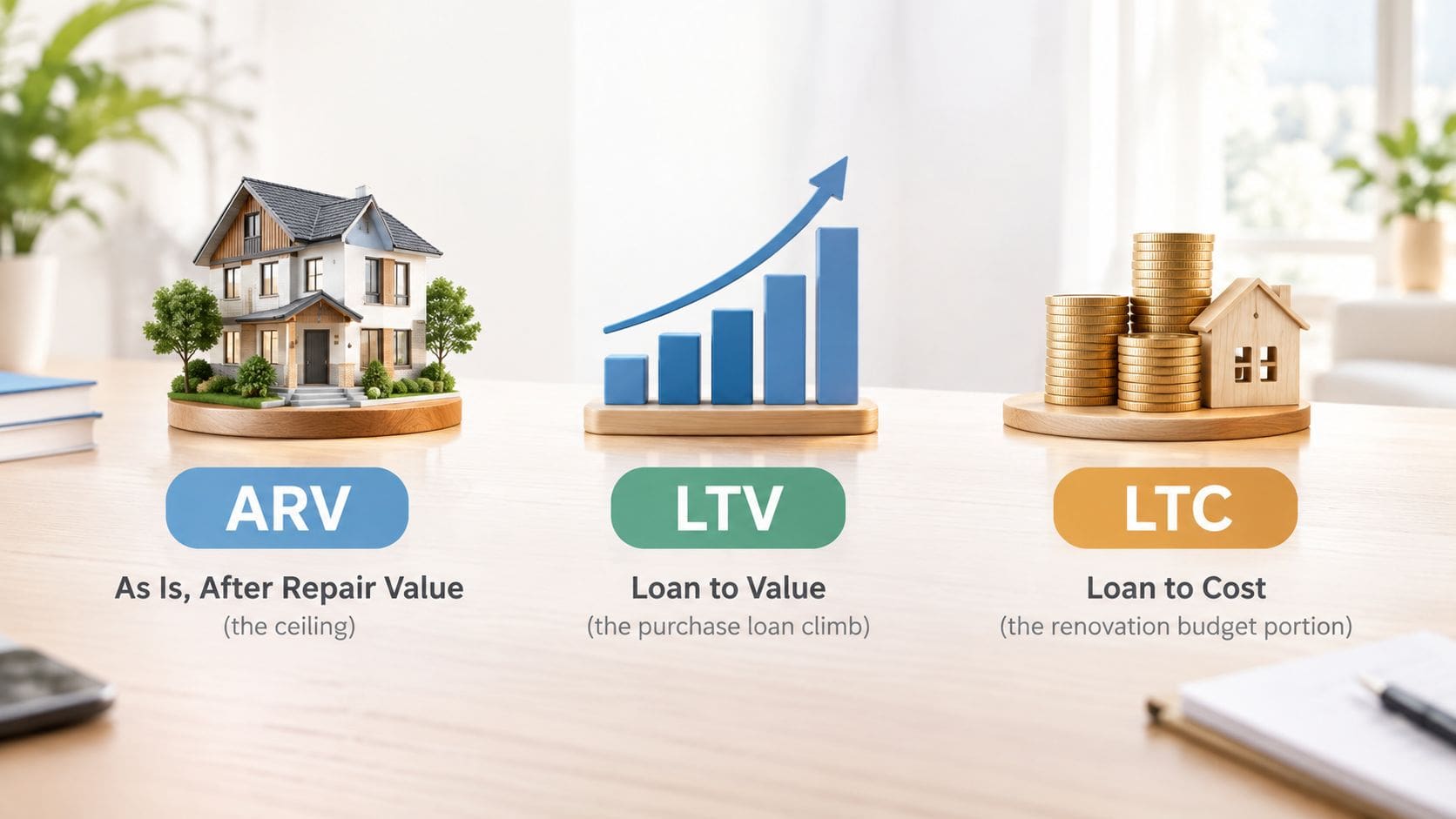
A practical real estate underwriting framework helps organize these tests before you submit a package.
What makes an approval stronger
A lender looks beyond the spreadsheet. The file usually rises or falls on execution risk.
- Experience: Completed flips demonstrate that you can estimate costs, manage trades, respond to surprises, and sell finished property.
- Liquidity: You need cash for required equity, closing expenses, interest, insurance, taxes, utilities, and any gap between paying a contractor and receiving a draw.
- Contractor capability: A low bid isn't useful if the contractor can't complete the work. Lenders want a credible scope, schedule, licensing where required, and evidence of completed projects.
- Budget realism: Line items should match the property's condition. Thin allowances for mechanical, structural, or permit work create immediate concern.
- Exit quality: A sale supported by credible comparable sales is easier to underwrite than a refinance dependent on unverified rent or an aggressive valuation.
In a tighter margin environment, lenders may apply more conservative ARV assumptions and reduce financing when comparable sales are thin. Cosmetic-only flips can create that problem because small finish differences may produce wide resale outcomes. The lender's job is to protect the collateral. Your job is to prove that the project survives a less flattering version of the appraisal.
Rates, Fees, Draws, and Timelines in Practice
The note rate is only one part of the cost. In 2026, published benchmarks place fix-and-flip rates roughly between 7.25% and 12.99%, with origination fees commonly between 1% and 3%. Current fix-and-flip rate benchmarks also emphasize that pricing, terms, and closing speed vary by lender, borrower experience, and ARV coverage.
A lender may quote an attractive rate but require more equity, charge higher points, or impose expensive draw and extension terms. Compare the complete capital structure, not the headline percentage.
The cost components
| Component | Typical 2026 Range |
|---|---|
| Interest rate | 7.25% to 12.99% |
| Origination fee | 1% to 3% |
| Rehab funding | Draw-based, subject to approved scope and ARV limits |
| Loan maturity | Short-term, commonly structured for the project timeline |
The rehab holdback usually remains controlled by the lender or closing agent. You complete a phase, submit the required documentation, and request an inspection. After the lender verifies the work, the draw is released. A clear explanation of how construction draws work can help you plan contractor cash flow before closing.
The most common operational mistake is treating approved rehab money as immediately available. It isn't. If your contractor requires payment before inspection, you need enough liquidity to bridge that timing. The construction draw schedule guidance is useful when mapping milestones to invoices and inspections.
Timeline and carrying risk
A fast closing can help you meet a contract deadline, but speed depends on a complete file, clean title, property review, appraisal or valuation work, and entity readiness. Delays often occur because the borrower submits a rough scope, changes the purchase structure late, or assumes the lender can solve an unresolved title issue.
The loan payoff arrives through a sale, refinance, or another approved exit. If construction finishes but the resale takes longer than planned, the extension provisions matter. Ask about extension pricing, whether unused rehab funds carry a fee, how inspections are billed, and whether the lender charges interest on undrawn funds.
Practical rule: Treat every unused dollar of loan availability and every extra month of maturity as a negotiated cost, not as free flexibility.
A Sample Deal Math for a 2026 Flip
Consider a project with a $180,000 purchase price, $50,000 rehab budget, and $300,000 ARV. The example uses a 70% LTC cap, a 75% ARV cap, an 11.5% interest rate, 2 origination points, and a 9-month hold. These are scenario inputs, not a promise of available terms.
The total project cost is $230,000. At 70% LTC, the maximum loan is $161,000. The ARV ceiling is $225,000 at 75% of $300,000, so LTC controls the structure. The borrower must cover the remaining project cost, plus financing and transaction expenses.
| Line Item | Amount |
|---|---|
| Purchase price | $180,000 |
| Rehab budget | $50,000 |
| Total project cost | $230,000 |
| Loan at 70% LTC | $161,000 |
| Borrower equity toward project cost | $69,000 |
| Origination fee at 2% | $3,220 |
| Nine months of interest at 11.5% on $161,000 | $13,858.75 |
| Illustrative taxes, insurance, and utilities | Not specified |
| Selling costs | Not specified |
| Projected sale price | $300,000 |
The known financing costs bring cash required before unspecified property and sale expenses to $86,078.75. The apparent gross spread between sale price and project cost is $70,000, but that spread is not the investor's profit. Interest and points alone reduce it to $52,921.25, before taxes, insurance, utilities, selling costs, repairs outside the scope, and any price reduction.
That's why a projected ARV isn't the same as a cash return. A slower sale can increase interest, while a resale discount reduces the proceeds available to retire the loan. The practical fix-and-flip profit calculator framework is useful for testing those variables rather than relying on a single optimistic sale price.
The breakeven sale price must include the loan payoff, project equity, financing charges, carrying costs, selling expenses, and any required reserves. Because several inputs in this illustration are unspecified, there isn't one honest breakeven figure without adding assumptions. Run the calculation with your actual tax bill, insurance quote, utility estimate, broker fee, transfer costs, and expected days on market.
Borrower Qualifications and Exit Strategies
A fix-and-flip lender evaluates the sponsor and the property together. A strong project can offset limited experience, but it won't eliminate the need for liquidity or competent execution. Likewise, an experienced investor can still lose approval when the ARV is unsupported or the renovation budget is incomplete.
What belongs in the borrower file
Expect the lender to review:
- Track record: A record of completed renovations and resales helps establish execution ability.
- Credit profile: Private lenders may be more flexible than banks, but credit history still reveals unpaid obligations, defaults, and financial behavior.
- Available liquidity: Cash must cover equity, closing expenses, carrying costs, and draw timing.
- Entity structure: The borrowing entity should be organized before closing, with ownership and signing authority documented.
- Project team: A credible general contractor, subcontractor plan, and permit approach reduce completion risk.
Credit requirements vary by program, so don't assume a particular score guarantees approval. Underwriters generally care more about the complete risk picture than one isolated metric.

The exit determines the repayment plan
A traditional resale is the cleanest exit. The lender expects a listing, a buyer, closing documents, and payoff from sale proceeds. Keep the expected listing condition and sales strategy consistent with the ARV used in underwriting.
A wholesale or assignment exit may require different lender approval and may not fit every loan structure. Don't assume you can transfer the contract or substitute a buyer without reviewing the loan documents.
A BRRRR-style refinance changes the analysis. If you plan to retain the property, the finished asset must support permanent debt under rental cash-flow criteria. The short-term loan needs to remain outstanding long enough for stabilization, appraisal, leasing, and refinance closing.
A backup exit isn't a second optimistic sale price. It's a separate repayment plan with its own valuation, documentation, and timing.
If the property will become a rental, prepare rent support and operating assumptions. If it will be sold, prepare a pricing strategy and comparable sales. The lender wants to know how principal gets repaid, not merely that the renovation can be completed.
Fix and Flip Loans Compared to Other Financing
The right financing depends on the property's condition and the time available before closing. A conventional bank loan may offer a lower cost but move too slowly or reject heavy renovation. A private project loan may close quickly but carry more expensive terms or require more equity.
| Product | Funding Speed | Max Leverage | Typical Rate | Best For |
|---|---|---|---|---|
| Fix-and-flip loan | Fast, subject to complete underwriting | Usually constrained by LTC and 65% to 75% ARV limits | Published 2026 benchmarks range from 7.25% to 12.99% | Purchase plus renovation with a defined exit |
| Conventional bank loan | Slower and documentation-heavy | Based on borrower, property, and program rules | Not specified | Stabilized property and long-term ownership |
| Bridge loan | Fast to moderate, depending on collateral and structure | Varies by asset and lender | Not specified | Short transition between acquisition and permanent financing |
| DSCR rental loan | Moderate, after the property supports rental underwriting | Based on property value and cash flow | Not specified | Long-term rental ownership or refinance |
| Generic hard money | Fast, with terms varying significantly | Often asset-focused | Not specified | Time-sensitive acquisitions where flexibility matters more than price |
Fix-and-flip debt sits between a bank mortgage and raw emergency capital. It is designed around a project, so the lender can evaluate the purchase, scope, ARV, draw schedule, and exit as one transaction. That makes it more suitable for an uninhabitable or heavily dated property than a standard rental loan.
The trade-off is that the debt is temporary and usually more expensive than permanent financing. If the renovation becomes a long hold, you may be paying short-term pricing for a property that no longer needs short-term capital.
A lender may also separate true bridge financing from rehab financing. Bridge debt can fund a transition or acquisition, while a fix-and-flip loan typically includes controlled renovation proceeds. Ask which risk the product is built to solve.
For homeowners and investors comparing renovation funding in a specific local market, general financing for Tyler remodels can provide useful context on how renovation costs and funding needs differ from an investor resale project. The distinction matters. A homeowner renovation loan and an asset-based flip loan may fund construction, but they serve different borrowers, collateral strategies, and exits.
Regional Considerations for GA, NC, SC, and TX Investors
A deal can underwrite well on paper and still become difficult in a local market. Distant comparable sales, thin buyer demand, slow permits, and expensive insurance can all reduce the lender's confidence and increase the time your capital remains tied up.
Recent market commentary identifies Texas and the Southeast as weak regions in a lending index. The overall fix-and-flip reading also declined from 63 in Q1 2026 to 59 in Q2 2026, while 21% of flippers sold below ARV estimates, compared with 17% in the prior quarter. The 2026 lending benchmark discussion highlights the underwriting issue: a valuation miss can consume a spread that looked adequate at acquisition.
How local underwriting changes
Georgia investors may find stronger comparable support in urban infill areas than in rural markets. Even within a metro, appraisers can disagree about finish quality, school zones, and the buyer group most likely to purchase the property.
North Carolina and South Carolina require close attention to absorption. Established employment centers, coastal areas, and smaller towns can produce very different resale timelines. A property that works in one submarket may need a larger contingency or lower purchase price in another.
Texas underwriting often separates liquid metro acquisitions from rural or edge-of-market collateral. The property type, nearby sales, and expected resale audience matter more than the state label.
Permits and contractor availability affect the project timeline. Structural, electrical, or mechanical work needs more coordination than a cosmetic renovation, and weather exposure or limited insurance availability can raise carrying costs in storm-prone areas.
Read the lender signal before making an offer
| State | Typical Maximum Loan-to-Value | Average Days on Market | ARV Confidence | Lender Appetite |
|---|---|---|---|---|
| Georgia | Deal-specific | Market-specific | Stronger with nearby closed comps | Varies by metro and property type |
| North Carolina | Deal-specific | Market-specific | Depends on absorption and comp depth | Selective by submarket |
| South Carolina | Deal-specific | Market-specific | Sensitive to location and buyer demand | Selective, especially for unusual assets |
| Texas | Deal-specific | Market-specific | More conservative outside liquid metros | Varies sharply between urban and rural deals |
These categories avoid invented state averages. Lenders price and size a loan around the parcel, neighborhood, product type, renovation scope, and exit plan.
Before making an offer, ask which comparable sales the lender would accept, whether the property type is common locally, how rural or edge-of-market collateral is treated, and what happens if the appraisal falls below your estimate. A direct answer can matter more than a headline rate, because it reveals how much valuation and execution risk the lender believes the project carries.
Practical Next Steps for Funding Your Next Flip
Start with a lender-ready package, not a sales pitch. The faster the underwriter can verify the property, scope, borrower, and exit, the faster you'll know whether the deal deserves a deposit.
Assemble the file before requesting terms
Prepare these items:
- Purchase contract: Include all amendments, assignment language, seller credits, and the required closing date.
- Rehab scope: Break the work into line items, identify contractor responsibility, and separate materials from labor where practical.
- ARV support: Provide three relevant closed comparable sales and explain adjustments for size, condition, layout, and finish.
- Entity documents: Have formation records, ownership details, and signing authority ready.
- Liquidity evidence: Show the cash available for equity, closing, carrying expenses, and contractor payments before draws.
- Exit plan: Identify the likely resale channel, listing strategy, or refinance path.
Ask every lender for the same information so you can compare offers accurately. Request the interest rate, origination points, underwriting and inspection charges, draw timing, interest calculation method, extension terms, prepayment language, and any minimum interest period.
Stress-test the deal before signing
Run the project with a delayed sale and a lower resale price. Then test a larger renovation bill, a slower draw, and a lender appraisal below your ARV. If the transaction only works under the most favorable assumptions, it doesn't work.
Watch for upfront fees before meaningful underwriting, unexplained rate spreads, vague draw rules, and promises that aren't reflected in the term sheet. Get the complete cost structure in writing.

A disciplined sequence is simple: obtain parallel quotes, verify ARV with conservative sales, model delayed exits, confirm contractor capacity, and secure a listing or refinance plan before closing. Sims Ventures offers asset-based fix-and-flip financing, purchase-plus-rehab structures, draw-based funding, and advisory support for investors in Georgia, North Carolina, South Carolina, and Texas. Visit Sims Ventures to review financing options and discuss whether your next project fits a short-term acquisition and renovation structure.
