

Loan for Airbnb: Financing Short-Term Rentals in 2026
You've got a duplex under contract in Asheville or Galveston. Your W-2 income is acceptable, your down payment is ready, and the property looks excellent as a nightly rental. Then the appraisal comes back with projected short-term-rental revenue, and the refinance processor asks for a 12-month lease. You don't have one because the property was never intended to operate as a conventional rental.
That's where many investors discover that a loan for Airbnb isn't a regular investment mortgage with a different revenue line. Short-term-rental income is seasonal, platform-based, and often supported by projections rather than a signed lease. The financing strategy has to match the operating model from the first offer through the eventual refinance.
Why Airbnb Financing Feels Different From a Regular Rental Loan
The conventional mortgage problem
A conventional lender is built to document stable borrower income and predictable property income. The file typically revolves around personal tax returns, employment income, debt-to-income calculations, and a long-term lease or market rent estimate. An Airbnb produces something else entirely, with nightly bookings, changing occupancy, platform fees, seasonal demand, and operating costs that don't appear in a standard lease package.
Suppose the appraisal supports projected short-term-rental revenue of $48,000 annually. That number may be useful to a lender with a dedicated STR program, but it won't automatically fit a conventional rental-income worksheet. If the property has no qualifying lease and the revenue hasn't been reported in the format the conventional lender expects, the processor may exclude the income completely.
That creates an immediate mismatch. The property may support its own debt as a vacation rental, while the mortgage application is evaluated as if the property were a long-term rental with fixed monthly rent.
Lender's view: The question isn't whether guests are willing to pay nightly rates. The question is whether the lender's approved underwriting system can recognize and document those rates.
Why misclassification causes trouble
Listing an Airbnb as a standard rental on a refinance application can create more than a paperwork delay. If the appraisal identifies the property as a short-term rental, but the application presents it as a long-term lease investment, the lender may request revised documentation, reject the projected income, or send the file into a different review channel.
The issue isn't that conventional loans can never finance investment properties. They can be effective for borrowers with clean tax returns, documented rental history, and an income profile that fits the program. The problem is that those products weren't designed around irregular nightly revenue.
That's why STR financing is its own product category. DSCR lenders use property cash flow, while bridge and private lenders focus more heavily on collateral, execution, and the plan to stabilize the asset. The right lane depends on whether you're buying an already-performing rental, renovating a property, or converting a new acquisition into a compliant short-term rental.
How DSCR Lending Works for Short-Term Rentals
DSCR means debt service coverage ratio. In plain English, it measures whether the property generates enough qualifying income to pay its monthly housing obligation. A common structure divides monthly gross rental income by monthly PITIA, which includes principal, interest, taxes, insurance, and applicable association dues.
Take one property generating $7,500 per month in gross rental revenue with $5,250 in monthly PITIA:
$7,500 ÷ $5,250 = 1.43 DSCR
A 1.43 ratio means the qualifying income covers the payment and leaves a meaningful cushion before additional operating expenses and unexpected volatility. The ratio matters more than the borrower's salary in a true property-based program.
The income test
A short-term-rental DSCR program may use 12 months of rental history or conservative market projections for a new listing, as described in this DSCR underwriting guide. One underwriting method calculates STR DSCR by multiplying monthly gross rent by 80%, reflecting operating costs, then dividing the result by PITIA. That same guide identifies a 1.25 minimum DSCR for its short-term-rental programs and a 60% maximum LTV when STR income is used for qualification.
Program standards vary, but current market practice commonly places minimum STR DSCR requirements between 1.0 and 1.25, meaning the property must produce at least the full debt payment, and sometimes a 25% surplus, from rental income alone. The practical range is summarized in this current Airbnb DSCR market overview.
For a new acquisition, the lender may review comparable nightly rates, occupancy assumptions, property type, location, and seasonality. For an operating property, the lender usually wants platform statements or other booking records that show how revenue behaves month by month.
Why borrowers choose DSCR
Conventional underwriting waits for personal income documentation, tax returns, and an acceptable debt-to-income profile. A full-documentation STR loan may use a longer history of booking statements instead of relying on projections. DSCR changes the center of gravity. The property qualifies based on its cash flow, while the borrower still faces credit, liquidity, entity, and collateral review.
That structure can fit self-employed investors, foreign nationals who meet program requirements, and owners whose tax returns show heavy depreciation. It can also help investors separate property performance from salary income when they're building a portfolio.
Before requesting terms, run the property through a DSCR loan calculator using conservative revenue and the full PITIA payment. DSCR is the closest thing to an asset-based mortgage for nightly rentals, but it isn't a free pass. If the property's supportable income doesn't cover the debt, the lender won't solve the problem with optimism.
Comparing DSCR, Hard Money, Bridge, and Conventional Loans
The right loan depends on the property's condition, the closing deadline, and when the asset should produce stable income. A low advertised rate does not help if the lender cannot close the deal.
| Loan Type | Typical LTV | Close Time | Rate Band | Best Use Case |
|---|---|---|---|---|
| DSCR | Program-specific, with STR limits varying by lender | Moderate | Pricing varies by leverage, credit, property, and DSCR | Stabilized or supportable STR acquisitions and refinances |
| Bridge | Deal-specific | Fast | Higher than permanent debt | Purchase, renovation, permits, and operational ramp-up |
| Hard money | Usually lower than permanent financing | Fastest lane | Highest-cost category | Distressed assets, urgent closings, and limited documentation |
| Conventional | Program-specific | Slowest lane | Usually the lowest-cost category | Borrowers with strong personal income and acceptable rental documentation |
DSCR for stabilized cash flow
DSCR is the appropriate permanent-debt option when an Airbnb already operates legally, the appraisal supports the rental model, and adjusted income covers the payment. Qualification centers on the property's cash flow rather than a traditional salary-based model, although credit, liquidity, entity, and collateral requirements still apply.
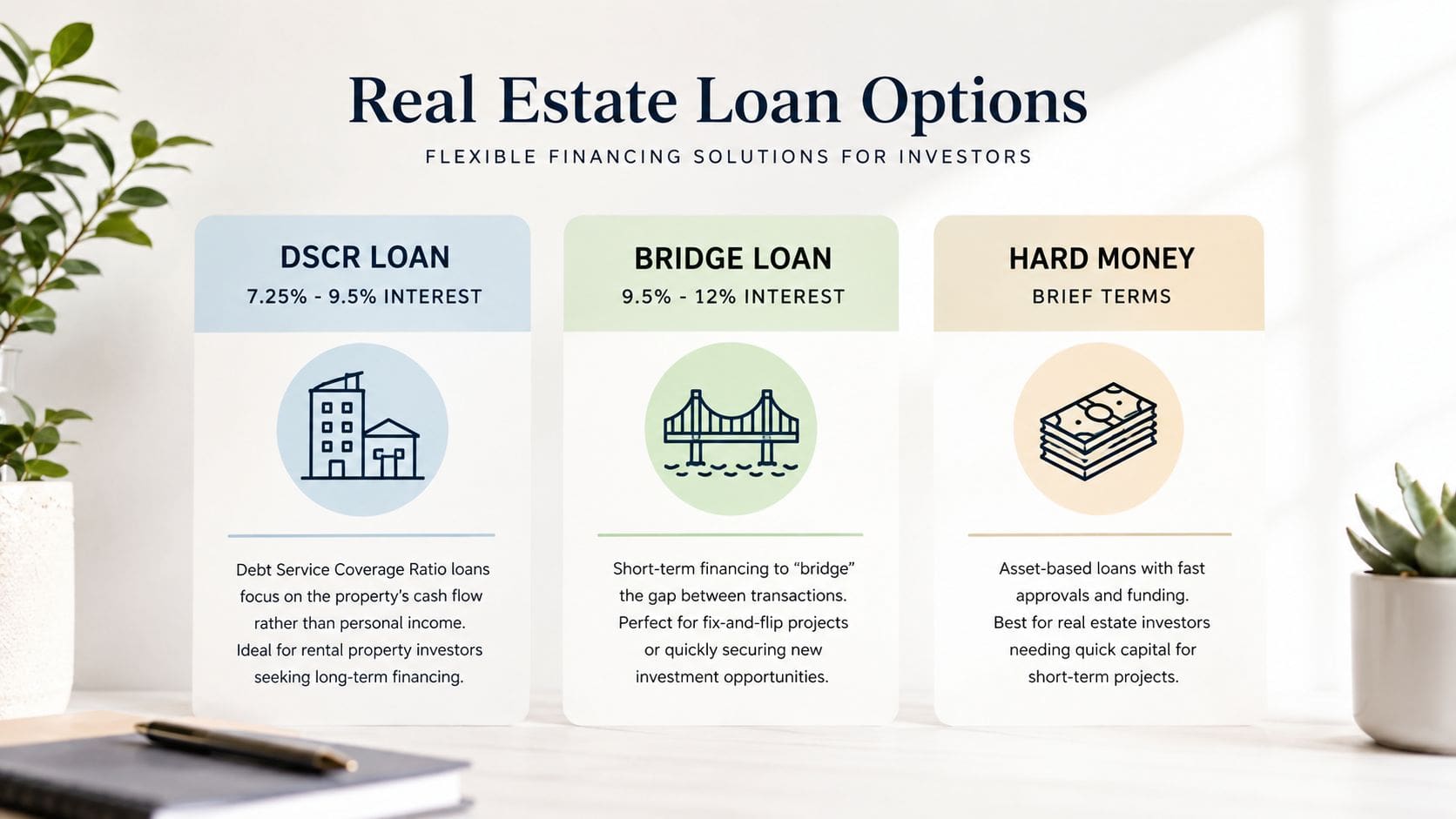
Market guides for 2026 report Airbnb DSCR pricing in the 7.75% to 9.25% range, common 1.0x to 1.25-plus DSCR requirements, stronger tiers reaching 75% to 80% LTV, and a 0.25% to 0.75% premium over long-term rental DSCR debt. Those ranges are summarized in this Airbnb DSCR financing guide.
Use DSCR after the property is ready for underwriting. It is usually a poor first loan for a house that still needs substantial repairs, furnishings, permits, or operating history.
Bridge and hard money for execution
Bridge financing fits a transition. You purchase the property, complete renovations, obtain permits, furnish it, launch the nightly-rental operation, and build enough performance history for a refinance. The lender evaluates collateral, the execution plan, and the expected exit rather than relying only on current booking revenue.
Hard money offers the most flexibility and carries the highest cost. It can fit a distressed asset, an urgent seller deadline, or a borrower who cannot yet document operating performance. Treat it as short-term financing, not a permanent solution. Identify the refinance or sale exit before closing.
For a purchase that requires speed or improvements, review this guide to a bridge loan for investment property before selecting permanent debt.
Conventional for a narrow borrower profile
Conventional financing works when the file fits program rules cleanly. The borrower needs acceptable personal income documentation, the rental income must qualify under the program, and the property must meet requirements for type, insurance, and occupancy.
Projected nightly income, LLC ownership, rural locations, and non-warrantable condominiums can make conventional financing difficult or unavailable. A lower rate does not compensate for a loan that cannot close.
The practical sequence is straightforward: use bridge or hard money to acquire and improve a property that is not yet financeable, then refinance into DSCR debt once the operation and documentation support the payment. Use conventional financing only when the borrower and property already satisfy its stricter rules.
What Lenders Underwrite on an Airbnb
A lender will not approve an Airbnb loan because the calendar shows strong peak-season bookings. The file must support qualifying income, collateral value, available liquidity, legal operation, and a credible ability to keep paying through weaker months.
The five levers in the file
DSCR comes first. Lenders compare qualifying short-term-rental revenue with PITIA, often looking for a minimum between 1.0 and 1.25, based on the program and risk profile. The income may come from platform history or a market projection, but the assumptions must withstand review.
Revenue must be normalized. Underwriting examines average daily rate, occupancy, unit type, bedroom count, location, and monthly seasonality. A sound review compares the property with the top five to ten comparable properties, applies an occupancy haircut such as 85% of the median, and checks whether the borrower can maintain six months of debt service in reserves, as described in this short-term-rental underwriting playbook.
Control loss exposure. STR DSCR programs commonly use 70% to 80% LTV as a broad market range, while some reduce proceeds when STR income supports qualification. The appraisal must support both the real estate and the rental model. Long-term rental comparables alone may miss the value and risks of a legally operating nightly rental.
Reserves cover the low season. Peak demand can make a property look profitable while weak booking months strain cash flow. Some programs require three months of reserves when DSCR is at least 1.0, and six months when DSCR falls below 1.0, according to the earlier underwriting reference.
Borrower and property risk still matter. Credit, entity formation, insurance, local permits, HOA rules, prior experience, and property condition can change the approval even when the DSCR calculation passes.
| Variable | Lender Threshold | Example Deal A, GA Cabin | Example Deal B, TX Duplex |
|---|---|---|---|
| DSCR | Commonly 1.0 to 1.25 minimum | Must withstand seasonal demand | Must support both units under conservative assumptions |
| LTV | Often 70% to 80%, program-dependent | Lower leverage may protect against mountain seasonality | Valuation and insurance can control proceeds |
| Income support | History or conservative projections | Comparable cabins and monthly demand pattern | Duplex-specific STR comparables and actual booking records |
| Reserves | Program-dependent, often several months of PITIA | Liquidity must cover slower periods | Liquidity must cover both units and operating interruptions |
Before applying, test the operating plan, expense load, and exit assumptions. Borrowers can see how Global can boost your rental to improve revenue management and guest operations, but the lender will qualify the deal under its approved methodology. Use this real estate underwriting framework to organize rent, expenses, reserves, and the refinance case before submitting the file.
A Real Pathway From Purchase to Long-Term Refinance
A successful Airbnb financing plan usually has an order. Investors get into trouble when they use permanent debt before the property is ready, or when they close a short-term loan without a credible refinance exit.
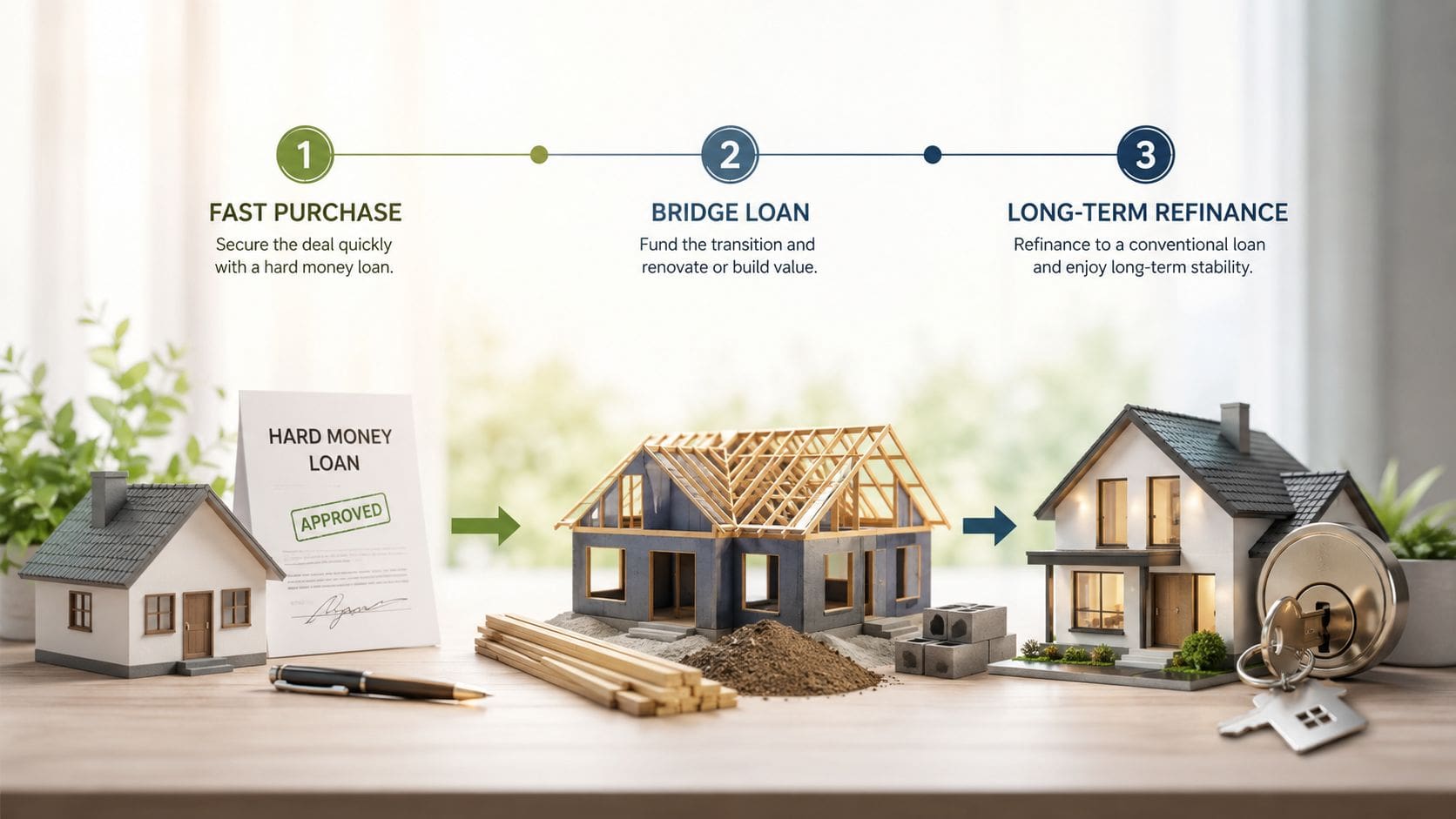
Phase one closes the purchase
A buyer in Asheville, Charleston, or the Texas Hill Country may need to close before a conventional lender can evaluate operating history. Hard money or transactional funding can provide the speed required for a competitive offer, especially when the property needs work or the seller values certainty.
At this stage, the lender wants the purchase contract, title path, valuation, scope of work, borrower liquidity, and exit strategy. Don't present a nightly-rental projection as if it were guaranteed revenue. Present the assumptions, the comparable properties, the permits, and the capital available to complete the plan.
Phase two creates the operating history
A bridge loan can carry the property through renovation, furnishing, permit work, and the initial ramp-up. Interest-only payments and renovation holdbacks can preserve cash while contractors complete the work, but the borrower must monitor the calendar closely.
Permits can take longer than expected. A neighbor complaint can delay launch. A low-demand season can produce fewer bookings than the original projection. Those delays don't just affect revenue. They consume the bridge term and increase the amount of time before the permanent loan can close.
A current market analysis for STR owners can help organize demand assumptions, operating costs, and the launch plan before you commit to the bridge timeline.
Phase three refinances the asset
Once the property has a documented operating record and supportable DSCR, refinance into long-term DSCR debt. Some lenders accept projected income for new listings, while others want a defined rental history. Plan the refinance around the stricter standard, not the most optimistic term sheet.
The trade-off is straightforward. You pay more for flexible acquisition and stabilization capital, then seek lower-cost permanent debt after the property earns lender confidence. The strategy works only when the total project cost, stabilized value, expected cash flow, and refinance proceeds all support one another.
Eligibility and Documentation Checklist for STR Borrowers
A clean file closes faster because the lender can spend time underwriting the deal instead of chasing missing documents. Prepare the package before requesting a term sheet.
Borrower and entity file
- Entity records: Keep the LLC or corporation in good standing, with an EIN and signed operating agreement.
- Ownership details: Provide government identification, entity ownership information, and any personal guaranty documents the program requires.
- Experience summary: Include a short real estate biography if you want the lender to consider your operating background when reviewing pricing.
- Financial profile: Prepare personal and business tax returns when requested, or ask whether a bank-statement alternative is available for the program.
For properties in Georgia, North Carolina, South Carolina, and Texas, verify whether the lender requires a U.S.-domiciled borrowing entity. Entity-friendly financing doesn't eliminate compliance requirements.
Property and operating file
- Contract and title: Submit the purchase contract, settlement details, and ownership structure early.
- Insurance: Obtain coverage that expressly permits short-term-rental use and satisfies the lender's liability requirements.
- Valuation: Order an appraisal that includes relevant short-term-rental comparables, not only long-term rent.
- Legal operation: Document permits, zoning compliance, local registration, and any required tax accounts.
- Association approval: Review HOA or condominium restrictions before spending money on appraisal and inspections.
- Revenue history: Provide monthly platform statements, booking records, and operating-account activity when refinancing an existing Airbnb.
Before pre-approval, clean up unexplained deposits, recent credit issues, inconsistent entity names, missing insurance endorsements, and optimistic revenue projections. A lender can work with an imperfect borrower. It can't underwrite information that changes from one document to the next.

Costs, Timelines, and What to Do Next
The financing cost should be judged against the project timeline and exit, not the interest rate in isolation. A cheaper loan that misses the purchase deadline can cost more than a higher-cost loan that closes, completes the work, and reaches a permanent refinance.
For 2026 market guidance, DSCR Airbnb loans are commonly described in the 7.75% to 9.25% range, while the actual quote depends on DSCR, LTV, credit, property type, reserves, and location. The cited market guide also identifies common STR structures around 1.0x to 1.25-plus DSCR, stronger tiers reaching 75% to 80% LTV, and a modest premium over long-term rental DSCR debt. Treat those figures as a starting framework, not a commitment.
| Financing stage | Main cost consideration | Timing priority | Use it when |
|---|---|---|---|
| DSCR purchase or refinance | Pricing and leverage are tied to property cash flow | Allow enough time for appraisal, title, and underwriting | The asset is ready for permanent debt |
| Bridge | Interest-only cost, points, extension risk, and holdback structure | Protect the renovation and permit schedule | The property needs stabilization |
| Hard money | Highest flexibility usually comes with highest cost | Close quickly and define the exit first | The deal is distressed, urgent, or difficult to document |
| Conventional | Lower-cost structure if the file qualifies | Expect more documentation and process constraints | Personal income and rental documentation fit cleanly |
Before you apply, confirm that the county, property type, insurance structure, and STR use are eligible. Pull monthly revenue and expense data from your operating records and build a conservative forecast. A rental cash flow tool from RealtyAPI.io can help organize the initial income, expense, debt, and cash-flow assumptions before a lender reviews the file.
Investors in Georgia, North Carolina, South Carolina, and Texas should also have the LLC operating agreement ready, verify local short-term-rental rules, and identify lenders that will consider rural properties or non-warrantable condominiums. Then compare total project cost against stabilized value and cash flow. Rate matters, but yield, time to stabilization, refinance proceeds, and reserve capacity decide whether the deal survives.
Common Questions About Loans for Airbnb Properties
What rates apply to STR DSCR loans?
Pricing varies by financing method, debt-service coverage ratio, credit, property type, reserves, and market risk. Treat any quoted range as a starting point, not a promise. The lender's final terms depend on the property's cash flow, valuation, insurance, and exit plan.
Can I refinance an existing Airbnb?
Yes, if the property is operating legally and the income can be documented. A lender will review monthly platform revenue, operating expenses, appraisal, insurance, permits, and debt-service coverage. A longer operating record strengthens the refinance file. For a newly launched property, conservative projections may receive more scrutiny.
What kills an application?
Low qualifying DSCR, thin reserves, unacceptable insurance, missing permits, HOA restrictions, and an appraisal unsupported by short-term-rental comparables can stop a deal. Verify legal use and insurance before ordering the appraisal. Confirm the property can operate as presented before underwriting begins.
Are 30-year fixed DSCR terms available?
Many lenders offer 30-year fixed DSCR structures. Compare the payment with adjustable-rate options, then review prepayment terms, reserves, and refinance flexibility. The lowest initial payment is not automatically the best loan for an Airbnb whose revenue changes by season.
Can a non-warrantable condominium qualify?
Some DSCR lenders will consider one. The review usually includes the condominium project, association documents, insurance, rental rules, property condition, and cash flow. Conventional financing generally applies tighter project standards, so confirm eligibility before making the loan structure part of your offer.
How much Airbnb income must be documented?
Requirements depend on the program and the property's history. New listings may be evaluated with conservative projections and market evidence. Refinance files usually rely on monthly operating records, expenses, and an established revenue pattern. Keep statements, tax records, booking history, and a clear expense schedule ready.
For a purchase, bridge loan, or DSCR refinance in Georgia, North Carolina, South Carolina, or Texas, Sims Ventures provides asset-based financing based on property cash flow and project execution. Send the contract, revenue assumptions, renovation budget, and exit plan early. A lender can then identify documentation gaps before they compress the closing timeline.
