

Why Optimize Funding Sources for Real Estate Success
Finding the best way to structure real estate funding can make or break your next urban development project. With a mix of loan types, equity investments, and government-backed programs available in the American market, understanding how each option fits your needs is essential for building long-term profitability. This article will break down funding optimization to show how combining financial sources can reduce risk and strengthen your strategy for growth.
What Does Funding Optimization Mean?
Funding optimization represents a strategic approach to maximizing financial resources and potential returns in real estate investment. At its core, this concept goes far beyond simply securing capital – it’s about intelligently structuring and leveraging multiple funding sources to enhance project success and minimize financial risks.
In the context of real estate, funding optimization involves several critical components:
- Analyzing diverse funding streams
- Matching capital sources to specific project requirements
- Minimizing overall financing costs
- Balancing risk and potential returns
- Creating flexible financial structures
Professional investors recognize that comprehensive funding analysis requires understanding the complex dynamics of different financial instruments. This means looking beyond traditional bank loans and exploring alternative financing options like private equity, crowdfunding, syndication, and specialized real estate investment platforms.
The goal isn’t just acquiring funds, but strategically positioning capital to maximize project potential. This approach requires deep financial intelligence, understanding market conditions, and creating adaptive funding strategies that can pivot with changing economic landscapes.
Funding optimization transforms capital from a mere resource into a strategic competitive advantage.
By examining funding sources holistically, real estate investors can create more resilient and adaptable financial frameworks that support long-term growth and minimize potential financial constraints.
Pro tip: Always conduct a comprehensive financial assessment before selecting funding sources to ensure alignment with your specific investment objectives and risk tolerance.
Types of Real Estate Funding Sources
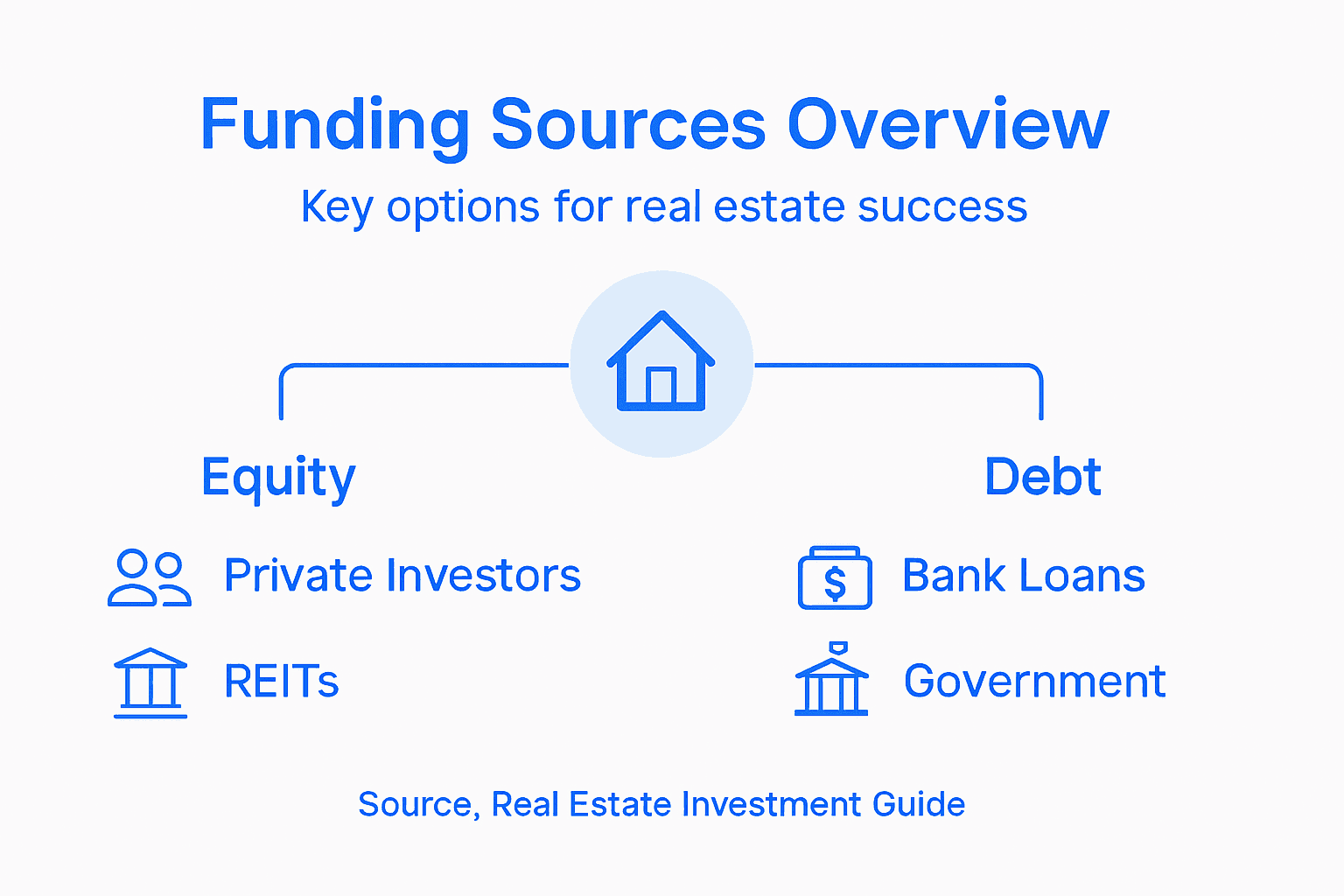
Real estate investors have access to a diverse range of funding sources, each with unique characteristics and strategic implications. Understanding these options is crucial for creating a robust financial strategy that aligns with project goals and risk tolerance.
The primary categories of real estate funding sources include:
- Equity Investments
- Direct property ownership
- Real estate investment trusts (REITs)
- Private equity partnerships
- Crowdfunding platforms
- Debt Financing
- Traditional bank mortgages
- Commercial loans
- Hard money loans
- Private lender financing
- Government-Backed Funding
- Specialized government loan programs for specific development projects
- Grants for community development
- Low-interest rural development loans
Equity Investments provide direct ownership and potential appreciation, allowing investors to participate directly in property value growth. These options typically offer more control but also come with higher risk and potential market volatility.
Debt Financing remains a cornerstone of real estate funding, offering structured repayment plans and leveraging opportunities. Real estate investment strategies often incorporate multiple debt instruments to balance risk and maximize financial flexibility.
Strategic funding diversification can transform potential limitations into competitive advantages.
Government-backed programs provide unique opportunities, especially for developments in specific regions or serving community needs. These funding sources often come with favorable terms and can be critical for projects that might struggle to secure traditional financing.
Here is a comparison of real estate funding sources and their typical investor profiles:
| Funding Source Type | Typical Investor Profile | Main Goal |
|---|---|---|
| Equity Investments | Long-term growth seekers | Capital appreciation |
| Debt Financing | Income-focused investors | Stable cash flow |
| Government-Backed Funds | Community-oriented investors | Lower borrowing costs |
This overview helps clarify which funding options best fit different investor objectives.
Pro tip: Always conduct a comprehensive analysis of each funding source’s terms, interest rates, and long-term implications before making a final selection.
Benefits of Funding Source Diversification
Real estate investors who strategically diversify their funding sources create a robust financial framework that enhances project resilience and long-term success. Diversification strategies provide critical protection against market volatility and economic uncertainties.
The key benefits of funding source diversification include:
- Risk Mitigation
- Reduced vulnerability to single funding stream failures
- Increased financial stability
- Protection against market fluctuations
- Financial Flexibility
- Multiple capital access points
- Ability to leverage different financing terms
- Faster project funding capabilities
- Strategic Opportunities
- Enhanced negotiation power
- Broader investment potential
- Improved project scalability
By spreading financial resources across multiple funding channels, investors can minimize operational disruptions and create more resilient investment portfolios. This approach allows for strategic pivoting when specific funding sources become less attractive or unavailable.
Funding diversity transforms financial constraints into strategic advantages.
Diversification is not just about having multiple funding sources, but about creating a sophisticated, adaptive financial ecosystem. Each funding stream brings unique advantages, from the stability of traditional bank loans to the flexibility of private equity and the targeted support of government programs.

The table below highlights how diversification impacts different aspects of real estate investing:
| Aspect | With Diversification | Without Diversification |
|---|---|---|
| Risk | Spread across sources | Higher vulnerability |
| Financial Adaptability | Greater flexibility | Limited response options |
| Long-Term Growth | More sustainable potential | Susceptible to disruptions |
This summary underscores the strategic value of having multiple funding sources.
Pro tip: Regularly reassess and rebalance your funding portfolio to maintain optimal financial flexibility and risk management.
Risks of Poor Funding Structure Choices
Real estate investors face significant challenges when they fail to strategically structure their funding sources. Oversimplified funding approaches can create substantial financial vulnerabilities that compromise project success and long-term investment performance.
The most critical risks of poor funding structure choices include:
- Financial Inflexibility
- Limited ability to adapt to market changes
- Reduced capital access during challenging periods
- Higher vulnerability to economic shifts
- Operational Constraints
- Increased project funding delays
- Higher borrowing costs
- Reduced negotiation power with lenders
- Strategic Limitations
- Narrowed investment opportunities
- Decreased innovation potential
- Restricted project scalability
Ineffective funding structures can trap investors in restrictive financial cycles that erode project potential and diminish overall investment returns. These limitations often stem from a lack of comprehensive financial planning and an inability to leverage diverse funding mechanisms.
Poor funding choices don’t just limit projects—they can completely derail investment strategies.
Real estate investors must recognize that funding is not a static element but a dynamic component of their investment ecosystem. Rigidly structured funding approaches can create bottlenecks that prevent rapid adaptation to market opportunities and emerging investment landscapes.
Pro tip: Conduct quarterly reviews of your funding structure to identify potential constraints and proactively develop more flexible financial strategies.
Common Mistakes in Funding Optimization
Real estate investors often sabotage their financial strategies by making critical errors in funding approach. Narrow funding perspectives can dramatically undermine investment potential and limit project success.
The most prevalent mistakes in funding optimization include:
- Oversimplification
- Relying on single funding sources
- Ignoring complex funding interactions
- Failing to understand market dynamics
- Strategic Blindspots
- Neglecting alternative financing options
- Underestimating funding source compatibility
- Overlooking long-term financial implications
- Operational Inefficiencies
- Accepting unrealistic cost limitations
- Mismanaging administrative funding requirements
- Inadequate financial planning and forecasting
Ineffective funding approaches can create significant operational constraints that prevent investors from maximizing their real estate investment potential. These mistakes often stem from a lack of comprehensive financial understanding and strategic planning.
Funding optimization is not about finding money—it’s about creating a sophisticated financial ecosystem.
Successful real estate investors recognize that funding is a complex, dynamic process requiring continuous adaptation and strategic thinking. By understanding and avoiding these common mistakes, investors can develop more robust and flexible funding structures that support long-term growth and project success.
Pro tip: Develop a comprehensive funding strategy that includes multiple sources and periodic reassessment of your financial approach.
Unlock Strategic Funding Solutions for Real Estate Success
Navigating the complexities of funding optimization requires more than just access to capital. As highlighted in the article, real estate investors face challenges such as financial inflexibility, operational constraints, and the need for diversified funding sources to mitigate risks and maximize returns. At Sims Ventures, we understand that structuring deal and capital financing is critical to building a resilient investment portfolio. Our expert advisory and specialized financing empower you to move beyond single-stream funding toward a sophisticated, adaptive financial strategy.
If you are seeking to transform your investment process and maximize your profits, explore our Real Estate Investment: Maximize Your Profits solutions. Take advantage of smart funding source diversification and comprehensive capital structuring supported by our partnership approach. Don’t let poor funding choices limit your project potential. Visit Sims Ventures today to partner with a team committed to your stable growth and long-term success.
Ready to optimize your funding strategy? Discover actionable insights and bespoke financial solutions designed specifically for the real estate market at Sims Ventures. Your next deal deserves more than just capital—it deserves a strategic advantage.
Frequently Asked Questions
What is funding optimization in real estate?
Funding optimization in real estate refers to strategically structuring and leveraging multiple funding sources to maximize financial resources, enhance project success, and minimize risks.
Why is diversifying funding sources important for real estate investors?
Diversifying funding sources helps mitigate risks, increases financial flexibility, and provides strategic opportunities for better negotiation power and project scalability.
What types of funding sources are available for real estate investments?
Real estate funding sources include equity investments, debt financing, and government-backed funding programs, each having unique characteristics and implications for investors.
What are the common mistakes to avoid in funding optimization?
Common mistakes include oversimplifying funding approaches, neglecting alternative financing options, and failing to conduct thorough financial planning, which can jeopardize investment potential.
Recommended
- Savvy Investors Close Deals with New Approaches 2026
- Building Your Portfolio in a Challenging Market 2026
- The Ultimate Competitive Advantage for Real Estate Investors 2026
- Ways to Build Wealth for Financial Independence 2026
- Financing Options for Investors: Building Wealth in Real Estate | Bold Street AI
