

Non QM Investor Loans: A 2026 Guide
Non-QM loans reached 8.0% of total U.S. mortgage rate-lock volume in July 2025, up from 5.21% a year earlier, while investor and DSCR loans represented 28.7% of non-QM volume in that month, according to National Mortgage Professional's coverage of Optimal Blue data. That shift matters because investor financing is no longer a side channel used only when conventional underwriting fails. It's becoming a central part of how rental properties are acquired, improved, stabilized, and refinanced.
The practical question isn't whether a DSCR loan is available. It's which loan belongs at each stage of the deal, what the lender needs to see before funding, and whether the eventual rental income can support the permanent debt. In active investment markets across the Southeast, the strongest execution usually starts with a bridge or asset-based acquisition loan, then moves into DSCR financing once the property has finished construction, repairs, leasing, and rent stabilization.
Why Non-QM Investor Loans Matter in 2026
Non-QM financing exceeded 10% of total mortgage rate-lock volume in July 2026, and investor and DSCR loans represented 33.5% of non-QM production. Those figures show that rental-property financing has become a developed lending channel, with more lenders experienced in evaluating income-producing assets. They do not make non-QM debt the right choice for every borrower.
For an investor closing this quarter, market growth means more specialized execution, not automatically cheaper financing. A lender that regularly underwrites rentals knows how to review leases, market rents, property taxes, insurance, association dues, vacancy assumptions, and the difference between a credible stabilization plan and an optimistic spreadsheet. That experience can matter when tax returns understate cash flow or the property must be assessed as a business rather than as a household expense.
Conventional financing remains effective for borrowers with straightforward personal income and properties that fit standardized guidelines. It becomes harder to use when an investor owns several entities, reports substantial depreciation, earns variable business income, or has a portfolio that no longer fits a simple personal-income analysis. A non-QM lender can review property cash flow, liquid assets, deposits, collateral, and the borrower's execution history as parts of one credit decision.
The value of this channel is most apparent during the handoff from acquisition to stabilization.
A value-add purchase may need short-term bridge capital before the property produces reliable rent. That bridge loan can fund the acquisition and repairs while the borrower completes construction, leasing, and other work required for stabilization. A DSCR refinance may become workable only after those steps are finished and the appraiser can support the property's rental income. Choosing both loans as one sequence helps prevent a financing gap between purchase and permanent debt.
The S&P Global discussion of investor-property DSCR loans describes the structural distinction. DSCR investor loans are generally underwritten to property cash flow rather than borrower income and are generally exempt from QM and ability-to-repay rules because they are secured by investment properties. That flexibility expands access, while making rent support, payment terms, reserves, and property condition central to approval.
The trade-off is clear. Non-QM can solve an income-documentation or timing problem, but the borrower must price the bridge period, refinance risk, reserves, and permanent loan terms before closing the acquisition.
How Non-QM Differs from Conventional QM Loans
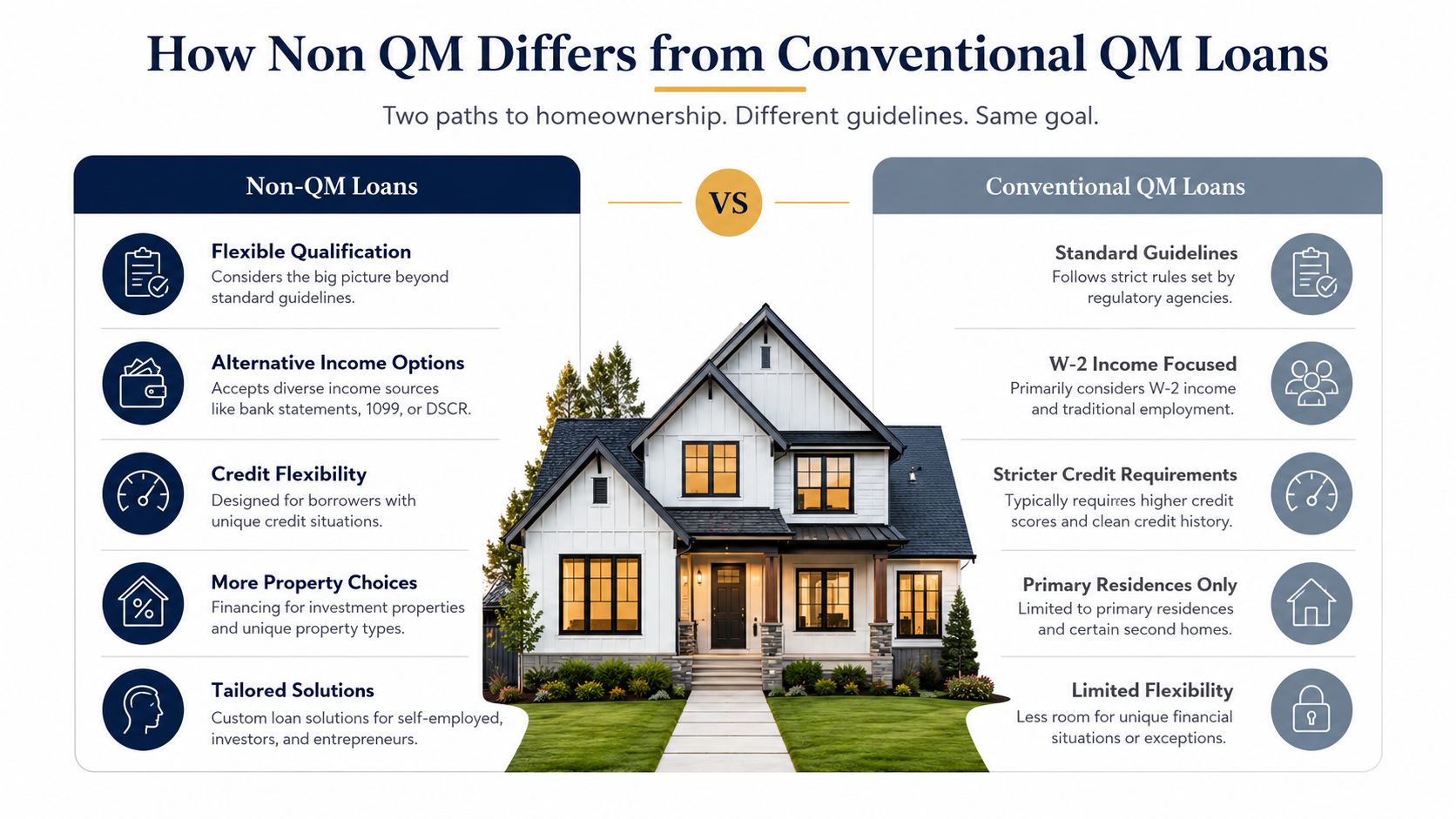
A qualified mortgage is like ordering from a fixed menu. The ingredients, portion sizes, and preparation rules are standardized, so a loan that fits the menu can move through a predictable process. A non-QM loan is closer to a custom order. The lender still checks every ingredient, but may assess deposits, assets, rental income, and the property's performance instead of relying only on standard employment income and tax returns.
The distinction doesn't mean non-QM underwriting is casual. It means the lender uses a different evidence set. A borrower may qualify through bank statements, asset depletion, DSCR, or full documentation using non-traditional income, depending on the property, entity structure, credit profile, and loan purpose.
What changes on the term sheet
Conventional pricing typically centers on standardized borrower and property factors. Non-QM investor pricing usually gives more weight to loan-to-value, credit score, DSCR band, property type, reserves, and prepayment structure. Debt-to-income may be less central or may not apply in the same way for a DSCR transaction.
The flexibility has a cost. Non-QM investor loans commonly carry higher rates than agency financing, and the spread depends on the risk profile rather than on the product label alone. A lower loan-to-value position, stronger credit, and healthier DSCR can improve execution. A tight ratio, unusual property, weak rent documentation, or limited reserves can move pricing in the opposite direction.
Reserve requirements also deserve attention. Depending on the program and risk profile, lenders may require three to twelve months of PITIA. That money isn't merely a formality. It demonstrates that the borrower can absorb vacancy, repairs, insurance changes, or a delayed lease-up without immediately depending on the property's next rent payment.
The prepayment decision
Read the prepayment clause before comparing rates. Non-QM investor loans may use yield maintenance, a declining penalty, or a step-down structure. A lower note rate can be a poor trade if the investor expects to sell or refinance shortly after stabilization and the penalty makes the planned exit expensive.
Practical rule: Compare the full capital stack, including points, reserves, extension terms, and prepayment costs. The lowest quoted rate isn't necessarily the lowest-cost loan for the deal you actually intend to execute.
Understanding DSCR as the Core Credit Metric
DSCR answers a narrow but important question: does the property's eligible rental income cover the proposed debt service? The working formula is:
DSCR = eligible gross rental income ÷ PITIA
PITIA means principal, interest, taxes, insurance, and applicable association dues. The lender calculates the proposed payment using the new loan, not the borrower's existing payment, then applies the program's rent methodology. Many lenders use a rent factor such as 75% or 80%, depending on the property and documentation.
Consider a duplex priced at $400,000 with monthly rent of $3,400 and monthly PITIA of $3,250. Using the unadjusted rent figure, the calculation is $3,400 divided by $3,250, which produces a DSCR of approximately 1.05. If the lender applies a rent haircut, the qualifying ratio may be lower, so the borrower should never underwrite from the headline rent alone.
For a broader explanation of the metric, investors can review what debt service coverage ratio means. The central threshold is 1.0. Above 1.0, the property's qualifying income covers the calculated debt service. Below 1.0, the investor is effectively relying on outside income or reserves to cover the shortfall.
How pricing bands affect the decision
Lenders often organize pricing and approval posture around DSCR bands. The exact adjustment varies by program, but the decision framework generally looks like this:
| DSCR Band | Typical Rate Adjustment | Approval Posture |
|---|---|---|
| 1.20 or higher | Most favorable available pricing for the file | Stronger cash-flow support and broader flexibility |
| 1.00 to 1.19 | More conservative pricing and review | Viable, but documentation and reserves receive closer attention |
| Below 1.00 | Higher pricing or limited program availability | Often requires stronger compensating factors, lower leverage, or a different structure |
A ratio can also be supported by cross-collateralized rental income when the program allows it, but that changes the risk analysis. The lender may review the entire portfolio's income and obligations, not just the subject property. Market-based rents can help when actual rents are below comparable properties, but the appraisal and rent schedule must support the figure. A listing agent's projection isn't enough.
Documentation Paths Investors Actually Use
The right documentation path depends on where the borrower's financial strength is easiest to verify. A self-employed investor may have strong business deposits but limited taxable income. A portfolio owner may hold substantial liquid assets with little conventional employment income. A hands-off landlord may want the property to qualify without personal income driving the primary analysis.
| Documentation Path | Best Fit For | Typical Evidence Required | Common Rejection Trigger |
|---|---|---|---|
| Bank statements | Self-employed borrowers with consistent deposits | Personal or business statements, deposit analysis, explanations for large deposits | Inconsistent deposits or unexplained funds |
| Asset-based qualification | Asset-rich borrowers, including investors with concentrated liquidity | Brokerage or bank statements, reserve history, asset verification | Insufficient seasoning or assets that aren't readily usable |
| DSCR | Rental investors seeking property-based qualification | Lease, appraisal rent analysis, property expenses, proposed PITIA | Rent that doesn't support the required ratio |
| 1099 or CPA-supported income | Contractors and borrowers with nontraditional income | 1099 records, CPA documentation, business evidence | Income history that can't be reconciled or verified |
Bank statements and asset qualification
Bank-statement underwriting requires more than one strong month. Underwriters commonly review twelve to twenty-four months of personal or business statements, trace recurring deposits, exclude unsupported funds, and request explanations when a large deposit does not match the borrower's documented activity. Investors considering this route can review how to verify income with autobankstatement, while recognizing that the lender's own checklist controls the file.
Asset-based qualification fits a borrower with concentrated liquidity, including a foreign national or an investor whose wealth is held in securities rather than monthly earned income. The lender will confirm that the assets are liquid, seasoned, and available after closing. A current balance does not prove that the funds were held consistently or can be accessed without creating a new obligation.
The bridge-to-DSCR handoff also affects which path makes sense. During acquisition and repairs, bank statements or verified assets may support the borrower's ability to complete the plan. After stabilization, the property's rent and operating expenses may provide the cleaner basis for a DSCR refinance. Choosing documentation for the exit before closing can prevent an expensive restructuring later.
DSCR evidence and failure points
DSCR files shift attention from personal income to property evidence. Underwriters may review the current lease, an appraisal with market-rent comparables, or short-term-rental revenue subject to a program-specific haircut. They also test taxes, insurance, association dues, and the proposed payment.
Common breakpoints are predictable. A lease may exceed the rent supported by the appraisal. Short-term-rental history may not satisfy the lender's required lookback. A reserve account may contain a seasoning gap. The fastest files identify these issues before submission, then adjust the requested loan amount, documentation, or exit plan before the appraisal and underwriting conditions arrive.
Bridge to DSCR and the Investor Deal Lifecycle
A rental acquisition rarely begins with a permanent DSCR loan. The property may have damaged interiors, incomplete permits, below-market rents, or no usable lease history. A short-term bridge loan fills that gap by financing the acquisition and, where appropriate, the improvement plan. Once the property is repaired and producing supportable rent, the investor can evaluate a DSCR take-out.

Acquisition and construction
Suppose an investor contracts to buy a tired rental that needs meaningful repairs before a tenant can move in. The bridge lender reviews the purchase, scope of work, borrower experience, estimated value, and exit plan. The loan may fund a portion of the purchase and rehab budget, with proceeds released through inspection-driven draws.
The bridge product is usually more expensive than permanent debt because it carries execution and construction risk. It may use interest-only payments, upfront points, a defined maturity, and extension conditions. The borrower must budget interest carry, draw timing, inspections, insurance, taxes, and contingency funds instead of assuming every dollar of the rehab budget becomes immediately available.
For a deeper look at acquisition capital, review the bridge loan for an investment property. The key point is structural: bridge financing is designed to solve a condition and timing problem, while DSCR financing is designed to solve a stabilized cash-flow problem.
Stabilization and the take-out
After repairs, the property needs a defensible rent figure. The investor may lease the units, complete the appraisal, confirm taxes and insurance, and document the property's operating profile. The DSCR lender then underwrites the proposed permanent payment against eligible rent and PITIA, with pricing determined by the program's risk bands.
The handoff should be planned before the bridge closes. The investor needs to know whether the exit is a thirty-year amortizing DSCR loan, a sale, or another capital source. If the project becomes a flip instead of a rental, the bridge is repaid from sale proceeds and no DSCR loan is needed. That decision can change the renovation standard, holding budget, marketing plan, and acceptable capital structure.
Execution insight: A bridge loan shouldn't be approved without a credible exit, and a DSCR refinance shouldn't be assumed before the future rent has been tested against the proposed payment.
Loan-to-Value Trends and Risk Discipline in 2026
Investor borrowing has grown alongside DSCR financing, but the shift requires closer underwriting. Industry analysis found that the average DSCR on business-purpose investor loans declined from 1.36 in 2022 to 1.18 in 2023 and 1.09 in 2024. Borrowers were carrying more debt while remaining, on average, above the positive-cash-flow threshold. That trend does not eliminate discipline. It raises the cost of getting the assumptions wrong.
A property that once produced a wide cash-flow margin may now qualify closer to break-even as rents, expenses, and financing costs change. The investor then has to reduce the loan amount, contribute more equity, accept thinner cash flow, or choose a different property. Higher loan proceeds can preserve acquisition capacity, but they leave less room for vacancy, repairs, insurance increases, and payment changes.
Why a 1.0 ratio is not a comfort zone
A 1.0 DSCR means qualifying rent covers the modeled PITIA. It does not show a meaningful operating cushion. One vacant month, an unexpected repair, or a payment adjustment can push cash flow negative even when the initial ratio meets the program minimum.
Adjustable-rate DSCR products require particular attention. A rate step-up can increase PITIA without any change in rent. A tight ratio becomes more fragile when the lender applies a rent factor or actual expenses exceed the initial estimate. DSCR is a screening metric, not a promise of distributable cash.
Analysts have also projected approximately $175 billion in non-QM originations for 2026, compared with roughly $108 billion the prior year, with DSCR and other investor products representing about half of projected non-QM collateral. As investor lending becomes more prominent in securitization, file quality still matters. Financing costs, prepayment behavior, and weaker DSCR bands can affect loan-pool performance.
The discipline I want in a file
I prefer a post-refinance DSCR of at least 1.10, separate personal reserves, and rent supported by the appraiser rather than the listing. These are underwriting standards, not universal lender requirements. They provide a more durable starting point than targeting the lowest qualifying ratio.
The bridge-to-DSCR handoff is where this discipline gets tested. Acquisition financing can carry a property through repairs, but the permanent loan must work after stabilization under conservative rent, expense, and payment assumptions. If those numbers only work at the edge, the investor should reduce the loan amount or hold additional liquidity before closing.
Qualifying for a Non QM Investor Loan
Start with the exit, not the application. If the property is intended to become a rental, identify the stabilization work, expected rent, proposed DSCR payment, and refinance timing. If it's a flip, document the sale strategy and the bridge repayment source. A lender can work with an unusual deal, but the file must explain how the debt gets repaid.
A pre-submission checklist
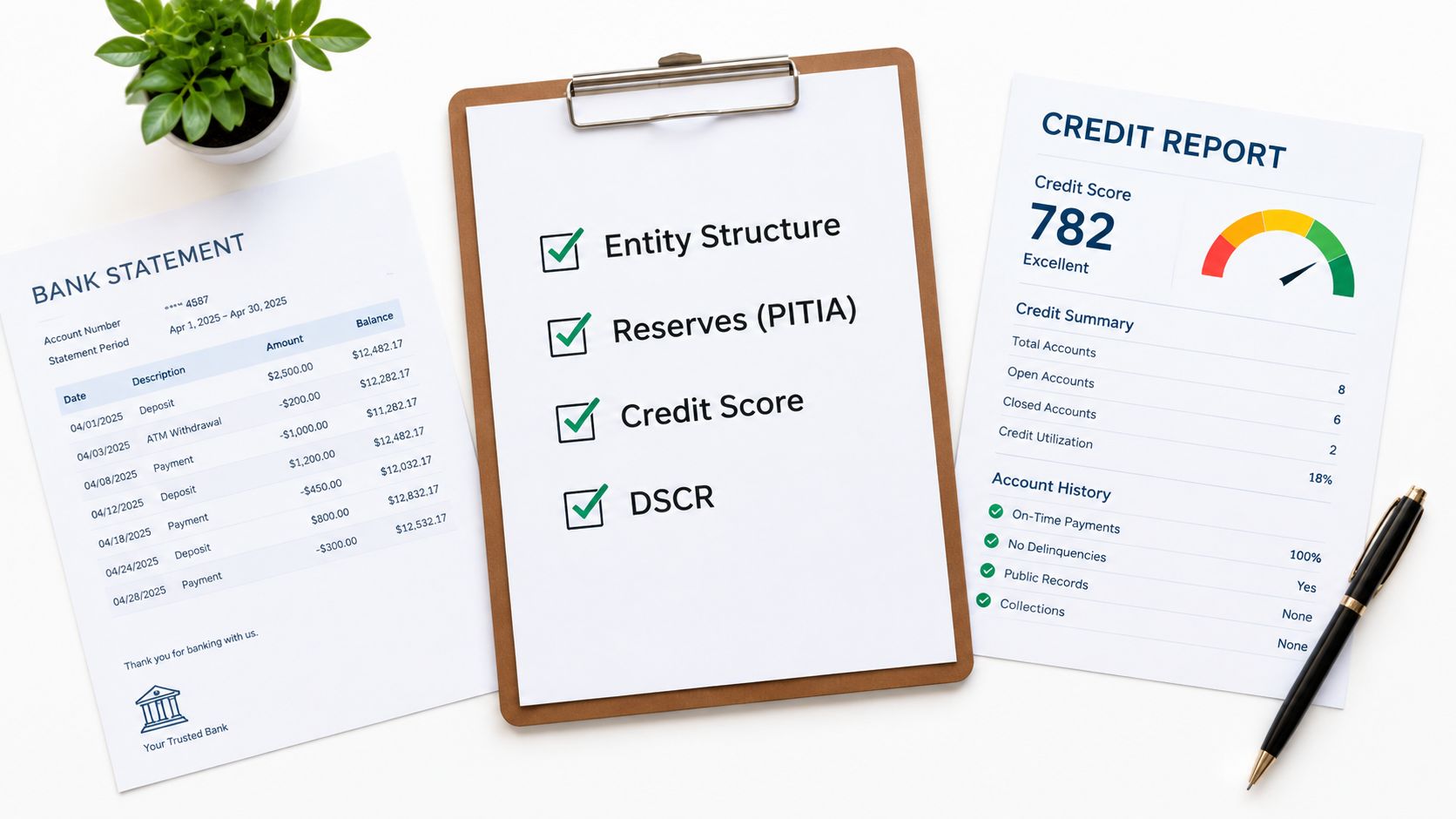
- Entity structure: Confirm who owns the property, whether the borrowing entity is seasoned, and whether the guarantor has prior experience using an LLC for investment property.
- Liquidity: Measure reserves in months of PITIA, not only as a dollar balance. Confirm that the money is seasoned and remains available after closing.
- Documentation path: Choose DSCR, bank statements, asset-based qualification, or another route based on the evidence you can produce.
- Credit profile: Ask about the credit expectations for the selected documentation path and the effect of recent derogatory events.
- Property support: Gather leases, rent schedules, insurance, tax information, association details, and a clear scope of work where repairs are involved.
- Track record: Be prepared to explain prior projects, prior non-QM seasoning, and whether you've completed deals at the target price and complexity.
- Exit clarity: State whether repayment comes from a DSCR refinance, sale proceeds, a cash-out refinance, or another documented source.
DSCR programs typically need a clear refinance or sale exit. Asset-based programs may require twelve to twenty-four months of liquid reserves, while bank-statement programs commonly require twelve to twenty-four months of personal or business statements and explanations for large deposits. Those requirements vary by lender, so obtain the written checklist before moving money or restructuring accounts.
For a focused review of DSCR loan requirements, use the lender's criteria to pre-qualify the property and borrower together. Internal pre-screening can prevent avoidable underwriting delays and may save two to three weeks of cycle time when the original submission would otherwise arrive incomplete.

Get rate sheets from at least three non-QM lenders, then compare the complete structure, including loan-to-value ratios, reserves, points, extension terms, and prepayment provisions. Sims Ventures provides bridge, DSCR, fix-and-flip, construction, and refinance financing for investors in Georgia, North Carolina, South Carolina, and Texas. Visit Sims Ventures to discuss the acquisition-to-stabilization plan and determine which capital structure fits the property's actual exit.
