
Fix and Flip Line of Credit: How It Works in 2026
You already know the feeling. One property is under contract, rehab money is tied up in the first draw, and a second deal is waiting on your desk while the seller keeps asking when you're closing. A normal one-deal loan can fund the first flip, but it can't always keep a whole pipeline moving. That's where a fix and flip line of credit becomes a practical tool, not just another loan label.
Active investors don't usually run into trouble because a single deal is bad. They run into trouble because three decent deals hit at once, capital gets trapped, and the next closing slips past the deadline. A revolving facility changes that equation by letting one credit relationship support multiple acquisitions and renovations instead of forcing you to start over each time. For investors building volume, that difference matters more than a small pricing spread.
Why One Loan Is Not Enough When You Are Flipping Multiple Houses
The problem shows up fast. A borrower gets one flip funded, spends weeks waiting on permits and demo, then finds a second property with a thin margin and a motivated seller. By the time the first deal has absorbed cash, the lender is still working through a fresh application on the second. The third opportunity never even gets a serious look.
That bottleneck is why a revolving facility gets attention from active operators. A fix and flip line of credit is built for repeated use across multiple projects, not a single address, and that structure lets capital recycle instead of sitting in one closed loop. Market examples show facilities from $500,000 to $10 million with loan-to-value often capped at 75% of after-repair value (ARV), acquisition financing around 85% of purchase cost, and rehab funding that can reach 100% of the rehab budget.
A single-deal loan can still be the right tool for a one-off flip. It becomes a poor fit when the investor has more than one file in motion and needs the next draw, the next close, and the next rehab budget to move without a fresh start each time. For operators building repeat volume, the practical value is speed. One credit relationship can keep several deals moving while a series of isolated loans would force each property back through the same underwriting cycle.
If you are trying to scale past a couple of houses a year, the structure matters as much as the rate. The investors who keep a pipeline full usually study how the line interacts with acquisition timing, rehab pacing, and exit risk, not just whether the first deal pencils. A useful example is the Sims Ventures guide on flipping 10 houses a year, which reflects the same basic reality, volume depends on how well the capital stack supports repeated closings.
The question is whether your funding keeps pace with your deal flow.
The old way forces every project to stand alone. The revolving way treats the investor's pipeline as the asset, which is why people who scale volume start asking for a credit line rather than another isolated loan.
What a Fix and Flip Line of Credit Actually Is
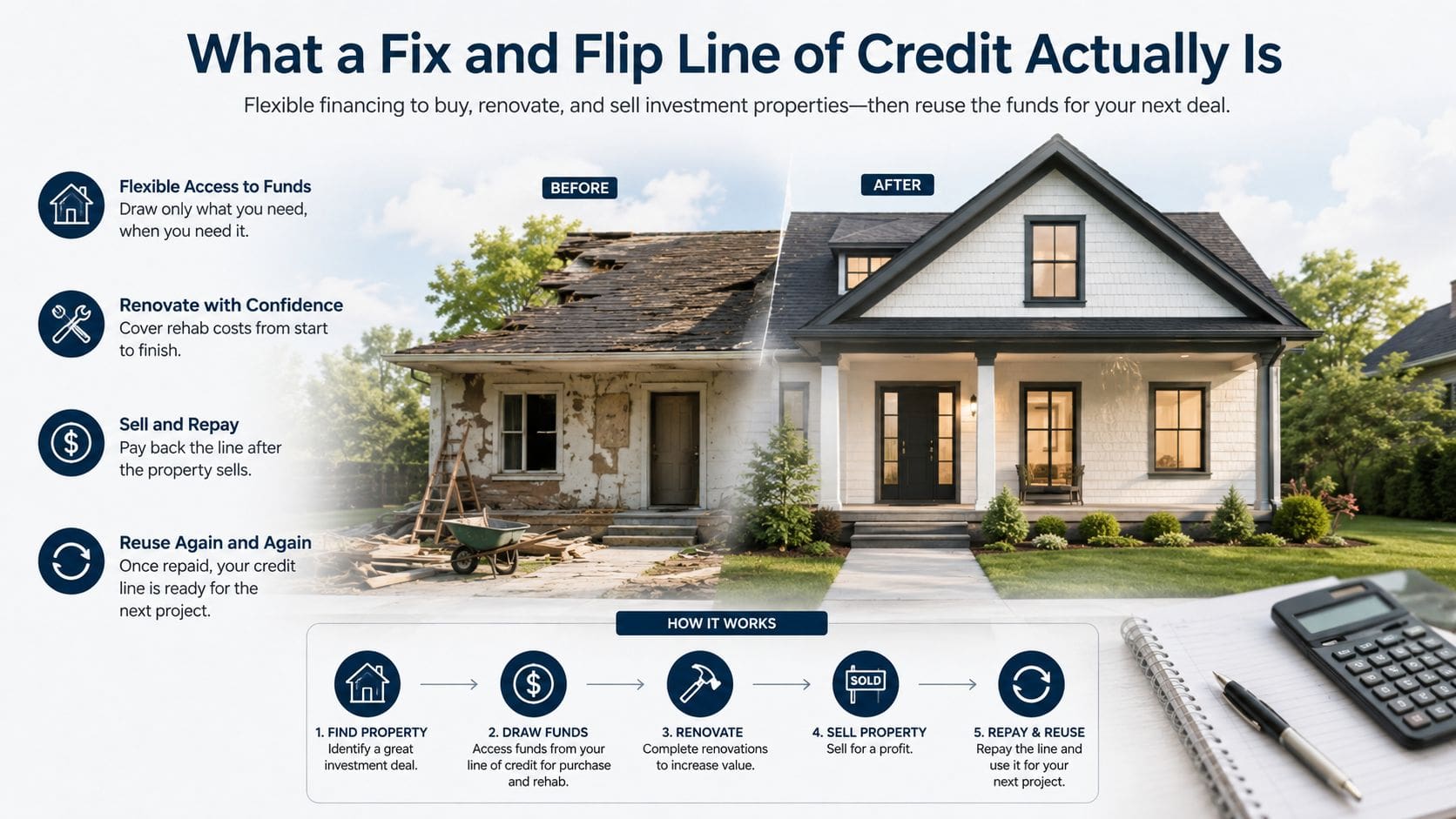
A fix and flip line of credit is a revolving, asset-based facility that can support one project or several at once. Think of it less like a single mortgage and more like a business credit card for flips, except the credit decision is tied to ARV, rehab scope, and borrower execution rather than store receipts. The lender does not approve a blank check, it approves a capacity to fund deals as they come to market.
How the facility is usually sized
Market examples show the line can be sized with tiers that often run up to 75% of ARV, around 85% of purchase cost, and as high as 100% of the rehab budget. That combination matters because it separates acquisition capacity from renovation capacity. The borrower is not forced to fund every dollar of construction from the same pocket on day one.
Terms are generally short, commonly 6 to 18 months, with interest-only payments and a balloon payoff at sale or refinance. Another market guide describes similar facilities running on 12- to 24-month terms and often using interest-only structures, with some programs allowing no interest until rehab funds are drawn. That structure is what makes the product behave like working capital instead of permanent debt.
Why the structure feels different in practice
A single-draw loan closes one project and ends there. A line of credit opens a facility once, then lets the borrower use available capacity as new properties are sourced and underwriting clears. The point is not cheaper money, it's faster redeployment of capital.
One practical way to think about it is this. A one-off loan is a single purchase. A line of credit is a reusable buying limit for a repeatable business model.
Fix and Flip LOC vs ARV Loans, Hard Money, Construction Loans, and Builder's LOCs
The confusion starts because all of these products can fund real estate, but they do it for different reasons. A revolving flip facility is designed for investors who need to keep buying, renovating, and exiting without resetting the whole lending process each time. That makes it distinct from the common one-deal structures people compare it to.
| Product | Best For | Typical Term | Leverage Basis | Draw Structure |
|---|---|---|---|---|
| Fix and Flip LOC | Active investors running several rehabs | Short-term, usually revolving | ARV, purchase cost, rehab budget | Staged draws across multiple projects |
| ARV loan | A single flip with a defined exit | Short-term | After-repair value and deal economics | Purchase plus rehab draws on one property |
| Hard money loan | Speed on one specific deal | Short-term | Collateral and project viability | Usually tied to one property |
| Construction loan | Ground-up or major build activity | Short-term to mid-term | Construction budget and completed value | Milestone-driven draws |
| Builder's LOC | Builders managing several vertical projects | Facility-based | Budget and project pipeline | Draws tied to multiple build phases |
The important difference is not just terminology, it's workflow. An ARV loan or hard money loan is typically anchored to a single property and a single exit. A construction loan is usually centered on a build schedule and draw inspections. A builder's line of credit is closer in spirit to the flip LOC, but its underwriting logic is built around construction budgets and homebuilding cadence.
If your business model is “buy, fix, sell, repeat,” one-deal financing can work until volume increases. After that, it starts slowing the machine.
For a clean comparison point, the basics of private lending versus one-off hard money are laid out in this internal guide on hard money loans versus private lending. The key takeaway is simple. Choose the product that matches your deal flow, not the one that sounds familiar from your last closing.
Understanding the True Cost of Capital and Common Oversights
A flip LOC can look cheap at first glance, then turn expensive once the deal starts moving. The bill usually includes interest, origination points, draw fees, wire fees, and the carry cost of capital that sits unused while permits, inspections, or subcontractor timing slow the project down. Borrowers usually get hurt by delay more than by a slightly higher rate.
Credit quality still shapes the price. Many lenders expect the borrower to be in the mid-600s or better, and first-deal programs often tighten that standard further. That changes the terms you see, because stronger credit and a cleaner track record usually improve pricing and structure. The teaser rate is rarely the rate a real borrower gets.
What gets priced into the deal
The cost stack is easy to underestimate because it is spread across several line items.
- Interest. This is the obvious charge, but it is only one part of the total.
- Origination points. Upfront lender fees raise the effective cost before any rehab work starts.
- Draw fees. Each inspection, wire, or administration step can add friction to the budget.
- Idle capital carry. If funds are approved but not yet drawn, the project still pays for the facility while money sits unused.
The mistake I see most often is a borrower chasing the lowest headline rate and ignoring timing risk. A slightly higher-priced facility can still be the better move if it closes faster, funds rehab draws without delays, and keeps the project from stalling. On a flip, a missed close can kill the purchase, and a weak draw schedule can leave the rehab half-finished while crews wait on cash.
Underwriting drives the economics too. Lenders want a clear scope of work, a realistic rehab budget, and enough spread left in the deal to exit with profit. That is where real estate underwriting standards matter, because the lender is testing whether the numbers support the loan before it ever looks at repayment. Some programs look for profit cushions around the low-teens on net profit of ARV or about one-fifth gross profit on total project cost, but the exact threshold depends on the lender and the file. A cheaper structure that forces delays or underfunds the rehab can cost more than a tighter-priced facility that performs on schedule.
Underwriting, Draw Mechanics, and Repayment Flow
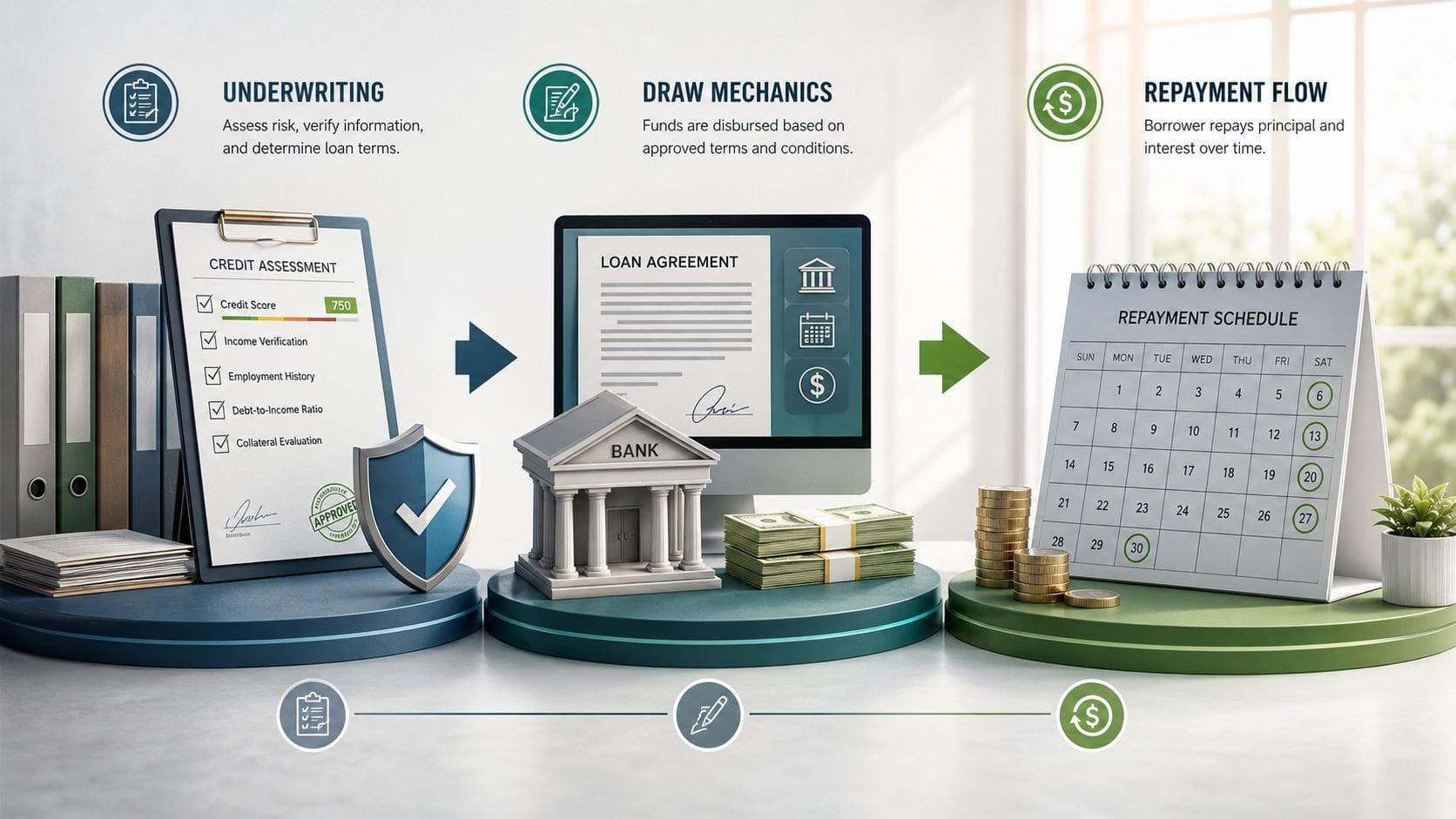
The approval process usually starts with the deal, not the borrower's W-2s. Lenders look at ARV, the scope of work, expected resale path, liquidity, and the borrower's track record. That doesn't mean credit is irrelevant. It means the file has to make sense as a project before it makes sense as debt.
The mechanics are simple once you see the flow. The lender reviews the acquisition, verifies the rehab plan, and sets the facility size based on the numbers and borrower profile. Then the line funds the purchase, rehab draws release in stages, and repayment happens at sale or refinance. That structure is why these facilities are commonly used for short-term flip execution rather than long-hold ownership.
How the draw process usually works
A strong draw system protects both sides. Acquisition funds go out at closing, rehab money gets released after inspection milestones, and final draws happen when the project is ready for exit. That staged method reduces idle carry cost because the borrower is not paying to hold the entire rehab budget from day one, and it gives the lender better control over what gets funded and when.
The interest structure matters too. Industry guidance shows these loans are usually interest-only, and some programs allow no interest until rehab funds are drawn. That lowers early-month pressure when permitting, materials, or contractor scheduling push the start date back.
For a process reference, this internal underwriting guide on real estate underwriting is useful for seeing how deal quality gets translated into lending terms. The borrower who wins here is usually the one with clean documents, realistic budgets, and a rehab plan that can survive inspection without constant revisions.
Staged draws are not just lender control. They're borrower discipline, because they force the budget to match progress.
When an LOC Beats One-Off Loans and When It Does Not
A revolving facility wins when the investor has a real pipeline. If you're sourcing multiple flips, closing often, and trying to redeploy profits without waiting for each deal to finish its own financing cycle, a line of credit can create real operational speed. It also helps when your business depends on certainty, because one approved facility can support several transactions rather than sending each one back through the full process.
It does not make sense for everyone. A first flip often needs simpler financing and fewer moving parts. A single isolated project usually doesn't justify the extra scrutiny, the concentration questions, or the discipline required to manage a revolving facility well. If your calendar has one deal, not a queue of them, the LOC can be more structure than you need.
The rule of thumb that holds up
Use the revolving model when capital recycling is the business model. Use the one-off model when you're testing a deal, learning the market, or running a thin pipeline. That's the difference between portfolio liquidity and transaction financing.
Another thing investors miss is concentration risk. If several projects sit under one facility, a single miss can stress the whole relationship faster than a standalone loan ever would. The line gives you flexibility, but it also asks for tighter execution, better reporting, and cleaner allocation of rehab dollars.
Flexibility is valuable only if the operator can handle it.
That's why seasoned flippers and small builders tend to adopt LOC structures later, after they've already learned how their projects behave in practice. They're not buying access to money. They're buying speed, repeatability, and the ability to keep the next deal moving.
Pre-Application Checklist for Qualifying in GA, NC, SC, and TX
Before asking for terms, have the file ready. Lenders move faster when the entity documents, borrower background, and project package are complete from the start. In the Southeast, title work, appraisal timing, and closing coordination can move quickly, but only if the borrower isn't waiting on missing paper.
What to assemble first
- Entity paperwork. Bring the LLC or borrowing entity documents clean and current.
- Track record or resume. Show completed flips, even if the experience is limited.
- Credit reports and bank statements. Underwriting will want a clear view of liquidity and repayment capacity.
- Scope of work and rehab budget. Break out the project by trade and stay realistic.
- Comps that support ARV. The resale number has to be defendable, not optimistic.
- Insurance evidence. Have property and builder coverage ready for closing.
For Georgia, North Carolina, South Carolina, and Texas, speed comes from organization. If the title company is ready, the property file is clean, and the appraisal request goes out with the right support, the deal is much more likely to stay inside an expedited timeline. That matters more than any single document because delays usually stack.
A practical borrower also brings more than one exit path. If the flip doesn't move as planned, the lender wants to know the refinance or disposition strategy is still realistic. That doesn't mean overcomplicating the file. It means showing that the deal survives contact with the market.
Choosing Sims Ventures or an Alternative and What to Do Next
A good fit here is the investor who already runs active flips or small residential projects in GA, NC, SC, or TX and wants asset-based underwriting with an expedited close. Sims Ventures is set up for that style of borrower, along with investors who need bridge-to-DSCR pathways, fix-and-flip financing, or builder-oriented capital under one lending relationship. The value is not in complexity. It's in matching the facility to the job.
An alternative makes more sense when the borrower is outside that footprint, only has one project, or needs permanent takeout financing from day one. A revolving fix-and-flip facility is a working tool, not a universal answer. If the business is not producing enough repeat volume, a simpler loan can be cleaner.
The decision rule is straightforward. If the next deal depends on capital recycling and quick execution, a credit facility deserves a serious look. If you are still proving the model on one property, keep it simple.
Sims Ventures also publishes advisory material for investors who want to think through structure before they borrow, which helps when the question is not just “Can I get funded?” but “Does this setup support the way I buy and sell property?” If that's the conversation you need, get your documents together, review the next deal, and decide whether the facility fits the pipeline or the pipeline needs to grow first.
If you're trying to fund multiple flips without slowing down your pipeline, Sims Ventures provides asset-based financing for fix-and-flip projects, builder capital, and DSCR strategies in GA, NC, SC, and TX. Visit Sims Ventures to review your deal, compare structure options, and see whether a revolving facility fits the way you invest.
