
Ground Up Construction Financing: A Builder’s 2026 Guide
You've got the lot tied up. Plans are done. Your contractor is ready to move. Subs are lined up. Then the financing stalls.
That's the point where a lot of good projects get dragged into a process that wasn't built for construction in the first place. A conventional lender wants to look at your tax returns, your W-2, your personal debt picture, and a fully finished property. But a ground-up deal starts with dirt, permits, a budget, and a future value that only exists if the build gets executed well.
Builders and investors run into the same problem over and over. The deal makes sense on paper and in the field, but the financing side moves like it's underwriting an owner-occupied mortgage. By the time the file gets passed around, the contract timeline is tight, the permit window is moving, and your contractor is asking whether this project is real.
Ground up construction financing solves that problem when it's structured correctly. But there's a catch. Most content stops at the basic definition and never gets into the parts that make or break a project: draw timing, inspection friction, budget discipline, and the exit strategy problem that shows up after the home is finished.
Your Project Is Ready But Your Bank Is Not
A common scenario looks like this. An investor secures infill land in a strong submarket, gets the plans approved, prices the build, and expects financing to follow the logic of the deal. Instead, the lender keeps circling back to personal income documents, asking questions that matter more for a salaried borrower buying a finished home than for a builder taking a property from permit to completion.
The problem isn't always the rate. It's time, process, and fit.
Banks often want a clean file that behaves predictably. Ground-up projects don't behave that way. Permits move. site work reveals surprises. Draw timing matters. A builder may operate through an LLC. An investor may have solid assets and a viable plan but uneven reported income because real estate businesses don't fit neatly into a conventional underwriting box.
That's why many borrowers start looking for a construction loan preapproval path built for investors before they lose momentum. Preapproval matters because it forces the financing conversation to happen before the contractor mobilizes and before your timeline starts bleeding money.
What usually goes wrong
- The lender underwrites the borrower, not the project. That misses the core risk in new construction.
- The timeline slips in committee. Your file sits while appraisals, title, and internal approvals move at a pace that doesn't match the job site.
- No one addresses the exit early. The loan gets discussed as if closing is the finish line. It isn't.
A shovel-ready project can still die from financing friction long before the first pour.
The practical fix is to treat financing as part of project execution, not a separate administrative task. If the lender can't evaluate plans, budget, contractor strength, and exit path in the same conversation, you're already carrying unnecessary risk.
What Exactly Is Ground Up Construction Financing
You close on the lot, the plans are approved, the builder is ready to mobilize, and the financing still does not work like many borrowers expect. Ground up construction financing is a short-term loan built to fund the build itself, with money released in stages as the project advances.

That distinction matters because the loan is tied to execution, not just ownership. The lender is not advancing capital against a completed property. The lender is advancing capital against a budget, a set of plans, a contractor, and a sequence of verified progress.
In practice, the structure usually includes:
- Interest-only payments during construction
- Funds released through draw requests
- Inspections before each disbursement
- A short payoff period through sale or refinance after completion
The draw schedule is where borrowers either stay in control or get squeezed. If your framer needs funds on Tuesday but your lender only processes draws every other week, the schedule slips fast. Subs get pushed, materials get reordered, and carrying costs keep running. A construction loan is only as useful as the lender's ability to release capital in step with the job.
That is why I tell builders and investors to stop treating the draw schedule like paperwork. It is an operating system for the project. If the schedule is unrealistic, the loan is unrealistic.
Why it isn't a normal mortgage
A standard mortgage starts with finished collateral. Ground up construction financing starts with land and a business plan. As improvements are completed, the collateral gets stronger, and the lender releases the next tranche of funds based on that progress.
This also creates a hard reality many borrowers miss at the start. The loan does not end when the house is built. It ends when you execute the exit.
The exit strategy is part of the loan, not an afterthought
The biggest mistake in ground up financing is exit strategy mismatch. A borrower takes a short-term construction loan assuming they will sell quickly, then the market softens and the property sits. Or they expect to refinance into permanent debt, but the finished asset, lease-up, appraisal, or borrower profile does not support that takeout plan on the timeline the loan requires.
That is not a minor issue. It is one of the main risks in the deal.
A workable construction loan has to match all three parts of the project:
- The build timeline
- The draw mechanics
- The exit path, usually a sale or refinance
If one of those pieces is off, the pressure shows up before maturity. At Sims Ventures, that is part of how we look at a file. We are not just asking whether the plans make sense on paper. We are asking whether the draw structure can support the contractor's pace and whether the exit fits the borrower's business plan.
If you expect full funding at closing or plan the exit later, you are setting the project up for avoidable stress.
Ground up construction financing works well when the capital structure matches how the job will run. That means realistic draws, a credible budget, and an exit strategy that fits the loan term instead of fighting it.
Choosing Your Financial Partner Bank vs Private Lender
Choosing the lender isn't just about pricing. It's about whether the capital source matches the way your project behaves.
A bank can work when the file is simple, the borrower's income profile is easy to document, and the timeline has room for delays. That's not every build. Many investors and builders operate through entities, have layered income, or need the lender to evaluate a project on its merits rather than on how clean the borrower looks on a tax return.
Where the decision usually gets made
| Priority | Bank approach | Private lender approach |
|---|---|---|
| Underwriting focus | More likely to lean on personal financials and conventional documentation | More likely to weigh collateral, plans, budget, and project viability |
| Process style | Rigid, with more handoffs and policy gates | More direct, with fewer layers between review and decision |
| Best fit | Lower urgency, cleaner borrower profile, more patience | Time-sensitive deals, entity borrowers, deal-focused execution |
That doesn't mean one is universally better. It means each solves a different problem.
What works in the real world
If you're building a one-off project with a long runway and conventional income, a bank may be workable. If you're trying to preserve a contract deadline, keep a builder mobilized, or fund through an LLC based on the strength of the deal, flexibility matters more.
A private lender typically makes more sense when:
- Timing is part of the risk. Slow approval can hurt the deal as much as a bad budget.
- The project needs context. Site constraints, infill lots, or spec strategy often require common-sense review.
- You need operational responsiveness. Construction doesn't wait for back-office meetings.
The wrong lender doesn't just slow the closing. They can disrupt the build before it starts.
The main trade-off is straightforward. Banks may appeal to borrowers chasing the lowest possible cost of funds and willing to accept rigidity. Private lenders are usually chosen for certainty, speed, and an underwriting process that's built around execution. For builders, that's often the difference between a funded project and a dead one.
The Underwriting and Approval Process Unpacked
Underwriting for a construction deal starts with the file you hand over. If the package is thin, unclear, or inconsistent, the lender has to guess. Good lenders don't like guessing.
Technical qualification for ground-up construction loans typically requires architectural plans, engineering designs, detailed cost estimates, and a defined construction timeline, and complete plans can accelerate underwriting to about 15 days after appraisal and title are complete, according to this underwriting guide for ground-up loans.

That speed only happens when the deal is organized. If plans are incomplete, costs are vague, or the scope keeps changing, underwriting slows down because the lender has to keep reopening the same questions.
What a strong file looks like
A lender wants to see a project that can be built, managed, and exited without chaos. The essentials usually include:
- Full plans and supporting design documents. Sketches don't get a serious file far.
- A detailed line-item budget. Broad numbers aren't enough. Costs need to match the scope.
- A realistic timeline. Not the optimistic version. The credible one.
- Contractor information. Licensing, insurance, and relevant build experience matter.
- Permits or permit status. If approvals aren't in place, be clear about where they stand.
A useful way to think about underwriting is this: the lender is trying to determine whether your budget, timeline, and team are aligned with the actual work required to finish the house.
The metrics that matter
Terms like LTC and LTV intimidate newer borrowers, but they're practical once you strip away the jargon.
- Loan-to-Cost asks how much of the total project cost the lender is willing to finance.
- Loan-to-Value or after-value metrics ask how the finished collateral supports the loan amount.
- Cash flow and collateral strength often carry more weight than traditional income documents in deal-focused programs.
For borrowers who want a clearer view of how lenders evaluate these files, real estate underwriting standards for investors help frame what gets approved and what gets pushed back.
Clean documents don't just make the lender happy. They keep your closing from drifting.
What borrowers get wrong
The biggest mistake is assuming the lender will “figure it out.” They won't, and they shouldn't. If your budget doesn't reconcile with the plans, if the timeline ignores permit lead times, or if your contractor has never built a similar product, the file weakens fast.
The deals that fund cleanly usually have one thing in common. Someone treated underwriting like part of the build process, not paperwork to throw together the night before submission.
Navigating The Draw Schedule And Project Timeline
Ground up construction financing becomes operational with the draw schedule. On paper, it sounds simple. In practice, good projects remain on track and sloppy ones begin to create friction.
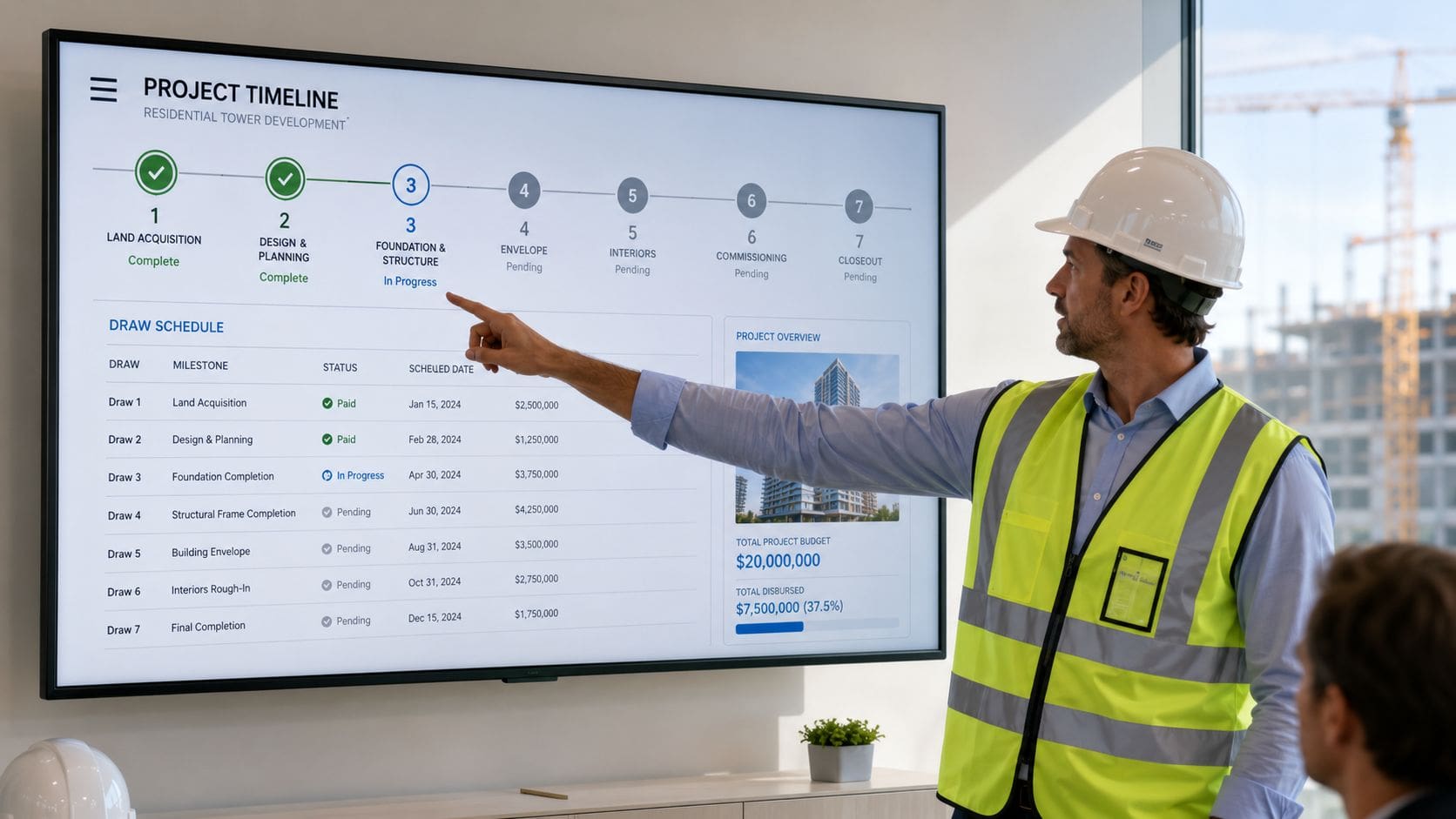
Ground-up construction financing uses a structured draw process where funds are released after completed milestones are verified. Lenders commonly finance up to 100% of vertical construction costs and 50–75% of horizontal development, with total financing often capped at 85–90% of LTC, according to this explanation of construction draw structures.
How the process works on the ground
The lender and borrower agree on a schedule before the project gets moving. Those draws typically correspond to real construction phases, not arbitrary dates. Work is completed, an inspection confirms progress, and then the next disbursement is released.
That sequence matters because it disciplines the project. It also means your job site and your capital flow have to stay coordinated.
A typical pattern includes phases like:
- Initial site work and foundation
- Framing and dry-in
- Mechanical rough-ins
- Interior completion and finishes
- Final completion
The exact structure varies, but the operating principle doesn't. Money follows verified work.
Where delays usually happen
Most draw problems aren't caused by the lender refusing to fund a good project. They happen because the file submitted for the draw is incomplete, the inspection gets requested too late, or the work completed on site doesn't match the approved budget line items.
Common trouble spots include:
- Poor communication with the contractor. The builder says a phase is done, but punch items still remain.
- Late inspection requests. If you wait until funds are urgently needed, you've already created avoidable stress.
- Budget drift. Money gets used in one phase that was allocated to another, which creates confusion during review.
Treat each draw request like a mini-closing. Accuracy matters, and timing matters.
How experienced builders keep momentum
They don't wait for cash pressure to start communicating. They prepare the next draw before the current phase is fully wrapped, keep photo records, and make sure the contractor understands what the inspector is coming to verify.
They also avoid building a timeline that assumes every inspection, trade handoff, and material delivery will land perfectly. Construction rarely behaves that cleanly. A disciplined draw process doesn't eliminate friction, but it keeps small issues from turning into payroll and schedule problems.
When borrowers understand the draw schedule upfront, they stop seeing it as lender control and start using it as a project management tool. That's the right mindset.
Structuring The Deal And Planning Your Exit Strategy
A construction loan is temporary by design. The build may go well, the inspections may clear, and the home may finish on time. None of that guarantees a clean exit.
The most common blind spot is assuming the permanent loan is automatic. It isn't.

The exit strategy mismatch
For spec builders, the exit is usually a sale. For build-to-rent investors, the planned exit is often a refinance into a DSCR loan. That sounds straightforward until the property is complete and the refinance lender asks for rental seasoning the investor assumed wouldn't matter.
A critical issue in the market is the exit strategy mismatch. 60–70% of new builds fail to qualify for DSCR financing immediately due to a 12-month seasoning requirement for rental income verification, as noted in this discussion of new-build DSCR qualification issues.
That mismatch catches people after the hard part is over. The house is done, but the long-term debt isn't available on the timeline they expected.
What works and what doesn't
What doesn't work is vague thinking. “We'll just refinance when it's done” isn't a strategy.
What does work is choosing one of these paths before the first draw:
- Build to sell. Your loan term, product type, and pricing assumptions should reflect a sale exit.
- Build to hold with a seasoning plan. If rental history may be required, plan the gap in advance.
- Use an interim facility intentionally. A bridge structure can buy time while the property seasons.
For investors planning multiple projects, a builder line of credit for recurring construction activity can be part of that strategy, especially when capital needs don't fit neatly inside one isolated project loan.
The exit should shape the loan on day one. If you wait until the certificate of occupancy, your options usually get narrower.
Questions to settle before you close
- Is this a sale or hold?
- If it's a hold, what documentation will the takeout lender require?
- If the refinance isn't available immediately, what carries the property in the meantime?
- Does the project budget leave room for a longer transition than expected?
A lot of investors focus on getting the build funded. Experienced ones focus on getting paid off. That's the difference.
Financing Your Build With Sims Ventures
For borrowers in Georgia, North Carolina, South Carolina, and Texas, one practical option is Sims Ventures, which offers asset-based financing for ground-up residential construction, bridge lending, DSCR lending, and builder-focused credit facilities.
That matters because construction financing works best when the lender understands the full life cycle of the deal, not just the closing. A builder may need a ground-up loan today, an interim bridge structure after completion, and a DSCR refinance once the property is ready for longer-term debt. If those pieces are disconnected, the borrower ends up solving the same financing problem multiple times.
Where that fit shows up
A lender built around investor workflows is usually a better fit when the borrower needs:
- Deal-focused underwriting instead of tax-return-driven review
- Construction draws tied to milestones for new residential builds
- A path for repeat projects rather than one-off transaction handling
- Advisory support on structure and timing when the exit isn't straightforward
That's particularly relevant for builders who are moving from one project into several. A single construction loan can fund one house. A broader credit relationship helps when your pipeline starts stacking.
The practical takeaway
Ground up construction financing isn't difficult because the concept is hard. It's difficult because every phase has to line up. The land, plans, budget, contractor, draw process, and exit all have to make sense together.
When they do, these loans can be a clean tool for building spec homes, rentals, and infill projects. When they don't, the stress usually shows up in the same places: delayed approvals, draw friction, and a refinance plan that wasn't real.
If your current lender is still trying to force a construction deal through a conventional mortgage lens, it may be time to work with a financing partner that evaluates the project the way a builder lives it.
If you're building in GA, NC, SC, or TX and want a practical conversation about structuring the loan, the draw schedule, and the exit before the project gets boxed into the wrong financing, reach out to Sims Ventures.
