
How Construction Loans Work for Real Estate Investors
Your builder has signed the contract, demolition starts soon, and the project budget looks complete in a spreadsheet. The problem is that the full construction cost isn't sitting in the bank account, and the contractor still needs to pay crews, order materials, and keep work moving before the next lender inspection.
That's where construction financing becomes more complicated than a standard mortgage. The lender doesn't usually hand over the entire commitment at closing. Capital moves through the project in controlled advances, and the timing of those advances can determine whether a profitable build stays on schedule or runs short of cash.
This guide explains how construction loans work for fix-and-flip investors, rental-property owners, builders, and small developers. The focus is ground-up residential construction, with particular attention to draw timing, inspection requirements, interest on advanced funds, reserves, and the permanent-financing exit.
Why Construction Financing Is Different
A builder can have land under contract, approved plans, and a signed construction agreement while still facing an immediate cash shortage. Crews need payroll, suppliers need payment, and permits or site work may require deposits long before the finished property can be sold, rented, or refinanced.
A mortgage for a completed home is secured by an existing, relatively stable asset. A ground-up construction loan supports an asset that changes every week. The lender therefore evaluates the property alongside the budget, builder, schedule, permits, inspections, documentation, and repayment plan.

The three questions behind the loan
Before applying, every borrower needs clear answers to three operating questions:
- How much will the lender fund? Construction financing is generally sized against total project cost, not only the future sale price. Market benchmarks commonly place senior construction financing around 70% to 80% of total project cost, while more conservative or higher-risk projects may fall around 65% to 70% (loan-to-cost ratio benchmarks).
- When will the money become available? Funds are commonly released after verified milestones and inspections. An invoice alone may not trigger an advance.
- How will the debt be repaid? The exit may be a sale, a refinance, a construction-to-permanent conversion, or another approved payoff strategy.
The advance rate determines how much equity the borrower must supply. That contribution may need to cover the remaining project expenses, approved equity requirements, overruns, and the cash-flow gap between completing work and receiving the next draw. Liquidity matters because an approved project can still lack usable cash when payroll is due and an inspection has not cleared.
Practical rule: A construction loan is a project-control agreement as much as it is a source of capital.
Market conditions also help explain cautious lending decisions. FDIC-insured institutions held $484.2 billion in acquisition, development, and construction loans outstanding at the end of the fourth quarter of 2024, down 1.3% from the prior quarter. One-to-four-family residential construction loans had declined for seven consecutive quarters to $89.5 billion, the lowest level since 2021 and 7.6% below the prior year (FDIC-insured construction lending data).
Borrowers should also understand who is active in this market. Institutions with less than $10 billion in assets held 56.9% of one-to-four-family residential construction and development loans at year-end 2024. Local knowledge, builder relationships, and project-specific underwriting can therefore shape both loan availability and the conditions attached to funding.
How Construction Loans Work
Think of the facility as a gated construction budget. The lender approves a total commitment, but each release passes through a gate. The borrower completes a defined phase, submits supporting documentation, an inspector verifies progress, and the lender authorizes the next advance.
The process usually starts with an application containing the property details, acquisition information, plans, budget, builder qualifications, permits, insurance, and proposed exit. Underwriting then tests whether the land, completed value, construction cost, sponsor equity, and repayment plan fit together.
At closing, the lender establishes the legal commitment and initial funding conditions. The committed amount is the maximum facility available under the agreement. The drawn balance is the amount advanced so far. Those numbers can be very different during the early part of a build.
The lifecycle in practical terms
| Stage | What Happens | Borrower Focus |
|---|---|---|
| Application | The lender reviews the project, sponsor, builder, budget, and exit. | Reconcile every cost and identify the equity source. |
| Approval | The lender sets leverage, conditions, fees, reserves, and draw rules. | Read the conditions instead of relying only on the headline rate. |
| Closing | Loan documents, title, insurance, and required closing items are completed. | Confirm what must be satisfied before the first draw. |
| Draws | Capital is released as approved construction milestones are completed. | Maintain enough working capital to reach each milestone. |
| Inspections | A third party verifies work and may review invoices, lien waivers, and budget status. | Submit complete packages and resolve deficiencies quickly. |
| Completion | Final work, occupancy documentation, and closeout materials are delivered. | Prepare the payoff, sale, or permanent financing before maturity. |
| Exit | The loan is repaid, refinanced, or converted if the documents allow it. | Confirm eligibility and timing well before the final draw. |
Interest commonly applies to the outstanding balance, not the full approved commitment. That structure can reduce carrying costs while the project is still at the foundation or framing stage, but it doesn't eliminate the borrower's need to fund labor, materials, deposits, and change orders before a draw arrives.
A borrower should ask whether the loan automatically converts to permanent debt, whether a new application is required, and what happens if the project exceeds its expected timeline. The home closing process for builders can also help builders organize the broader closing and completion timeline, particularly when the construction payoff depends on a completed sale.
The same questions apply to pricing. A quote should be evaluated alongside the draw process, fees, inspection requirements, maturity, extension terms, and exit conditions. Borrowers reviewing construction loan interest rates should treat the rate as one input in a larger capital structure, not as the entire financing decision.
Types of Construction Financing
The right structure depends on what you're building, how many projects you manage, and how the debt will be repaid.
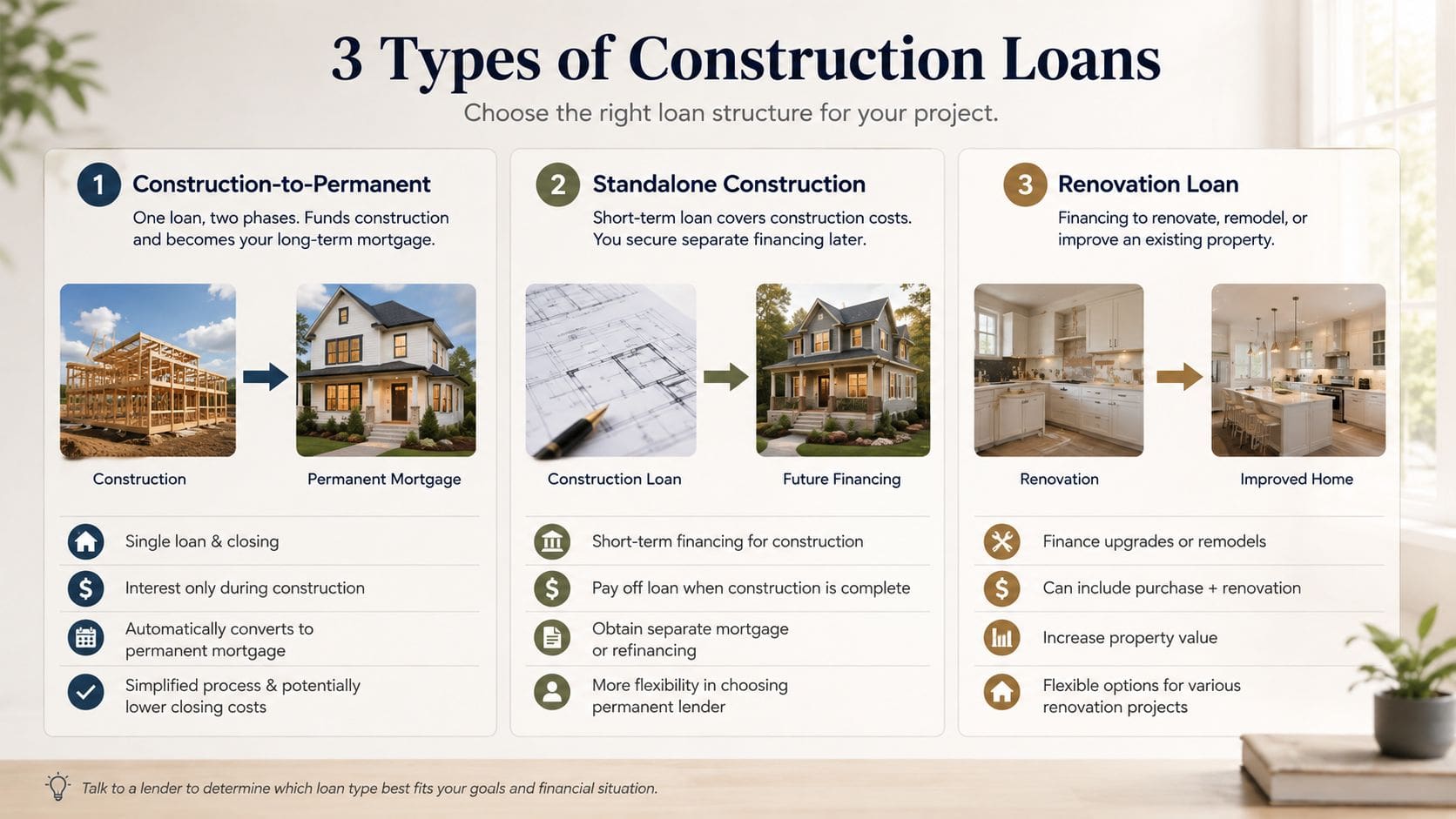
A homeowner-turned-builder who plans to occupy one completed home may prefer a construction-to-permanent loan. This structure can combine the construction phase with longer-term mortgage debt, reducing the need to arrange a separate takeout loan during the build. The borrower still needs to satisfy construction conditions and permanent-loan requirements, but the exit is planned inside one broader facility.
A flipper with a defined sale strategy may instead use a stand-alone construction loan. This facility funds the build for a limited term, and the borrower repays it through a sale, refinance, or another approved source. The structure can be useful when the property will be sold rather than held, but it creates direct maturity risk if the home isn't finished or market-ready when expected.
An experienced builder managing several jobs may need a builder's line of credit. Rather than treating every project as an isolated financing event, the facility may support multiple projects under borrowing-base rules, collateral controls, and project-level draw administration. The lender still evaluates each property, budget, and milestone, but the borrower may gain a framework suited to a recurring pipeline.
Comparing the structures
| Structure | Completion Requirement | Best Fit |
|---|---|---|
| Construction-to-permanent | The build must satisfy construction closeout and permanent-loan conditions. | An owner-occupant or rental investor planning to hold the finished property. |
| Stand-alone construction | The loan must be paid off through a sale, refinance, or other approved exit. | A flipper or developer with a defined disposition plan. |
| Builder's line of credit | Each project must satisfy facility rules, borrowing-base requirements, and draw controls. | An experienced builder rotating capital across multiple jobs. |
No structure is automatically cheapest. A one-closing arrangement may reduce the need for a second financing event, while a stand-alone loan may offer flexibility for a sale-driven project. A revolving facility may fit a high-volume builder but introduce reporting and collateral requirements that a single-project borrower doesn't want.
Operational discipline matters across all three. A builder who keeps contracts, change orders, inspections, invoices, lien waivers, and budget updates organized is better positioned to streamline construction projects, regardless of the loan type.
Underwriting a Construction Project
Construction underwriting asks whether five pieces can work together: the property, budget, sponsor, builder, and exit. A lender may like the location, but that isn't enough if the plans are incomplete, the cost basis is understated, or the borrower can't cover an overrun.
The project file
Start with the full cost basis. Include the land or acquisition price, demolition or site work, hard construction costs, architectural and legal expenses, permits, financing costs, insurance, utilities, marketing, and contingency. The lender needs to see a budget that reconciles to the requested loan amount and the borrower's equity.
Valuation requires similar discipline. The lender may review the current land value, comparable completed homes, the proposed plans, and the assumptions behind the projected finished value. A quote that says it will fund a certain portion of cost should be checked against the complete budget, not only the construction contract.
The sponsor and builder
The sponsor's experience, credit history, entity structure, liquidity, and ability to cure problems can affect the approval. A first-time builder with a partial budget may face more conditions than an experienced sponsor who presents a credible schedule, fixed bids, and a capable general contractor.
Asset-focused underwriting doesn't mean personal qualifications disappear. The lender still needs confidence that the borrower can make required payments, respond to change orders, manage contractors, and contribute equity when the project requires it.
Prepare these items before requesting terms:
- Property information: Purchase contract, deed or land ownership details, site information, and current title.
- Construction package: Plans, specifications, scope of work, permits, contractor agreement, detailed budget, and draw schedule.
- Execution evidence: Builder resume, references, subcontractor details, insurance, and realistic completion schedule.
- Financial support: Entity documents, credit information, bank statements or proof of equity, existing obligations, and liquidity.
- Exit support: Sale assumptions, refinance strategy, projected rent, or documentation for the permanent financing path.
For a rental strategy, construction analysis and permanent DSCR analysis are separate tests. The completed property must support the cash flow expected by the permanent or bridge-to-DSCR program. A project can be easy to build but difficult to refinance if the finished rent or value doesn't support the proposed debt.
Underwriting test: If the advance rate, cost basis, equity contribution, and completed value don't reconcile on one page, the quote needs clarification before you sign.
Draws, Inspections, Costs, and Documents
Consider a hypothetical single-family ground-up project with a total cost of $500,000. Assume, for illustration only, that the lender approves a $375,000 construction commitment, the sponsor contributes $125,000 of equity, the interest rate is 12% annually, and there are no additional fees in the example.
The sponsor's required equity is the difference between total project cost and the loan commitment:
$500,000 total cost minus $375,000 loan commitment equals $125,000 equity.
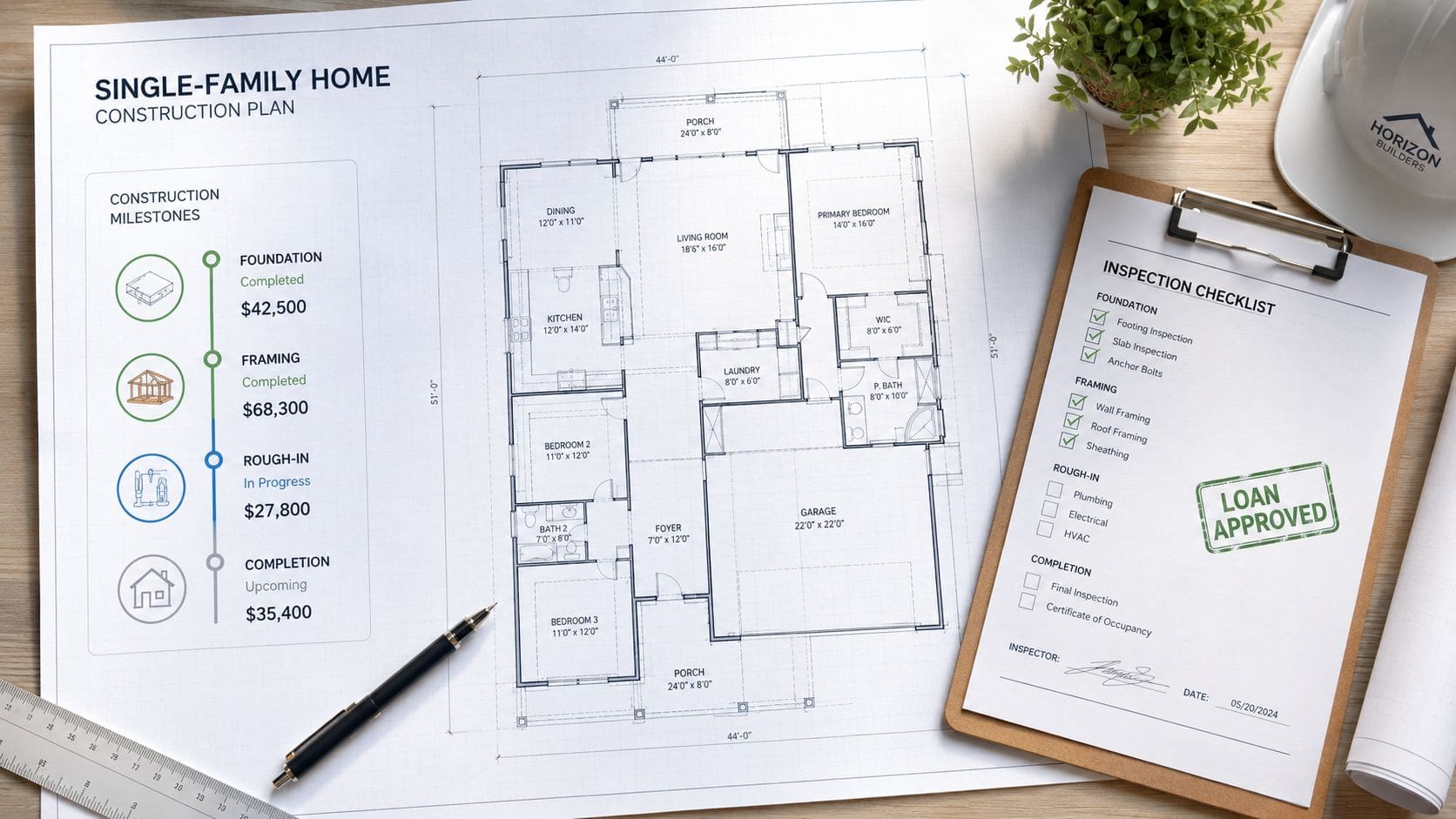
A representative schedule might divide the commitment into six milestone advances. The following percentages are an illustrative draw pattern from a representative schedule, not a universal lender requirement (construction loan draw mechanics):
| Milestone | Illustrative Share | Illustrative Advance |
|---|---|---|
| Foundation | 15% | $56,250 |
| Framing | 30% | $112,500 |
| Dry-in | 12% | $45,000 |
| Mechanical, electrical, and plumbing rough-in | 18% | $67,500 |
| Interior finishes | 18% | $67,500 |
| Final completion or certificate of occupancy | 7% | $26,250 |
| Total | 100% | $375,000 |
The borrower may pay early costs from equity, then request the first draw after the foundation milestone is complete. The lender or inspector reviews the work, checks the draw request against the budget, and may require invoices, photographs, lien waivers, title updates, or other evidence before releasing funds.
Interest follows the drawn balance
At a 12% annual rate, the monthly interest factor is 1%. If the borrower has drawn $56,250 after the foundation advance, the illustrative monthly interest is $562.50. After the framing advance, the cumulative balance becomes $168,750, producing illustrative monthly interest of $1,687.50.
| Cumulative Drawn Balance | Illustrative Monthly Interest |
|---|---|
| $56,250 | $562.50 |
| $168,750 | $1,687.50 |
| $213,750 | $2,137.50 |
| $281,250 | $2,812.50 |
| $348,750 | $3,487.50 |
| $375,000 | $3,750 |
These figures are only a transparent model. Actual interest may depend on the lender's calculation method, timing of advances, fees, reserves, payment structure, and loan documents. The important operating point is that the borrower must forecast both the equity spent before each draw and the interest created by prior advances.
The application package usually includes the purchase contract, entity documents, credit and financial information, builder resume, plans, specifications, budget, permits, title, insurance, draw schedule, and subcontractor details. A detailed construction draw schedule can help connect each milestone to the expected cost and evidence required for approval.
A borrower also needs a working-capital plan. The approved commitment isn't the same as available cash if an inspection, title update, invoice review, or draw authorization remains pending. A practical construction cash-flow management process should show the next payroll, material purchase, subcontractor payment, inspection date, and expected funding date.
Common Construction Loan Risks
A project can work on paper and still fail operationally. The most common breakdown occurs when the borrower spends the current draw before completing the next milestone, then discovers that the next advance is delayed by an inspection issue, missing document, failed subcontractor, or budget dispute.
Where projects stall
Incomplete budgets create problems before the first draw. Site conditions, utility connections, grading, retaining work, and permit-related expenses can exceed early assumptions. A contingency line helps, but only if it's realistic and remains available for actual surprises rather than being treated as extra profit.
Change orders create a second pressure point. A borrower may approve a scope increase because the work is necessary, but the lender may require documentation and approval before including that cost in the facility. If the sponsor can't fund the difference, the project may stop while the parties revise the budget.
Draw timing creates another mismatch. Construction loans are commonly released through four to six draws on a typical single-family ground-up project, with each release tied to verified completion (milestone-based construction draws). The borrower may owe workers and suppliers before the inspection occurs, so the project needs enough liquidity to bridge that interval.
- Failed inspection: Resolve the deficiency, document the correction, and understand whether a second inspection fee or revised request applies.
- Slow approval: Submit complete invoices, lien waivers, photographs, and budget updates rather than waiting for the lender to identify missing items.
- Insufficient reserves: Protect cash for labor, materials, interest, insurance, taxes, and unavoidable delays.
- Premature purchases: Avoid tying up liquidity in materials that don't support the next fundable milestone.
- Delayed exit: Begin the sale or permanent-financing process before final completion, not after maturity is approaching.
A lower advance rate can increase the initial equity requirement, but it may also reduce financial pressure and leave more room for cost overruns. The right comparison isn't just “more proceeds versus fewer proceeds.” It's whether the borrower can sustain the project through the most cash-intensive phase.
Exit risk deserves its own test
A construction loan may not convert automatically. The Consumer Financial Protection Bureau notes that payments may begin six to 24 months after origination and that borrowers may need to reapply if the loan doesn't automatically convert (CFPB construction-loan guidance). That makes takeout planning a closing requirement, not a final-stage administrative task.
Industry conditions can add pressure. NAHB data cited in the supplied source shows average contract rates near 7.9% to 8.0% on several AD&C loan types in late 2025, with effective rates higher after points are included (construction lending conditions). The borrower should stress-test the refinance, sale price, rent, and maturity extension before committing to the build.
Before closing, identify the next unpaid bill, the next required inspection, the cash reserve after that payment, and the exact payoff source if completion takes longer than planned.
How Sims Ventures Approaches Construction Capital
A project can have an approved budget and still run short of cash if the funding schedule ignores inspections, invoices, or payment timing. Sims Ventures presents its ground-up construction loans as milestone-driven financing. Capital follows verified construction progress instead of arriving as one fully funded balance, so the borrower must plan for the gap between paying a contractor and receiving the next draw.
The company also offers a builder's line of credit for sponsors managing multiple projects. This structure can support recurring deal flow, but it requires project-level budgets, borrowing-base calculations, collateral controls, reporting, and draw administration. A borrower developing one property may prefer a simpler facility. A builder with several active jobs may need a repeatable process that shows which project is using available capacity.
Sims Ventures describes its underwriting as asset-focused, with attention to collateral strength and projected cash flow. Its site states that some programs do not require tax returns or traditional income verification in the same way conventional lending often does, although approval criteria and documentation vary by transaction. Borrowers should still expect review of the property, budget, builder, equity, credit profile, and exit.
Speed and transition planning
Sims Ventures states that its expedited closing process is commonly targeted around 15 days, subject to appraisal, title, and underwriting completion, and that it has funded more than $52 million across thousands of investor deals (Sims Ventures construction lending information). These figures describe the firm's stated process and funding history. They do not promise that every transaction will close within that period.
The company serves investors across Georgia, North Carolina, South Carolina, and Texas. Its programs include ground-up construction, fix-and-flip, rental, bridge-to-DSCR, and builder-line financing. The bridge-to-DSCR option should be planned as a transition from short-term construction or bridge debt into stabilized DSCR debt. A borrower still needs adequate reserves if completion, leasing, appraisal, or refinance timing changes.

Private construction capital may provide an asset-focused process and flexibility for self-employed or newer investors. The borrower remains responsible for a credible budget, viable collateral, available liquidity, and a workable payoff plan. Interest generally follows funds advanced, but delays can still extend the loan term and increase carrying costs. Advisory support may help evaluate the deal and structure the capital, but it does not replace independent legal, tax, construction, or financial advice.
Preparing for Construction Loan Approval
Start with the exit, not the loan amount. Decide whether the completed property will be sold, refinanced into longer-term rental debt, occupied, or placed into another approved strategy.
Then build a reconciled package:
- Complete the budget. Separate land, hard costs, soft costs, financing, permits, insurance, contingency, and projected selling or stabilization expenses.
- Document the builder. Provide experience, references, contracts, subcontractor information, schedule, and evidence that the scope matches the budget.
- Confirm the site. Verify title, plans, permits, zoning, insurance, utilities, and any known site conditions.
- Map the draws. Tie each milestone to inspection evidence, invoices, lien waivers, expected payment dates, and the cash needed before release.
- Protect liquidity. Calculate the equity contribution and preserve funds for overruns, interest, delayed inspections, and unplanned work.
Different borrowers should emphasize different evidence. A self-employed flipper should document the sale strategy and liquidity needed to carry the property. A rental investor using bridge-to-DSCR financing should test projected rent and completed value against the future debt. A builder seeking a revolving facility should show project controls across the entire pipeline, not only one attractive site.
Ask the lender:
- What is the commitment amount and LTC basis?
- Is interest charged on drawn funds or the full commitment?
- Which fees apply, and when are they payable?
- How are reserves treated?
- What documents and inspections are required for each draw?
- How are change orders approved?
- What is the maturity and extension process?
- Does the loan convert automatically?
- If not, when must the borrower reapply?
- What conditions govern payoff, sale, or refinance?
Use a detailed construction loan requirements checklist before requesting final terms. The right facility isn't merely the one offering the highest advance rate or fastest quote. It's the structure whose controls, reserves, timeline, and exit match how the project will be built and sold, refinanced, or rented.
Sims Ventures offers ground-up residential construction loans, milestone-based draws, builder lines of credit, bridge-to-DSCR pathways, and advisory support for investors in Georgia, North Carolina, South Carolina, and Texas. Visit Sims Ventures to discuss your project budget, draw plan, liquidity, and permanent-financing exit with a private lending team.
