

Residential Construction Financing: A 2026 Guide
You can have a signed contract, a solid site, and a builder who knows the trades, then lose the deal anyway because the bank takes too long to move. That's the part most borrowers learn the hard way, especially when the project is a spec build, a small infill home, or a self-managed job that needs money to keep moving before the next draw is ready. Residential construction financing exists for that exact gap, and the way it's structured says a lot about why it works differently from a normal mortgage.
The hardest part isn't always getting the first dollar closed. It's keeping a project alive after dirt work starts, when cash is going out faster than completed collateral is coming in.
Why Residential Construction Financing Works Differently
A conventional mortgage funds a finished home. Residential construction financing funds a process, and lenders care as much about the process as the asset. That's why the paperwork is heavier, the timeline is more conditional, and the money is usually released in stages rather than all at once.
In the Southeast, I see this show up most often when a borrower is technically qualified for a bank loan but can't afford to wait for the bank's pace. A builder in Georgia may have the lot locked up, permits moving, and subcontractors lined up, then lose momentum because the lender is still reviewing documents. A private capital structure keeps the project moving because the lender is underwriting the deal, the collateral, and the exit, not just the borrower's tax return.
Why the timeline feels tighter
Construction financing lives on deadlines. If a project misses a material date, the cost stack changes fast, and the borrower is the one absorbing the friction. That's why speed matters just as much as rate, especially for investors who need to protect a purchase contract or keep a build schedule intact.
Practical rule: If the deal only works when every third party moves on time, it's too fragile.
The financing structure also matches the way houses are built. Land gets acquired first, improvements follow, then the property converts into a sale, a refinance, or a stabilized rental. Banks tend to treat that sequence as a risk they want to minimize, while private lenders often treat it as a workflow they can finance more directly.
Who this serves
This kind of capital fits borrowers who are building something the bank doesn't want to hold from day one. That includes fix-and-flip investors, small developers, self-employed builders, and owners who need a practical path from dirt to takeout. In GA, NC, SC, and TX, the common thread is simple, the project has to move even when the borrower's income profile doesn't fit a traditional box.
Residential construction financing works because it matches reality. The home isn't finished yet, so the loan shouldn't behave as if it is.
Loan Types and When to Use Each
The right structure depends on where the project is in its life cycle and how quickly you need capital. A borrower buying raw land for a one-off custom build has a different problem than a developer rolling several homes through the same team, same trades, and same municipal process. The mistake I see most often is forcing one financing product to do the job of another.
Ground-up construction loans
Use this when the project starts with land or a vacant lot and ends with a finished home. The loan is built around staged funding, milestone inspections, and a defined exit, usually a sale or a refinance. It's the cleanest fit for spec builds and small residential developments where the borrower needs capital to carry the project from start to finish.
Construction-to-permanent loans
These work when the borrower wants one path from construction into long-term debt. NAHB's survey found that in Q1 2026, 35% of surveyed builders financed some of their single-family homes with a construction-to-permanent loan, and on average 51% of the homes they built were financed that way, which shows how common this path still is in the market (NAHB AD&C Survey Report). That structure works best when the borrower wants a clearer conversion into takeout debt after completion.
Bridge and hard money structures
These are for speed and flexibility, not long-duration hold strategies. They fit acquisitions, time-sensitive repositioning, and situations where the borrower needs to secure control before a slower permanent lender can step in. In Georgia and Texas, I often see these used to avoid losing a property while the borrower lines up a longer-term plan.
Builder facilities and portfolio-style capital
When a builder is managing multiple lots or multiple starts, a single-property loan can become a bottleneck. A builder's line of credit can help finance more than one project under the same facility, which matters when crews, subs, and permit timing are already creating complexity. That's a better fit for repeat builders than a fresh loan every time.
| Loan Type | Best For | Typical Term | Key Feature |
|---|---|---|---|
| Ground-Up Construction Loan | New builds from lot acquisition to completion | Project-based, short duration | Staged draws tied to milestones |
| Construction-to-Permanent Loan | Borrowers who want a construction phase and then long-term takeout | Construction period plus permanent phase | Converts after completion |
| Bridge / Hard Money Loan | Fast acquisitions and transitional projects | Short duration | Speed and flexibility |
| Builder's Line of Credit | Multiple active projects | Revolving or multi-advance structure | Supports repeat starts |
A practical capital stack often includes more than one of these over the life of a project. The right mix depends on whether the borrower is solving for speed, carry cost, or long-term stability.
Underwriting Criteria and Documentation Requirements
A borrower can have strong income and still fail a construction loan. Lenders want to know whether the project can finish, whether the collateral can carry the balance, and whether the exit will work in the market. That is why self-employed borrowers and experienced investors often fit asset-based underwriting better than income-first underwriting, especially when the deal depends on staged draws and a clean takeout.
A file for a small infill build in Raleigh, a teardown in Atlanta, a coastal custom home in South Carolina, or a scattered-lot project in Texas usually gets slowed by the same thing. The lender wants proof that the plan, the builder, and the capital stack all line up before the first dollar goes out. That is the hidden friction many residential construction financing guides skip.
What the lender is really checking
The questions are simple, even if the file is not. Does the property make sense, can the builder deliver, and does the exit hold up when the project is done? If any one of those answers is weak, the loan gets harder to approve.
A clean package makes the project easy to understand fast. I tell borrowers to prepare it the same way they would prepare the jobsite, because missing items at underwriting usually become missing time later.
- Project scope: Plans, specs, line-item budget, and any phased work that affects funding.
- Borrower background: Builder experience, completed projects, and relevant comparable deals.
- Exit strategy: Sale, refinance, or conversion to stabilized debt.
- Timeline: A realistic schedule with room for weather, inspections, and subcontractor delays.
- Capital needs: Money required for purchase, construction, carry, and any gap between draws.
For private lenders, collateral strength and execution matter together. A well-structured draw schedule reduces exposure before work is in place, and it also shows whether the borrower understands how to manage a project that may need multiple funding sources. That matters in the Southeast, where one lender may cover acquisition, another may cover the build, and the borrower still has to bridge the middle phase without running short on cash.
The paperwork usually includes plans, specs, budgets, permits, title work, borrower financials, builder experience, and an appraisal or valuation package where the lender requires one. If the project involves a presale, the contract and buyer strength can matter just as much as the construction budget. If the deal depends on refinancing at completion, the lender will want to see that takeout path before the first draw.
In practice, lenders in Georgia, North Carolina, South Carolina, and Texas tend to react quickly to gaps in documentation. An incomplete permit file, an overstated budget, or a soft exit plan can slow the entire closing even if the borrower has plenty of equity. That is especially true on deals with multiple sources of capital, because each lender wants to see where it sits in the stack and what happens if one source runs late.
A practical underwriting file usually centers on the same checklist, then adds region-specific issues where needed. Coastal property in South Carolina may bring flood and insurance questions. A Texas infill build may turn on utility timing and local permit pace. A Georgia or North Carolina project may look straightforward on paper but still need a tighter explanation of how the builder will handle draw timing and carry cost between advances.
Current market pricing also matters. NAHB's AD&C Financing Survey reported that in Q4 2025 the average contract rate fell to 7.51% for land acquisition loans, 7.44% for land development loans, 7.47% for speculative single-family construction loans, and 7.16% for pre-sold single-family construction loans. The same survey found average initial points of 0.44% on land development loans, 0.34% on speculative single-family construction loans, and 0.37% on pre-sold single-family construction loans (NAHB AD&C Survey Report).
That pricing shows lenders are still active, but they are asking for tighter files and cleaner execution. For a closer look at how lenders evaluate collateral, structure, and exit, review the underwriting framework here.
Draw Schedules and Construction Monitoring
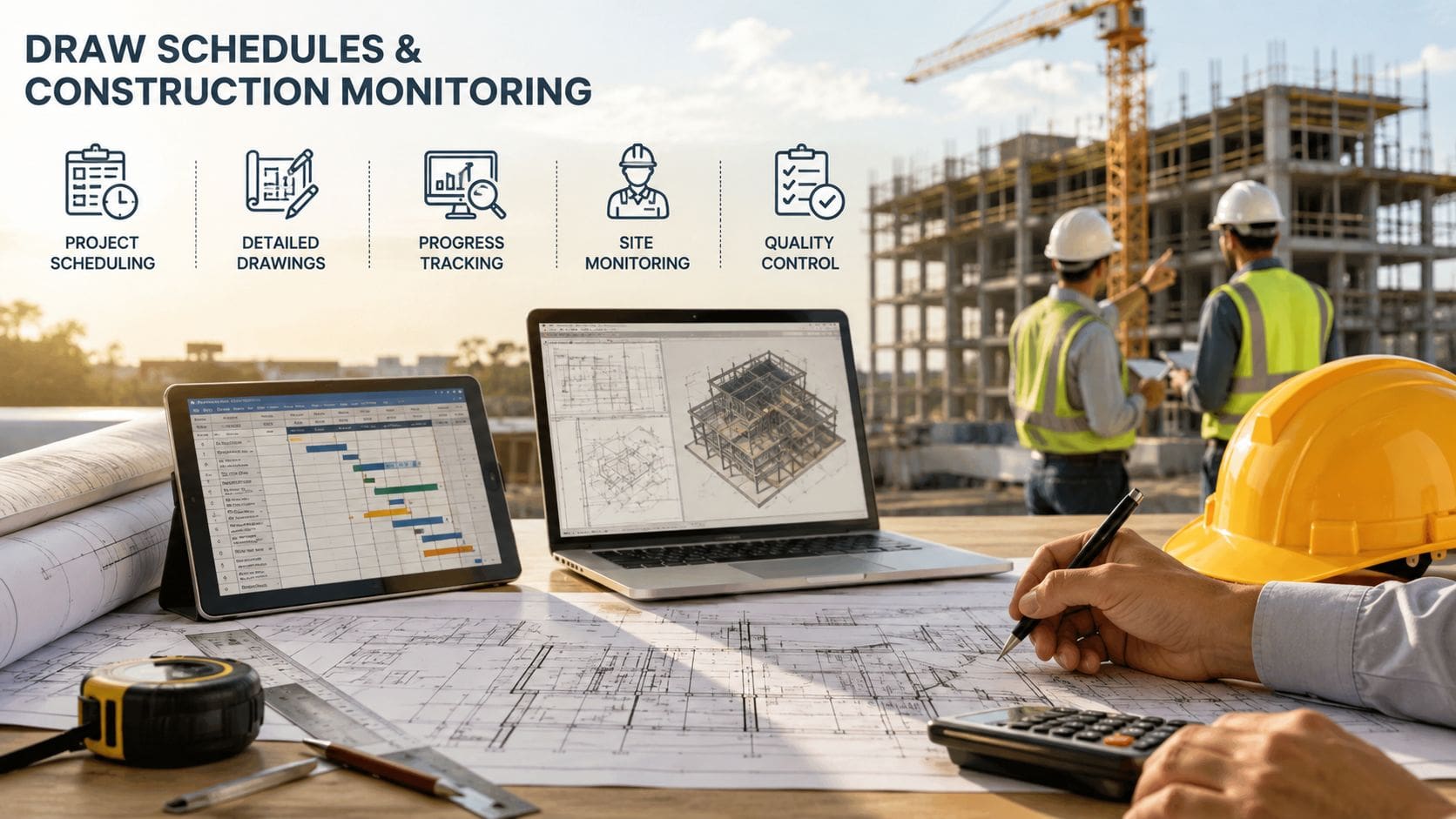
A construction loan rarely funds the whole job at once. It moves through a draw system, and that system protects the lender while keeping the borrower tied to completed work, not future promises. If you understand how the draws line up with real site progress, you can budget with more control, coordinate subcontractors with less friction, and avoid the cash pinch that turns a steady project into a rescue.
How the draw process usually works
Most draw plans follow a staged pattern of 4 to 6 disbursements tied to milestones such as foundation, framing, dry-in, mechanical, electrical, and plumbing rough-in, interior finishes, and final completion. Framing often takes the largest share because that phase carries the heaviest labor and material exposure. For a practical breakdown of how those milestones are usually sequenced, see this draw schedule guide.
A common allocation pattern is 15%, 30%, 12%, 18%, 18%, and 7% across the build phases. That is why liquidity gets tight between draws. If the next stage starts before the prior draw clears, the builder is the one covering the gap, and that gap is where good projects get strained.
What borrowers need to manage
The lender funds completed work-in-place, not intent. That means inspections, documentation, and milestone verification drive the release of money. If the site slows down or the paperwork is incomplete, the funds slow with it.
A clean draw file keeps the job moving. A messy one turns a solid schedule into a financing problem.
Borrowers need to stay close to the builder, inspector, and lender before each request. The cleanest files keep the same questions answered every time, what was completed, what was paid, and what still needs to happen? That discipline matters more than most borrowers expect, because a project can look healthy in the field and still stall if the draw package does not match the work on site.
If you want a practical walkthrough of the workflow, construction loan draw guidance is still useful to keep nearby.
The Middle-Phase Liquidity Gap Most Guides Ignore
Most construction guides stop at closing. That misses the period when a project is already in motion, cash is still going out, and the next source of capital has not opened yet. The job can look healthy on site and still strain the borrower's balance sheet.
That strain is not limited to one market. Independent market commentary on India points to a $15–20 billion funding shortfall in mid-stage residential construction and notes that smaller or regionally focused developers often rely on promoter capital, customer advances, or expensive private debt because banks concentrate on top-tier borrowers. The geography is different, but the financing logic is familiar. Once a project is partially built, it can be too far along for cheap acquisition money and not yet de-risked enough for permanent debt.
Why the gap is so hard to cover
A mid-stage project already has sunk cost, but it still carries completion risk. Lenders see unfinished work, not a finished asset, so the borrower can end up stuck between phases. The hardest money is often the last mile capital, the cash that keeps a good project alive until it can stabilize.
Practical rule: Build for the next phase before the current phase ends.
In the Southeast, that gap shows up when a builder has enough capital to start but not enough cushion to absorb delays in inspections, weather, utility coordination, or subcontractor scheduling. GA, NC, SC, and TX all have their own local rhythm, but the pain point is the same. If the file only works when every draw lands on time, the borrower is exposed.
A second layer of friction comes from multi-source financing. One lender may fund the build, another may provide the takeout, and the borrower may be bridging land, soft costs, and carry with separate capital. Each source has its own timing, conditions, and paperwork, so a small delay in one part of the stack can hold up the rest. Projects fail in the middle because the capital stack was built for an ideal path, not a real one.
The cleanest defense is planning. Borrowers should model more than construction cost, they should model the financing handoff itself. That means carrying reserves, keeping vendor terms realistic, and using lenders who understand the whole project cycle instead of only the close date.
Choosing the Right Lender for Your Project
A lender isn't just a funding source. It's part of the deal structure, and in construction work that matters a lot. The wrong lender creates drag, while the right one helps you price risk, sequence draws, and protect your timeline.
For builders and investors in Georgia, North Carolina, South Carolina, and Texas, the first screen is simple. Ask how fast they close, how they handle draws, and whether they've financed the kind of project you're doing. A lender that understands a one-off infill build may still be the wrong fit for a multi-lot strategy or a self-managed project with a tight entitlement schedule.
Questions that reveal fit
- Closing speed: Can they move quickly once appraisal, title, and underwriting are complete?
- Draw administration: Who approves the draw, how are inspections handled, and how predictable is funding?
- Project experience: Have they worked with spec homes, small subdivisions, or builder portfolios?
- Exit awareness: Do they think only about the start, or do they help plan the takeout too?
One practical option in this market is Sims Ventures, which offers asset-based financing for ground-up residential construction, fix-and-flip projects, rental capital, and builder facilities, along with advisory support on deal structure and execution. That matters because the best lending conversations usually go beyond rate and get into feasibility.
What usually separates strong lenders from weak ones
Strong lenders ask about the project first and the borrower second. They want to understand the plan, the buffer, and the timeline. Weak lenders reverse that order and make the process feel like a document chase.
You want a lender who can talk through the deal without making the builder explain the same file three times.
In time-sensitive Southeast deals, that kind of clarity is worth a lot. If the lender can't keep pace with the transaction, the market will move without you.
Your Action Plan to Prepare and Close
Start with the file, not the loan request. Put the budget, plans, specs, schedule, and exit strategy in one place before you shop capital. That alone will eliminate a lot of guesswork and make lender conversations much more productive.
Then pressure-test the numbers. Make sure the project still works if the draw timing is a little slower than expected or if one trade pushes back a milestone. If the deal can't survive a small delay, it's not ready for construction money.
Use this sequence before you apply:
- Assemble the documents: Plans, scope, budget, schedule, and builder details.
- Define the exit: Sale, refinance, or transition to stabilized debt.
- Check the property support: Title, appraisal, and underwriting items should be ready early.
- Match the structure: Choose the loan type that fits the phase of the project.
- Plan the handoff: If the property will stabilize, map the move into DSCR or another longer-term structure.
The approval process moves faster when the third-party items are ready. In practice, that means title work, appraisal coordination, and underwriting responses should be handled like part of the build, not like an afterthought. If you want a cleaner path into the process, start with pre-approval guidance here.
Residential construction financing rewards borrowers who think in phases. The more clearly you can show how the project starts, how it gets funded in the middle, and how it exits, the easier it is to close and the easier it is to finish.
If you're evaluating a ground-up build, a bridge to takeout, or a builder facility in GA, NC, SC, or TX, Sims Ventures can help you structure the file around the project instead of forcing it into a generic bank box. Visit Sims Ventures to review your capital plan and talk through the right financing path for your next deal.
