
What Is the BRRRR Method: Your 2026 Real Estate Guide
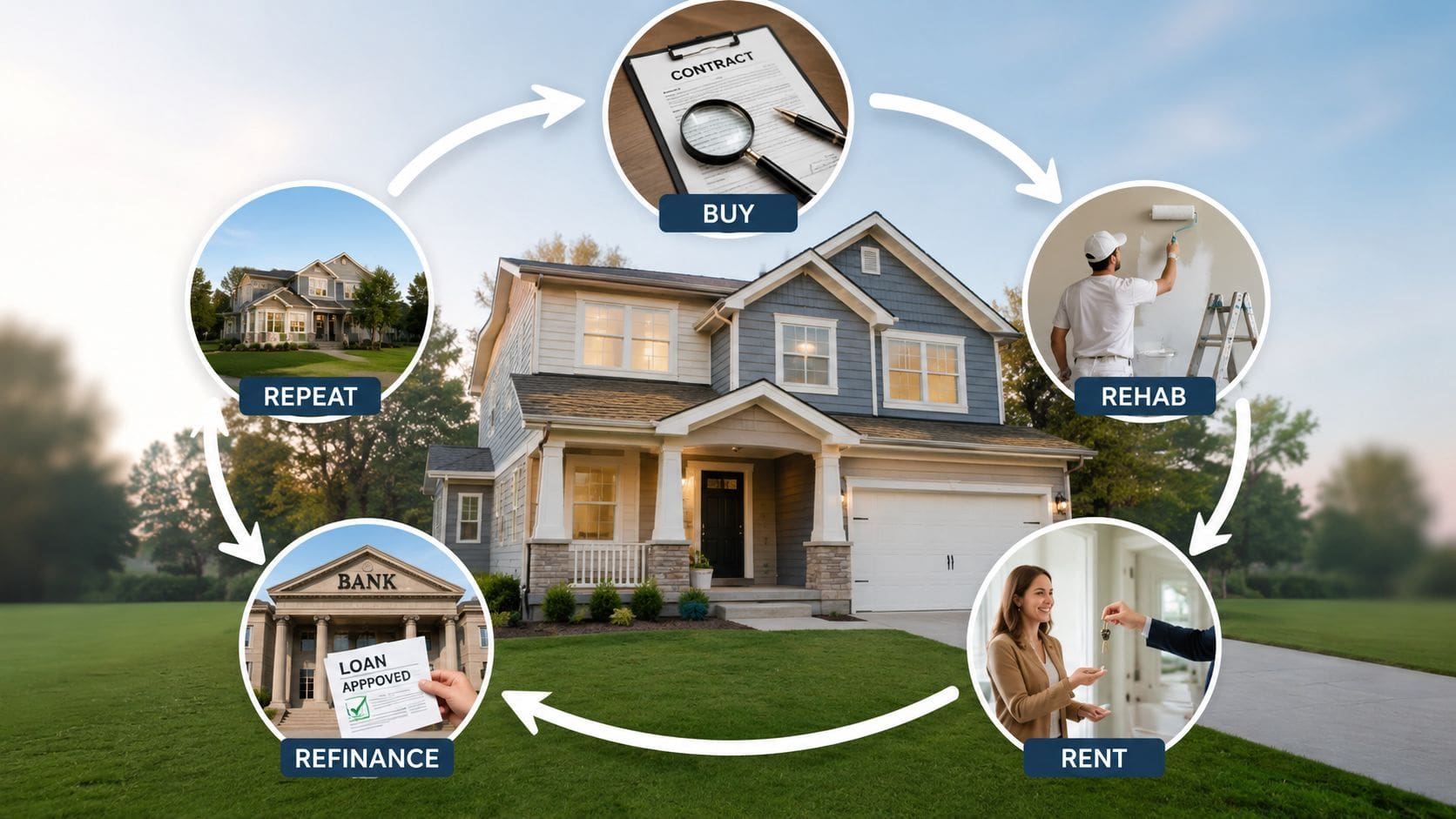
The BRRRR method is a real estate strategy for building a rental portfolio by recycling a single pool of capital through a 6-to-12-month cycle of buy, rehab, rent, refinance, and repeat. In practice, the refinance usually works only when you buy well enough and renovate well enough that the property can be refinanced at up to 75% loan-to-value, which is what allows you to pull cash back out and move to the next deal.
That's the problem most new investors are trying to solve. They buy one rental, it cash flows, and then they hit a wall because their money is stuck in that property. The BRRRR approach exists to break that bottleneck. Instead of waiting years to save another down payment, you improve the asset, stabilize it with a tenant, and try to convert trapped equity into deployable capital.
The textbook version sounds simple. Its practical application isn't. Today, the two issues that kill more BRRRR deals than anything else are refinance friction and rehab budgets that drift out of control. If you don't plan for both before you close, you can finish the project and still get stuck.
Your First Rental Is Just the Beginning
You close on your first rental and feel like you finally got in the game. Then the practical reality shows up. The property may be working, but the cash you used to buy it is tied up, and the next acquisition looks farther away than you expected.
That stall point is where a lot of investors either slow down or start making bad decisions. They chase thin-margin deals, overpay for cleaner properties, or assume a future refinance will bail them out. That's not a plan. That's hope with a deed attached.

Why BRRRR changes the growth curve
The answer to “what is the BRRRR method” isn't just the acronym. It's a financing strategy disguised as an investing strategy. According to this overview of the BRRRR method, it's a 6-to-12-month cycle built around buying a distressed property, rehabbing it, renting it, and refinancing at up to 75% LTV so you can recover capital and do it again.
That matters because one rental by itself doesn't create a portfolio. A repeatable capital loop does.
Who BRRRR is actually for
BRRRR fits investors who can operate actively for a short window, then hold long term. It's especially useful when you're willing to manage a project, solve a property problem, and think in terms of equity creation instead of just buying turnkey cash flow.
A few practical fit signals:
- You can analyze distressed property. You're comfortable valuing the deal based on where it can go after renovation, not just what it is today.
- You can manage a timeline. BRRRR rewards execution. Delays between closing, rehab, leasing, and refinance can crush the economics.
- You want rentals, not a one-time sale. This is a hold strategy. The refinance is the pivot point that keeps the asset in your portfolio.
The investor who treats BRRRR like a financing sequence usually outperforms the investor who treats it like a renovation project.
The 5 Steps of the BRRRR Method
A BRRRR deal usually looks solid at closing. The problems show up later, when the rehab runs long or the refinance comes in short. That is why each step has to be built around the exit from day one, not just the purchase.
Buy
Start with a property that has a clear path to higher value and stable rent. Cosmetic distress, dated interiors, deferred maintenance, and problem sellers can all create opportunity. Hidden foundation issues, bad layouts, title problems, or neighborhoods with weak rent demand usually create expensive lessons.
I underwrite the buy around two numbers. The finished value and the refinance proceeds. If those numbers do not leave room for mistakes, the deal is too thin.
If you need a quick refresher on how to calculate finished value, review this explanation of After-Repair Value or ARV.
Rehab
This step kills more deals than beginners expect.
The rehab has to do two jobs at the same time. It has to make the property rent-ready, and it has to support the appraisal for the takeout loan. Those are related, but they are not identical. New investors often spend on finishes that look good in photos but do little for rent, appraisal, or durability.
A better approach is to build the scope around value drivers:
- Repair major systems first, including roof, HVAC, plumbing, electrical, and structural issues
- Fix layout problems that hurt rentability or appraised value
- Use durable rental-grade finishes that hold up for the next tenant
- Carry a contingency reserve for change orders, hidden damage, and permit surprises
A simple rule I use is to assume the first budget is incomplete. If the numbers only work when everything goes perfectly, the numbers do not work.
Rent
The property needs more than a tenant. It needs documented income stability.
For the refinance file, lenders want to see a clean lease, market rent that makes sense for the area, and a property that looks professionally finished. Sloppy tenant placement creates two problems fast. Collections become shaky, and the lender starts questioning the file.
The operators who do this well screen hard, set rent based on current comps, and avoid pushing rent so aggressively that the unit sits vacant. VerticalRent covers that operating side well in its BRRRR Method guide for landlords.
Refinance
This is the step too many investors treat like a formality. It is not.
The refinance is where the lender checks every assumption you made. Did the rehab create value. Is the property leased at a supportable rent. Does the appraisal hold up. Do seasoning rules, DSCR requirements, or reserve requirements change the proceeds. A deal can look profitable on paper and still trap cash if the lender cuts value, reduces the loan amount, or asks for more documentation than you expected.
Underwrite the refinance before you close on the purchase. Know your target lender, likely loan terms, reserve requirements, seasoning period, and appraisal standard before you swing a hammer.
Repeat
Repeating only works if capital comes back out in a controlled way.
That means buying with margin, managing the rehab tightly, and solving financing early. Investors who scale with BRRRR are not just good at finding deals. They are disciplined about protecting the exit from budget creep and refinance delays.
That is the modern version of BRRRR. The textbook sequence still matters. The difference is that good operators now build each step around the two biggest failure points: rehab overruns and refinance bottlenecks.
BRRRR by the Numbers A Real World Example
You buy a house for $100,000, put $50,000 into the rehab, finish on schedule, and get it leased. On paper, the deal feels done. Then the appraisal comes in light or the refinance proceeds are lower than expected, and $20,000 to $30,000 of your cash stays stuck in the property.
That is the part newer investors miss. BRRRR is won or lost in the spread between your total cost and the value a refinance lender will recognize.
A practical rule many investors and lenders use is simple. If you want a strong shot at pulling all or most of your original cash back out, your all-in cost usually needs to stay around 75 percent of the after-repair value, sometimes lower once closing costs, interest carry, and lender reserves are included. The exact number depends on the refinance program, but the principle does not change. Buy with enough margin that a normal refinance can clear the debt and return capital.
The core equation
- Total Cost = Purchase + Rehab + Carry Costs + Closing Costs
- Maximum Refinance = Appraised Value × Allowed LTV
- Cash Left In Deal = Total Cost – Maximum Refinance Proceeds
Here is the clean version of the math.
| Metric | Amount | Notes |
|---|---|---|
| Purchase Price | $100,000 | Distressed property bought below stabilized value |
| Rehab Budget | $50,000 | Scope required to reach market rent and value |
| Total Direct Cost | $150,000 | Purchase plus rehab |
| Target ARV | $200,000 | Value needed for a 75% cash-out refinance to cover direct cost |
| Refinance LTV | 75% | Common benchmark for rental refinance underwriting |
| Maximum Refinance Proceeds | $150,000 | $200,000 × 0.75 |
| Capital Recovered | $150,000 | Covers direct purchase and rehab costs if value holds |
That example is useful, but it is cleaner than real life.
In an actual BRRRR deal, interest payments, lender fees, insurance, utilities, permit surprises, and a few weeks of extra holding time often push your real basis above the simple purchase-plus-rehab number. If the appraisal lands at $190,000 instead of $200,000, a 75% refinance only produces $142,500. That shortfall comes out of your pocket, not the lender's.
Where the math breaks
New investors usually do not miss the formula. They miss the inputs.
ARV gets stretched. Rehab bids come in too light. The scope grows after demolition. Rent assumptions get pushed to the top of the market. Then the refinance lender applies its own value, its own rent support, and its own reserve requirements. That is why a deal that looks strong in a spreadsheet can still trap cash.
I underwrite these deals with two filters. First, the buy has to leave room for mistakes. Second, the rehab budget has to survive a real contractor walk-through, not a guess made from listing photos.
A conservative acquisition rule helps. Many operators use a version of the 70% rule on the front end, meaning the maximum purchase price should leave enough room for rehab costs, financing costs, and profit after the property reaches its repaired value. It is not a law. It is a screening tool. In a tight market, that margin is often what protects you from the two biggest BRRRR killers: budget creep and refinance friction.
If you want to test multiple purchase, rehab, and ARV scenarios before making an offer, this fix and flip calculator for ARV and deal analysis is a practical place to start.
What this example teaches
The lesson is not that every BRRRR deal needs perfect numbers. The lesson is that basis matters more than finishes.
A clean kitchen helps rent the property. It does not fix an overpaid purchase price. Cheap debt helps returns. It does not rescue a rehab that ran 20 percent over budget.
Lenders also look beyond your spreadsheet. Credit profile, liquidity, existing debt, and documentation quality can affect whether your refinance closes as planned. If you need a better sense of those underwriting variables, Pinnacle's real estate mortgage resources give a useful overview of what can affect loan qualification.
The takeaway is straightforward. BRRRR works when you buy at the right basis, control the rehab tightly, and leave enough margin for a refinance that comes in a little lower or a little slower than planned. If the deal only works at the absolute best-case value and the absolute lowest rehab budget, pass and wait for a better one.
Financing Your BRRRR Deal The Right Way
You buy a property at the right basis, finish the rehab, place a tenant, and then the refinance stalls because the loan product never matched the plan. That is how a workable BRRRR deal turns into trapped cash.
Most financing mistakes happen at the front end. Newer investors often try to force one loan to cover purchase, rehab, and long-term hold. BRRRR works better when each phase has its own financing job.

Why the loan structure matters
A property that needs real work usually does not fit cleanly into conventional financing. The house may be vacant, the condition may be rough, and the closing timeline may be too short for a bank process built around stabilized properties and full income documentation.
That is why BRRRR is a staged capital strategy.
Short-term acquisition and rehab debt is built for speed, construction draws, and properties that are not rent-ready. The refinance is a different loan entirely. Once the work is done and the property is leased, the file is judged on the asset, the rent, and the finished condition. For many investors, that means debt structured around property cash flow instead of tax returns alone.
A financing sequence that fits the deal
A clean BRRRR capital stack usually follows this order:
- Buy with short-term capital. Use financing that can close on a distressed or underperforming asset.
- Fund the rehab with a realistic draw schedule. Make sure your lender's process matches your contractor timeline.
- Stabilize the property. Finish the work, place the tenant, and document rent clearly.
- Refinance into long-term rental debt. Exit into a loan that fits the property's income and your hold strategy.
Simple on paper. Harder in practice.
The two places I see deals break are draw management and refinance readiness. If your rehab funds come too slowly, the project drags and holding costs rise. If you wait until the project is done to ask whether the finished rent will support the exit loan, you are solving the wrong problem too late.
What lenders care about on the refinance
By the time you reach the exit, the lender is no longer financing potential. The lender is financing a completed rental property.
Three items usually decide whether the refinance works:
- Documented rent. A signed lease at a supportable market rate carries more weight than a pro forma.
- Finished condition. The property has to show as complete, durable, and rentable. Half-finished punch work can create valuation issues.
- Debt coverage. The income has to support the new payment with room to spare.
Borrower quality still matters. Credit, liquidity, reserves, and clean documentation can affect terms and approval speed, especially if the file has any weak points. For a broader breakdown of loan qualification factors, Pinnacle's real estate mortgage resources offer a useful overview. Investor underwriting is different from owner-occupied lending, but the same principle applies. Strong files close more smoothly.
The practical rule is simple. Set up the refinance before you close on the purchase. Know what the exit lender will require, what rent level the property needs to hit, how seasoning may affect timing, and how much rehab risk your budget can absorb. That is how you protect a BRRRR deal from the two problems that kill returns fastest: refinance friction and rehab overruns.
Strong BRRRR investors match the loan to the phase, then underwrite the exit before the rehab begins.
Navigating Modern BRRRR Risks
You buy the property right, the rehab goes close to plan, and the lease is signed. Then the refinance comes back short. The appraisal is lighter than expected, the lender wants more documented income history, or the debt coverage is thinner than your original model allowed. That is where a lot of BRRRR deals break now, not at purchase.

Refinance risk shows up late, but it starts early
The biggest mistake I see is treating the refinance like a formality. It is an underwriting event with its own rules, its own timing, and its own failure points.
Two problems cause most refinance headaches. The property value does not come in where the deal was underwritten, or the finished rent does not support the new loan well enough. Both issues can trap cash in the deal for months, and sometimes permanently.
The fix starts before closing.
Underwrite the exit with conservative rent and value assumptions. Confirm what your takeout lender will require for seasoning, lease documentation, reserves, and debt coverage. If you plan to use a DSCR product, study the lender's actual standards instead of assuming any leased property will qualify. A good starting point is understanding how a DSCR refinance loan for rental property investors is evaluated before you commit to the deal.
A few practices reduce refinance risk fast:
- Underwrite to a conservative appraisal. If the value comes in soft, the deal should still work well enough to protect your capital.
- Match the rehab to the neighborhood. Over-improving a rental rarely gets paid back at refinance.
- Document rent like a lender will review it. Signed lease, deposit trail, and clean tenant paperwork matter.
- Build the hold period around lender timing. Some refinance programs need more operating history than newer investors expect.
Rehab overruns hurt twice
Rehab overruns do not just raise your cash into the project. They also tighten your refinance exit.
If your original budget was thin, every extra repair dollar lowers your margin for error. A roof issue, electrical correction, plumbing replacement, or permit delay can change a solid BRRRR deal into a mediocre long-term hold. Older housing stock does this all the time, especially when the initial walk-through was rushed or the contractor bid was light.
Carry a real contingency reserve, usually in the 15 percent to 20 percent range for heavier value-add projects. That is not padding. It is protection against the work you will not see until demolition starts.
Cheap rehabs create their own problems. If the finish level is too low, the appraiser notices. So does the tenant pool. Lower rent, longer vacancy, and weaker valuation often follow.
The practical playbook
Experienced BRRRR investors handle these deals the way a lender would review them. Stress the file before the market does.
Ask three hard questions:
- If the appraisal comes in lower, how much cash stays trapped in the deal?
- If lease-up takes longer, can the property carry without forcing a bad refinance?
- If the rehab budget expands, do you still have enough liquidity to finish strong?
BRRRR still works. The margin for sloppy underwriting is smaller than it used to be. Investors who control refinance risk and budget creep are the ones who keep repeating the method.
BRRRR in the Southeast GA NC SC and TX
Real estate is local, and BRRRR gets local fast.
In Georgia and Texas, property taxes can change the shape of an otherwise acceptable rental very quickly. If your analysis is thin on taxes during the hold period or after refinance, your projected cash flow can look stronger on paper than it will in reality. Build your model around current assessed conditions and likely post-rehab operating reality, not just the acquisition snapshot.
State-specific operating notes
Texas adds another wrinkle because it's a non-disclosure state. That doesn't mean BRRRR can't work there. It means your ARV work has to be tighter. Verify comparable sales through the channels available to you, and don't stretch value just because direct sale-price visibility is less convenient.
North Carolina and South Carolina often reward investors who look beyond the biggest metros. Secondary markets can offer solid rental demand with less pricing pressure, but you still need to confirm rent depth at the neighborhood level. A good-looking deal in a growing city can still underperform if the immediate submarket doesn't support the lease rate you need.
What to focus on in these markets
A practical checklist for the Southeast:
- Georgia: Underwrite taxes and insurance conservatively on the long-term hold.
- North Carolina: Confirm rental demand street by street, not just city by city.
- South Carolina: Pay attention to local inventory and tenant profile, especially in smaller markets.
- Texas: Be extra disciplined with ARV support because direct comp visibility can be less straightforward.
If your strategy is refinance-driven, your local loan options matter as much as the property. Investors looking at rental exits in these states should understand how a DSCR refinance for investment properties is structured before they start chaining multiple BRRRR deals together.
From One Deal to a Portfolio with Sims Ventures
At its best, BRRRR turns one pool of money into a repeatable acquisition engine. That only works when the capital stack matches the business plan and the lender understands how investors operate.

The underlying force behind the strategy is velocity of capital. As The Real Estate CPA explains in its BRRRR strategy discussion, the method allows investors to recover their original capital within 6–12 months after rental stabilization and redeploy it into another acquisition without triggering capital gains tax from a sale. That's why experienced investors care so much about the refinance path. Without it, the cycle slows down and portfolio growth stalls.
Sims Ventures is built around that reality. The financing programs line up with the actual investor workflow: asset-based capital for acquisition and rehab, transition pathways for stabilization, and DSCR lending for long-term rental holds. That matters if you're operating in Georgia, North Carolina, South Carolina, or Texas and need a lender that looks at the property, the plan, and the exit together.
The other advantage is continuity. When the same lending relationship can support the early-stage project and the stabilized rental strategy, execution gets cleaner. You spend less time forcing a deal into the wrong loan box and more time protecting basis, managing rehab, and keeping your repeat cycle intact.
If you're building a rental portfolio and want financing that fits the actual BRRRR process, Sims Ventures can help you structure the deal from acquisition through refinance. Reach out to discuss your next project, pressure-test the numbers, and build a lending path that supports repeatable growth.
