

Why Flipping Houses Is a Bad Idea for Most Investors in 2026
Most house flipping advice starts with tactics. Find a distressed property. Buy below market. Renovate fast. Sell clean. Repeat.
That advice skips the first question that matters. Should you be in the flipping business at all?
If you strip away the TV edit, flipping is usually a thin-margin construction project funded by expensive money, exposed to delays, punished by taxes, and dependent on a clean resale at exactly the right time. Even worse, the business you build from it has a structural flaw most investors never think about. It has no durable enterprise value. You can work hard, get skilled, even make money, and still end up owning a demanding job instead of an asset.
That's the primary reason why flipping houses is a bad idea for most investors in 2026. The tactical risks are serious. The strategic dead end is worse.
The House Flipping Myth Versus a 33% Failure Rate
House flipping gets marketed like a shortcut. Buy ugly, make it pretty, cash a check. The problem is that the actual outcomes look nothing like the highlight reel.
Industry data shows that approximately 12% to 15% of all residential house flips nationwide in 2026 result in a net loss, with an additional 15% barely recouping initial capital after holding costs and closing fees, according to 2026 flip failure statistics. For first-time flippers, the risk jumps higher. Nearly 1 in 3, about 33%, will either break even or lose money on their initial project in that same source.
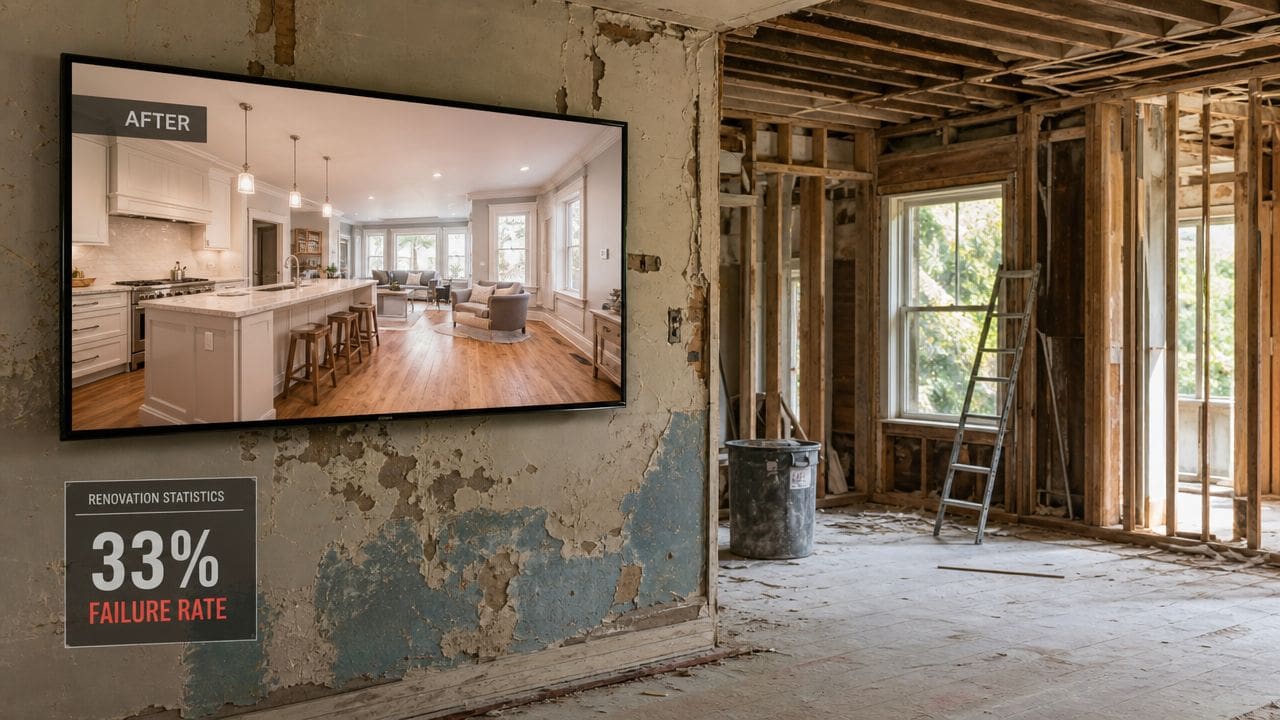
That's the part the glossy before-and-after format hides. A flip doesn't fail only when someone blows the rehab. It fails when the investor underestimates time, pays too much at acquisition, misses hidden repairs, or assumes the resale will happen smoothly because the kitchen looks good on camera.
What the myth gets wrong
The myth says flipping is investing. In practice, it's often speculation layered on top of construction management.
A real investor asks tougher questions:
- What if the contractor schedule slips: Carrying costs keep running whether the tile is installed or not.
- What if the resale takes longer than expected: The property doesn't care about your timeline.
- What if your estimate was optimistic: Small mistakes at purchase turn into permanent margin loss later.
Flipping isn't dangerous because one thing can go wrong. It's dangerous because several ordinary things can go wrong at the same time.
That's why experienced lenders look at flips with caution, especially from newer borrowers. The issue isn't ambition. The issue is that too many people enter the business thinking they're buying profit when they're buying exposure.
A better lens
The right question isn't, “Can this house be flipped?”
It's, “Does this project leave enough room for error after financing costs, repairs, delays, resale friction, and taxes?” Most of the time, the answer is tighter than people expect. And when the margin is thin, one missed assumption is enough to turn a promising deal into an expensive lesson.
Why the Perilous Math of a Flip Almost Always Wins
The flip usually goes bad long before demo day. It goes bad when the investor convinces himself that gross spread equals profit.
The cleanest way to see that is the 70% rule. The standard rule says an investor should pay no more than 70% of a property's after-repair value, minus repair costs. One commonly cited example is simple: if a home's ARV is $300,000 and repairs are $50,000, the maximum purchase price should be $160,000, according to this discussion of house flipping mistakes and the 70% rule.
The 70% rule is a ceiling, not a comfort zone
New flippers often treat that rule like a target. It isn't. It's a warning line.
If you pay more than that ceiling, you're squeezing the only thing that protects you from reality. That cushion has to absorb:
- Acquisition friction: Closing costs begin the minute you buy.
- Sale friction: You pay again when you sell.
- Carrying expense: Interest, taxes, insurance, utilities, lawn care, and basic upkeep don't pause while you wait.
- Market softness: Buyers don't reward your budget because you went over it.
A flip can look profitable on a napkin because people focus on ARV minus purchase minus rehab. That's not net profit. That's a sketch.
The costs investors leave out
Here's the version lenders pay attention to. It's not glamorous, but it's honest.
| Item | Projected Cost | Actual Cost | Impact |
|---|---|---|---|
| Purchase price | At or below the rule-based ceiling | Creeps above the ceiling during negotiation | Margin shrinks before work starts |
| Rehab budget | Initial contractor estimate | Grows after demolition and change orders | Profit gets squeezed fast |
| Financing carry | Short timeline assumption | Extends as project drifts | More interest and pressure |
| Taxes and insurance | Often treated as minor | Continue the entire hold period | Eats into net proceeds |
| Utilities and maintenance | Underestimated | Required to preserve showing condition | Adds silent monthly drag |
| Sale costs | Simplified or ignored | Real fees due at closing | Gross spread becomes thin net |
| Staging and marketing | Not always budgeted | Needed to compete for buyers | Extra expense to move the property |
That's why I tell investors to underwrite from the bottom line backward. Start with what you need to clear after every invoice and every closing statement adjustment. Then decide what you can pay.
A calculator won't save a bad deal
Tools help, but only if the assumptions are conservative. A good fix and flip calculator can force discipline around purchase price, rehab, and exit numbers. It can't rescue a deal bought on hope.
Underwriting rule: If the deal only works with a perfect rehab, a fast sale, and no surprises, it doesn't work.
The brutal part of flipping math is that it's unforgiving in both directions. Pay a little too much and the margin disappears. Sell a little below plan and the margin disappears. Hold longer than expected and the margin disappears. That's not a bug in the model. That is the model.
Execution Nightmares and Unavoidable Budget Blowouts
On paper, a flip looks like a sequence. Buy. Renovate. List. Sell.
On site, it feels more like triage. The crew misses a day. A permit sits. A subcontractor opens a wall and finds a problem nobody priced. The investor who thought he bought a real estate deal discovers he bought a job as a project manager, collections manager, scheduler, quality-control inspector, and stress absorber.
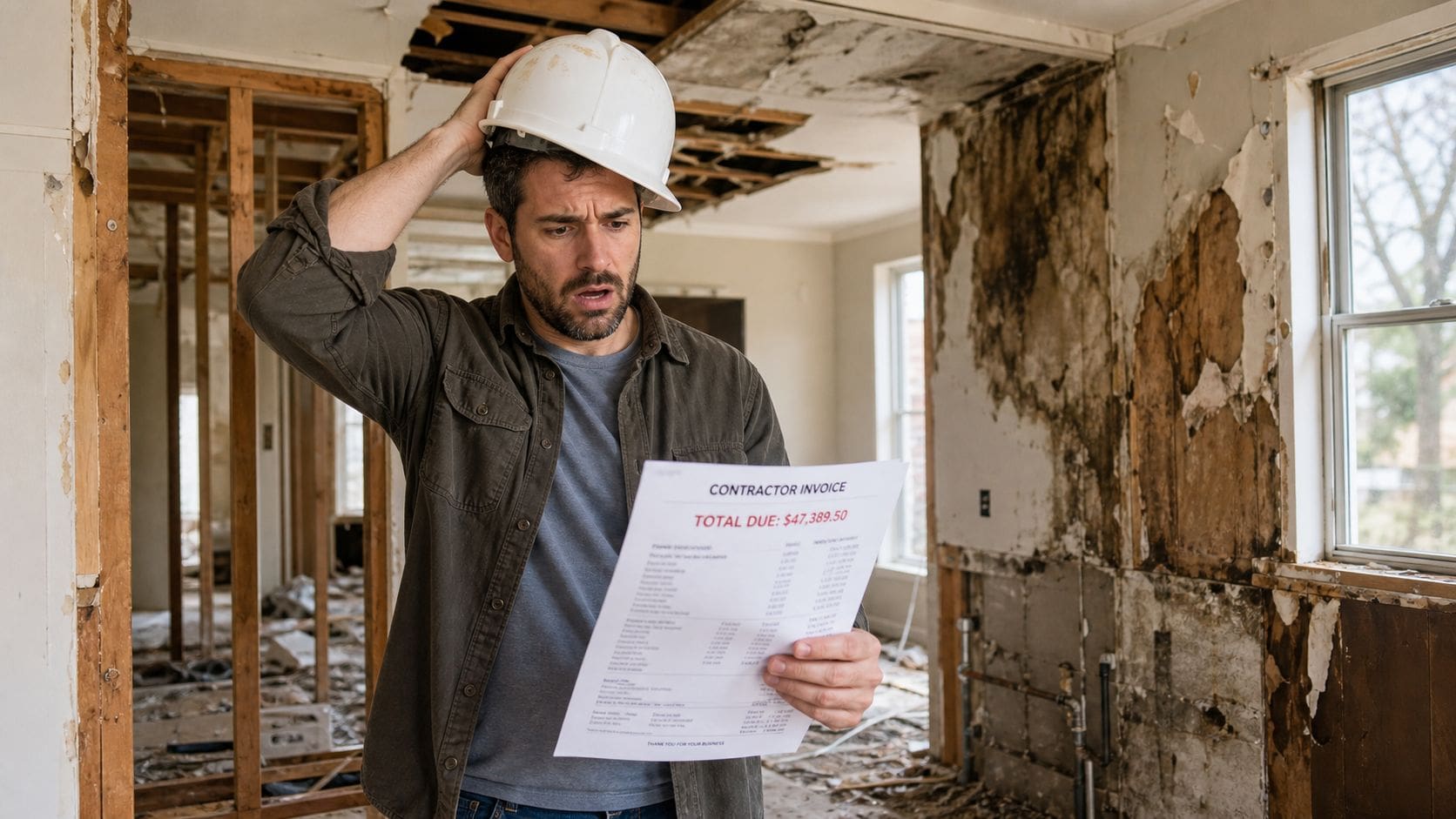
The numbers around execution are ugly. Renovation budget overruns occur in 60–70% of fix-and-flip projects, with average cost increases of 20–30% above estimates due to hidden structural defects. At the same time, holding costs build over a 6–9 month timeline and often consume 15–25% of projected ARV, according to this analysis of fix-and-flip overruns and holding costs.
The flip that goes sideways looks ordinary
Most bad flips don't implode in a dramatic way. They bleed.
A common sequence looks like this:
- The bid comes in light. The contractor prices visible work but doesn't own the unknowns behind walls, under floors, or inside older systems.
- Demolition reveals the truth. Electrical updates, water damage, framing issues, or foundation concerns move from “maybe” to “invoice.”
- The schedule starts slipping. Materials arrive out of order. Inspectors fail an item. One delay pushes three others.
- The resale window weakens. The house is finally done, but not on the timeline the original budget expected.
That pattern is why flipping punishes optimism. The project doesn't need a disaster to become a problem. It just needs a few ordinary setbacks.
Budget control is harder than people think
Construction budgeting isn't just about getting bids. It's about knowing which line items are fixed, which are allowances, and which are guesses dressed up as confidence. Teams trying to sharpen that side of the process can learn from broader field practices around MyOfficeOps on construction budgeting, especially regarding scope clarity and cost-control discipline.
For newer investors, another issue shows up fast. They don't have the bench.
A seasoned operator can often call a backup framer, a reliable electrician, or a second painter when the first one disappears. A beginner usually can't. If you don't already have that bench, building it mid-project is slow and expensive. A practical starting point is understanding the essential hires for a real estate rehabbing startup, because the wrong team will wreck even a decent deal.
A rehab budget is only as real as the people who can execute it on schedule.
Why this becomes a lifestyle problem
Many investors come to realize why flipping houses is a bad idea for them personally, not just financially. A flip demands constant intervention. It calls during dinner. It shows up on weekends. It punishes inattention.
If you like construction, vendor management, inspections, and daily problem-solving, that may be tolerable. If you thought you were buying passive profit, you bought the wrong asset class entirely.
The Tax Trap That Devours Your Profits
Even when a flip works operationally, the final number often disappoints for a simple reason. Gross profit is not spendable profit.
Flip income usually gets treated as short-term gain and taxed at ordinary income rates. That creates a different outcome than many investors expect when they first run the deal. According to this explanation of tax treatment for flips versus longer-term holdings, flipping houses typically incurs a 10–15% tax burden erosion due to short-term capital gains classification, with profits taxed at ordinary income rates that can reach up to 37% federal plus state rates, while long-term holdings may qualify for 15–20% capital gains rates.
Why a profitable flip can still feel disappointing
The investor sees a successful sale and focuses on the spread between buy and sell. The tax bill arrives later and reminds him that the government views this more like active income than patient investing.
That matters because flipping already carries heavy friction before taxes:
- You pay to acquire
- You pay to carry
- You pay to sell
- Then you pay taxes at a less favorable rate than long-term owners
By the time the dust settles, the “win” can feel a lot smaller than it looked in the original plan.
Buy and hold gets better tax treatment for a reason
Long-term rental owners operate in a different lane. They're building around cash flow, longer hold periods, and tax treatment that generally rewards duration and structure. They also have bookkeeping and documentation demands that get more important as a portfolio grows. For investors tightening that back-office side, resources like Superdocu simplifies tax form collection are useful because clean records matter when you're managing contractors, vendors, and property-related payments.
The tax code doesn't make flipping impossible. It does make it a less efficient way to build wealth.
That's the key distinction. A flip can still produce cash. It just tends to produce the least attractive kind of cash. It's hard-earned, irregular, and taxed in a way that strips out more of the upside than many beginners realize.
The Real Reason Flipping Fails The Zero Enterprise Value Trap
Most discussions about flipping stop at deal risk. That misses the deeper problem.
Even if you become competent at buying right, managing rehab, and selling clean, you still haven't built much of a business. You've built a machine that only earns when you keep feeding it deals. The minute you stop, revenue stops. There's no meaningful residual income. There's no recurring base. There's often nothing attractive to sell as an operating company.
That's the zero enterprise value trap. A flipping business is transactional by nature. Revenue ends when the property closes. According to this discussion of flipping as a zero-enterprise-value model, unlike rental portfolios that generate recurring cash flow, flipping has “zero enterprise value” because revenue ceases instantly upon the final sale of a property, making it difficult to systematize or exit for a lump sum. The same source notes that data from 2025 to 2026 shows ROI for flipping fell below 25% for the first time since 2008.
Why this matters more than one bad project
You can survive a bad deal. What's harder to fix is a business model that requires constant restocking.
A rental portfolio behaves differently:
- The asset keeps producing after acquisition and rehab
- Cash flow can continue without a sale
- Debt can be refinanced against income-producing property
- A larger portfolio can represent something durable and financeable
A flipping operation behaves like active labor wrapped in real estate. Yes, skill helps. Systems help. Team depth helps. But the core engine still relies on repeated transaction creation.
Jobs pay you once, assets can pay you again
That distinction changes how you should think about scale.
A lot of investors say they want freedom, but they choose a model that multiplies oversight, decision fatigue, and cash flow volatility. Every added flip means more moving parts, more execution risk, and more dependence on sale timing. If you step away, your pipeline stalls. If your pipeline stalls, your income stalls.
If the business stops paying the moment you stop working, you may own a job with overhead, not an enterprise.
That's the strategic reason why flipping houses is a bad idea for many. It's not only risky. It's also a poor foundation for long-term wealth if your goal is to build something durable, financeable, and eventually transferable.
Building Wealth Instead of Buying a Job Smarter Alternatives
The better path is usually the one that keeps the upside of renovation skill while removing the need for a quick sale. That means focusing on assets that can stabilize, produce income, and support future borrowing.
For many investors, that points toward rental strategies. Renovate for durability and rentability, not for a fast retail exit. Hold the property once it's stabilized. Refinance into longer-term debt tied to the property's cash flow. Then repeat carefully.

A stronger model than repeated flipping
One of the clearest frameworks is the BRRRR method for real estate investors. The mechanics matter less than the logic behind it. Improve the property, stabilize it with a tenant, refinance based on the income profile, and preserve control of the asset instead of selling the upside away.
That approach changes the investor's position in three important ways:
- It reduces dependence on perfect resale timing. You're not forced to sell just because the rehab is done.
- It turns renovation into a setup step, not the final payday. The work creates an income-producing asset.
- It creates something that compounds. One property can support the next without requiring a fresh retail sale every time.
For investors who want a broader perspective on that long-term mindset, this guide on how to build passive wealth with real estate is a useful companion read.
Where DSCR and Bridge-to-DSCR fit
Traditional financing often blocks investors because it leans hard on personal income documentation. That's not always the best lens for an investment property.
DSCR loans shift the focus toward the asset's ability to support its debt through property cash flow. For a landlord building a portfolio, that's often a better fit than forcing every deal through a conventional borrower profile. It aligns financing with what the property does.
Bridge-to-DSCR adds another useful layer. An investor can acquire and rehab with short-term financing, then move into longer-term DSCR debt once the property is ready and producing. That structure fits investors who are good at finding distressed opportunities but don't want to live on the sell side of every project.
When a flip can still make sense
There are cases where a fix-and-flip strategy works.
A few examples:
- An experienced operator with a proven crew: If the team is stable, bids are disciplined, and the exit market is well understood, flipping may be a tactical tool.
- A project with a clear resale mismatch: Some properties are better suited for sale than long-term hold.
- An investor using a flip as a narrow entry point: A short-term project can build experience, but it shouldn't automatically become the long-term business model.
The mistake is treating those exceptions like a universal blueprint.
What smarter investors do differently
They don't chase excitement. They chase repeatability.
They ask whether the property can survive a slower timeline. They care whether the financing structure supports the business plan. They think about refinance options before closing, not after the rehab. They look for assets that can keep paying after the construction dust settles.
That's how you move from transaction hunting to portfolio building. And that's how you avoid buying yourself a stressful job with no clean exit.
If you're investing in Georgia, North Carolina, South Carolina, or Texas and want help structuring deals around long-term wealth instead of one-off flips, Sims Ventures offers asset-based lending for rentals, bridge-to-DSCR transitions, fix-and-flip projects, and new construction. The team also provides practical guidance on deal evaluation, capital structure, and portfolio growth, which is often the difference between chasing transactions and building something durable.
