

Depreciation on Rental Property: A 2026 Investor’s Guide
Residential rental buildings are depreciated straight-line over 27.5 years under MACRS, which works out to about 3.636% of the depreciable basis each year. That deduction applies to the building, not the land, so the number that matters is your depreciable basis, not the contract price.
You can be sitting at a closing table, looking at a duplex that already cash flows, and still be told the IRS lets you write part of it off every year. That sounds strange until you remember what depreciation really is, a legal way to recover the cost of the income-producing structure over time, even while the rent checks keep coming in. For a landlord, that matters because the tax return, the loan file, and the eventual sale all react to the same paper entry in different ways.
If you've ever wondered why an asset you just bought can start losing tax value on day one, the answer is that the tax code treats the building like a wearing asset with a life span. The land underneath it doesn't wear out, so it stays off the depreciation schedule. That split between land and structure is where a lot of first-time investors get tripped up, and it's also where the planning starts.
Why Rental Depreciation Matters More Than Most Investors Realize
The moment this usually lands is at closing. You are looking at a settlement statement for a duplex, the roof looks new, the paint still smells fresh, and the tax rules still let you depreciate the building as if it is wearing out over time. That is not a loophole. It is the way income-producing property is treated, and the deduction keeps working even when the property throws off positive cash flow.
That is why depreciation on rental property matters to investors who care about the monthly spread and the loan file. It lowers taxable income without pulling cash out of your pocket, so the tax return can look leaner than the bank account does. The IRS treatment for residential rentals under MACRS makes the same basic point, the building is depreciated, not the land.
For a landlord, that paper deduction can change how a deal feels after tax. You collect rent, pay operating expenses, and still may have more cash left over than the tax return suggests. Depreciation often explains that gap.
Practical rule: If the property cash flows but the tax return shows less income, depreciation is often the bridge between those two numbers.
It also affects equity tracking. Each year you claim depreciation, your adjusted basis moves lower, so you are not just lowering current taxes, you are changing the math for a future refinance, sale, or exchange. That basis reduction is easy to ignore when you are focused on rent rolls, but it becomes very real when the asset changes hands.
For investors trying to scale, that matters because the tax side and the financing side are connected. A paper deduction can support after-tax cash flow today, while the lower basis can create a larger tax bill later if you sell without planning. That is why landlords who think only in terms of gross rent often miss the deeper value of the deduction, and why investors who think only in tax terms miss how it affects underwriting and exit proceeds.
If you are using borrowed funds to grow, this belongs in the same conversation as acquisition strategy. A useful starting point is how private money can support rental portfolio growth, because depreciation does not live in isolation. It shows up in the file, the forecast, and the sale.
How the 27.5-Year MACRS Rule Works
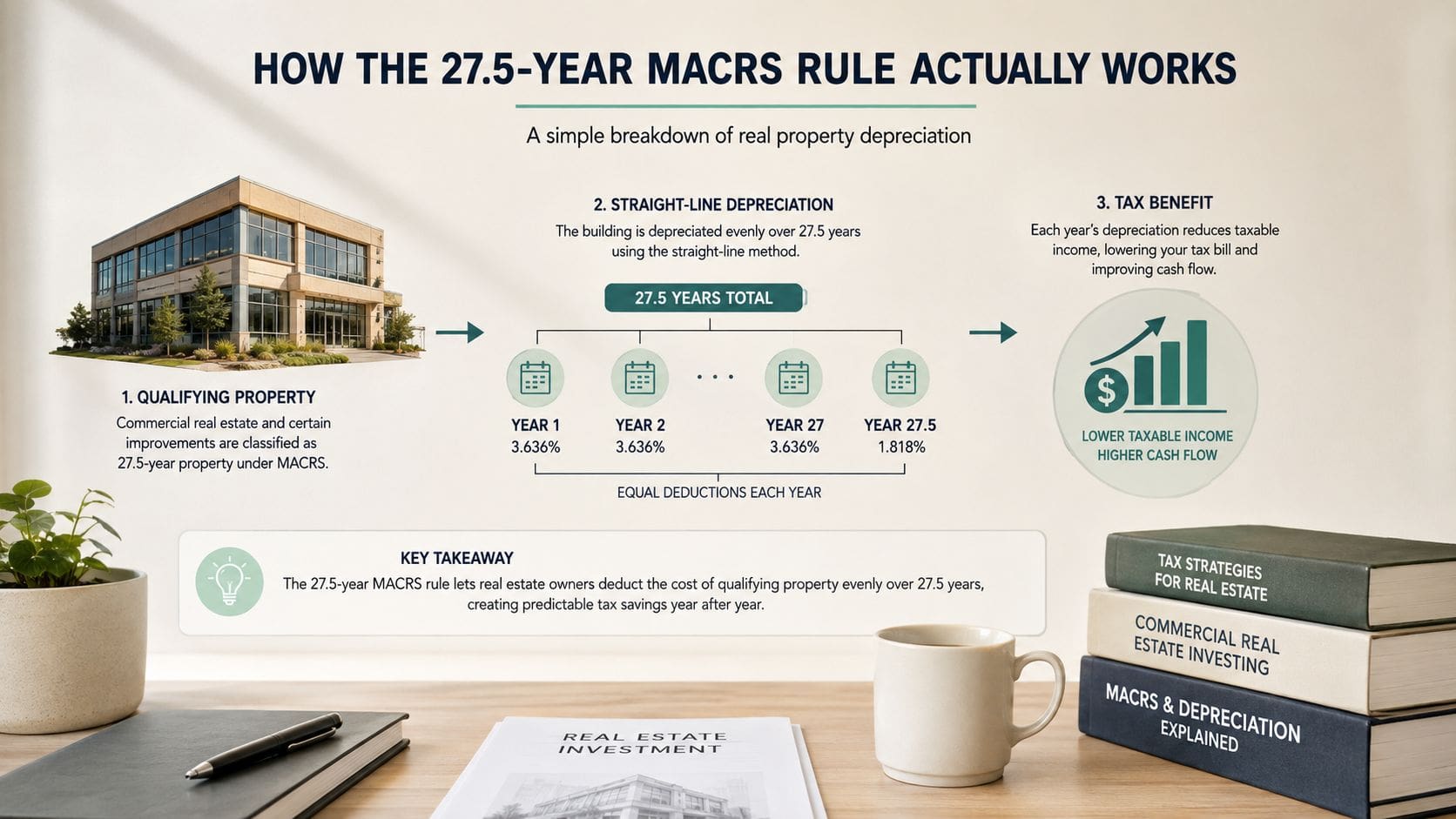
A landlord buys a property, starts collecting rent, and then learns that part of the building's value can be written off a little at a time each year. That is the basic idea behind MACRS for residential rentals. Residential rental property is recovered over 27.5 years on a straight-line basis, so the depreciable basis is spread evenly across the life of the building. The IRS also applies a mid-month convention, which means the first and last years are prorated instead of being treated like full 12-month years.
Start With The Right Basis
Your depreciable basis is not the purchase price you paid at closing. It is the portion tied to the building and other depreciable assets after you separate out the land. In practical underwriting terms, that means you begin with acquisition cost and capitalized closing costs, then back out the land allocation and keep any improvements on their own track.
A simple way to picture the math is to separate the property into parts that wear out on different schedules. The structure usually follows the 27.5-year rule, while items such as the roof, HVAC, and appliances may fall into shorter recovery periods or different treatment depending on how they are classified. That is why the tax basis on a rental property is rarely just one clean number, even when the deal itself looks simple on paper.
The Math In Plain English
Once you have the depreciable basis, the annual deduction is the basis divided by 27.5. That is the straight-line method in plain language, and it is the reason the same amount comes off each year except for the partial first and last years. For a $300,000 depreciable basis, the annual deduction works out to about $10,909, which is the math behind the 3.636% yearly rate.
For a landlord, the useful part is not just the formula. It is what the formula does to a deal. If you can estimate land value and isolate the structure value, you can get close enough to model how much income the tax return will show after depreciation, and that matters when a lender looks at debt service coverage. A property that looks tight on taxable income can still support the financing if the annual deduction lowers reported income enough to change the DSCR calculation.
If the land value is overstated, your deduction shrinks. If the structure value is higher, your annual write-off rises.
That is why experienced investors ask about basis early. The building portion drives the annual deduction, and the annual deduction flows into after-tax cash flow, loan qualification, and the eventual tax picture at sale. A deal can look fine at the headline rent level and still behave very differently once depreciation is in the file.
Worked Example From Purchase to Tax Savings
Say you buy a duplex for $350,000 and your land allocation is $70,000. That leaves a $280,000 depreciable basis for the building, and under the 27.5-year straight-line rule, the annual depreciation deduction is about $10,182. The exact first-year amount can be a little different because of the mid-month convention, but the full-year figure gives you a clean planning number.
| Sample Depreciation Calculation for a $350,000 Duplex | ||
|---|---|---|
| Line Item | Value | Notes |
| Purchase Price | $350,000 | Total acquisition price |
| Land Allocation | $70,000 | Not depreciable |
| Depreciable Basis | $280,000 | Building portion only |
| Annual Depreciation Deduction | $10,182 | $280,000 divided by 27.5 |
Now turn that into the tax side of the deal. If you're in a 25% federal bracket, that deduction can reduce federal tax by roughly $2,545 in a full year, before considering any state income tax effects. That is not cash in the mailbox, but it is real money that stays inside the investment instead of going to the IRS.
The more useful way to read the number is through underwriting. Mortgage principal builds equity, while depreciation lowers taxable income, so the essential question is after-tax cash flow. A property that looks tight on a tax-return basis can still leave usable cash after debt service and operating costs.
That gap is why lenders and investors can talk past each other. A bank may focus on loan metrics, while you care about what remains after tax. Depreciation sits in the middle of those two views. It does not change the rent check, but it changes what the rent check means to your bottom line and how the deal looks when a lender tests debt service coverage.
Investor takeaway: A property can be modest on paper and still be attractive after taxes because the deduction lowers the effective cost of ownership.
For deal analysis, the useful habit is simple. Estimate the land split, calculate the depreciable basis, and then stress the deal with and without the deduction. If the property only works when you ignore taxes, it is fragile. If it still works with taxes included, you have a stronger hold, and a cleaner starting point for exit planning because you already know how much tax benefit you are giving up as the basis runs down.
Accelerating Deductions With Cost Segregation and Bonus
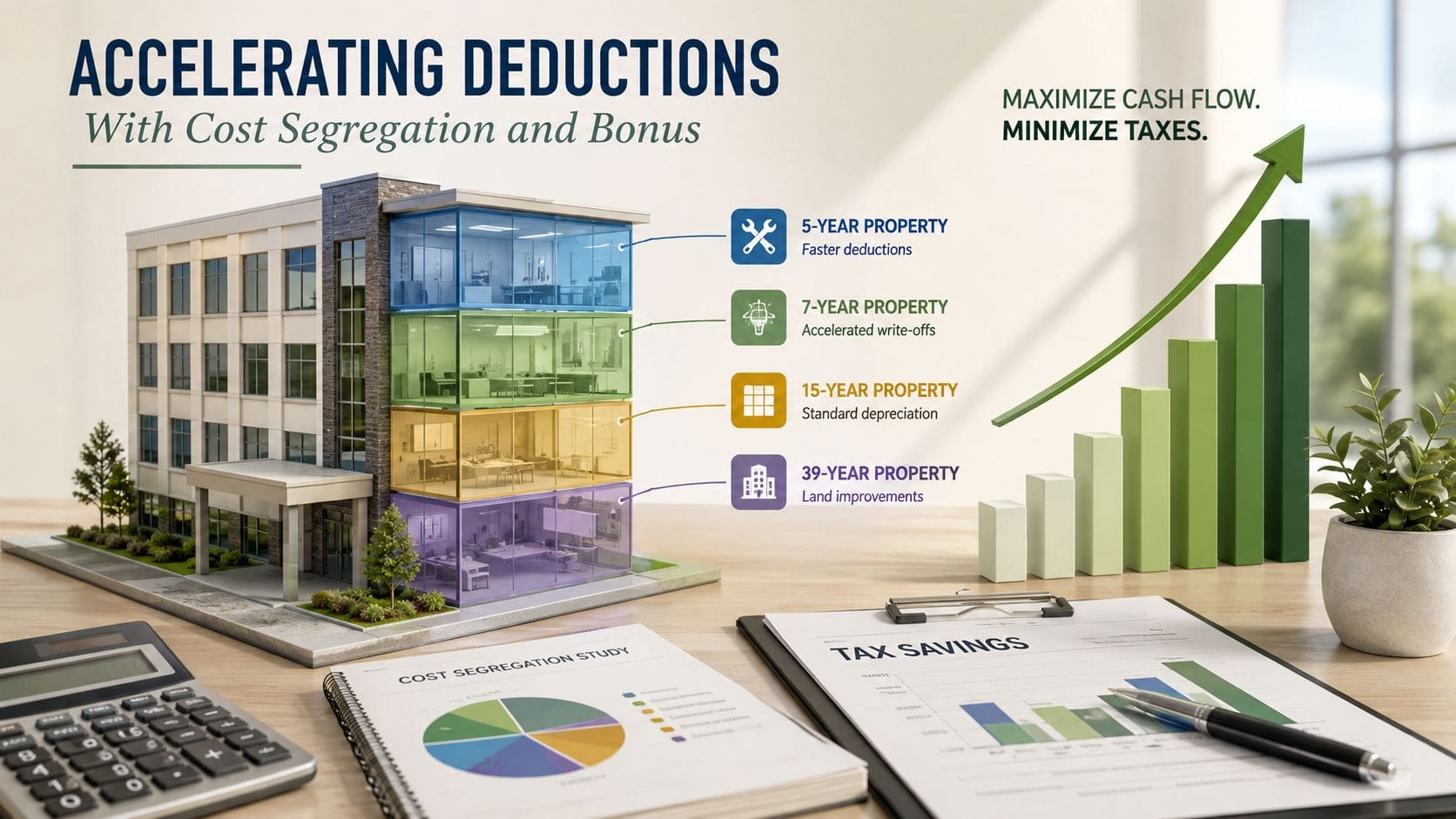
The next layer is breaking the property into component parts instead of treating everything like one lump of concrete and drywall. Some pieces of a rental wear out faster than the structure, so they can fall into shorter MACRS classes under IRS guidance on recovery periods. Appliances, carpeting, and certain fixtures can land in 5- or 7-year buckets, while land improvements may qualify for shorter lives than the building itself.
Why Componentization Changes The Timing
A cost segregation approach splits the asset into pieces, then assigns each piece to the right recovery period. That matters because faster write-offs bring the tax benefit forward, which can improve after-tax cash flow in the early years of ownership. It also means the adjusted basis falls faster, so you have to track what was claimed and where.
The trade-off shows up quickly once you compare the two paths. You get deductions sooner, but you also reduce basis sooner, which can matter on sale. Asset-by-asset tracking keeps that trade clear, and it avoids the mess of treating every line item as if it were part of the same recovery period.
A practical rule of thumb is to ask whether the property has enough structure and improvements to justify the extra analysis. Larger acquisitions and properties with meaningful land improvements tend to create more opportunity for reclassification. Smaller deals can still benefit, but the study has to make sense against the size of the basis and the amount of short-life property on site.
Where Bonus Fits In
Bonus depreciation can accelerate some of those shorter-lived components even further when the asset qualifies. The exact amount depends on the placed-in-service date and the property type, so the rule follows the tax law in effect for that asset. For investors, the important point is the direction of travel. More front-loaded deductions can help short-term cash flow, but they also push more basis reduction into the early years.
If you are weighing a study, treat the recordkeeping as part of the decision, not an afterthought. The deduction helps only if you can defend the classification later and reconcile it at sale. That is also why a clean schedule matters in a DSCR refinance review, since lenders care about the building's cash flow while the tax file still has to support the depreciation claimed.
How Depreciation Affects DSCR and Portfolio Underwriting
Debt Service Coverage Ratio, or DSCR, is the lender's way of asking whether the property throws off enough income to pay the debt. In plain English, it compares the cash a rental produces against the mortgage payment, and many DSCR programs care far more about the property than about your personal tax return. That's why depreciation can look invisible on one side of the file and still matter on the other.
Where The Tax Return And Loan File Diverge
Depreciation lowers taxable income, but it doesn't reduce actual cash collected from tenants. So a rental can look tight on a tax return and still qualify for financing if the property's cash flow supports the debt. Some lenders also adjust income by adding back non-cash items when they review the file, which is why a property that appears negative after depreciation can still make sense in a DSCR refinance.
That distinction matters for portfolio investors. You're often trying to show two different truths at once, one to the IRS and one to the lender. The IRS cares about allowable deductions, while the lender wants to see that the building can carry itself.
A clean rent-roll and expense package helps here because it shows the operating picture without letting tax accounting distort the picture. For a refinancing conversation, that means the depreciation line item should be understood, not feared. It can lower taxable income while leaving the cash story intact.
Practical rule: Don't confuse a tax loss with a cash loss. Underwriting looks at the property's ability to pay debt, not just the tax return's bottom line.
If you're packaging a refinance, you want your schedule to separate operating income, debt service, and the tax effects of depreciation. That gives the lender a fair view of the asset. For a simple starting point on DSCR-focused financing, this refinance resource fits the conversation because it centers the property's cash flow instead of personal income documentation.
The key investor takeaway is that depreciation can help twice. It can reduce taxable income today, and it can coexist with strong DSCR if the property is performing. That's a useful combination when you're trying to move from one deal to the next without letting taxes or financing block the path.
Depreciation Recapture and the Hidden Tax Bill at Sale
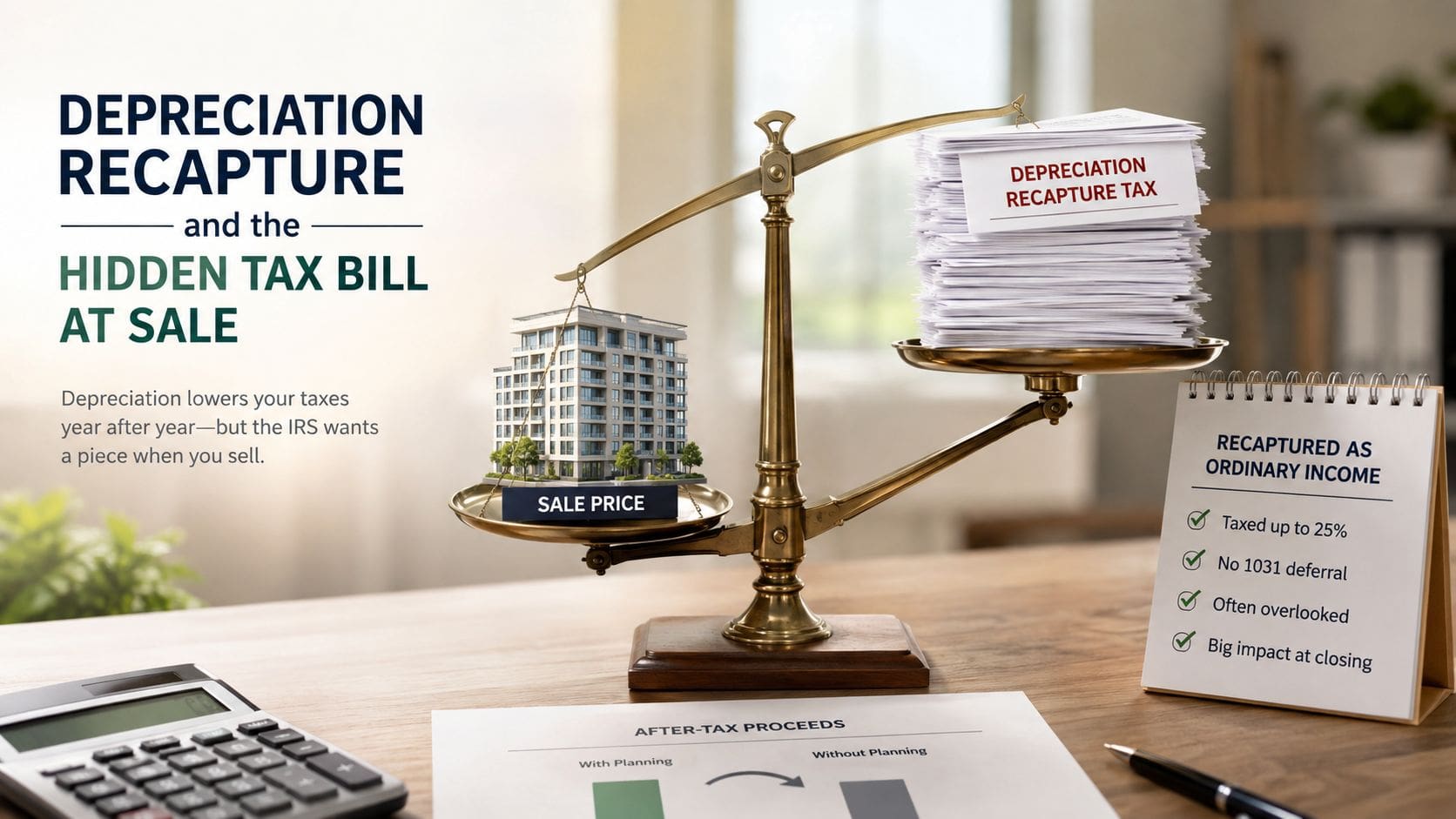
Depreciation is a deferral, not a permanent tax gift. When you sell, the IRS looks at your adjusted basis, and that basis has to be reduced by depreciation allowed or allowable. That means even missed depreciation can affect the gain calculation later. The deduction feels helpful while you own the property, then the rules tighten at disposition.
Why The Exit Changes The Math
A rental sale can create unrecaptured Section 1250 gain, which is tied to the depreciation taken on the building. That is the point where many landlords realize the annual write-off lowered current taxable income, but it also reduced basis and set up a later tax bill.
The surprise is usually bigger for investors who have held a property for years without keeping a clean depreciation schedule. Each year's deduction chips away at basis, so the taxable gain at sale can be larger than the owner expected from the listing price alone. The closing statement shows cash proceeds. The tax return can show something very different.
A simple example makes the mechanics easier to see. If you have accumulated $100,000 of depreciation and later sell the property for $50,000 above original basis, the recapture calculation can still create a meaningful federal tax bill because the depreciation already reduced your tax basis. The profit on paper is not the same thing as the taxable result.
The Missed Depreciation Problem
The IRS rule on allowed or allowable depreciation means skipping the deduction does not erase it for basis purposes. You can fail to claim it and still end up with a reduced basis in the gain calculation. That surprises a lot of first-time sellers, because unused depreciation feels harmless. It isn't.
If you plan to sell, basis tracking matters more than memory.
Portfolio strategy matters here too. Investors who expect to sell in the middle years of ownership need to think about the tax exit before they celebrate the tax entry. A 1031 exchange often comes into the conversation because it can defer recognition of gain when the property is swapped into another like-kind asset, but the structure still needs careful handling with a CPA and qualified intermediary. The bigger lesson is straightforward, the longer you hold rentals, the more important your depreciation ledger becomes.
For investors who want liquidity without a sale, a cash-out refinance can sometimes release equity while the depreciation schedule stays in place. This cash-out refinance resource fits that planning conversation. It does not erase tax rules, but it can change when you face them.
Exit Strategies That Soften The Recapture Bite
A sale doesn't have to mean handing the IRS the whole recapture check in one shot. A 1031 exchange can defer recognition of gain when you swap into like-kind replacement property, and that's why it stays central to many landlord exit plans. An installment sale can spread gain across tax years, which may soften the immediate hit if the deal structure supports it.
Timing matters too. If you're close to a sale, your CPA should look at how the transaction lines up with your broader income picture, because the tax result isn't just about the property, it's about the year. Some investors also consider whether a partial owner-occupant history changes anything, but that needs careful review before anyone assumes an exemption applies.
The biggest mistake is waiting until the closing statement is already in motion. By then, the advantage is gone. If you start the conversation early, you have more room to decide whether to sell, exchange, refinance, or hold.
Practical rule: Talk to your tax pro before you list the property, not after you accept the offer.
For investors thinking about liquidity without triggering a full sale, a cash-out refinance can sometimes pull equity out while keeping the depreciation schedule alive. That's why this cash-out refinance resource belongs in the planning stack. It's not a tax escape hatch, but it can change the timing of the tax conversation.
Recordkeeping, Working With a CPA, and Putting It All Together
Good depreciation work starts on day one. Keep the closing statement, the land allocation support, capital improvement invoices, cost segregation reports if you use them, and every annual depreciation schedule tied to the property. If the IRS ever asks how you arrived at your basis or why assets were classified a certain way, clean records save time and stress.
That's even more important once you have multiple properties. A depreciation software system or a CPA-prepared study can be worth the expense when the portfolio gets larger, because manual tracking gets messy fast. The more assets you own, the easier it is to lose track of component lives, prior deductions, and basis adjustments.
Call a CPA before any sale, before any cost segregation study, and before layering depreciation into a 1031 exchange. If you're also building a financing strategy around DSCR, make sure the tax story and the loan story line up cleanly. Investors who scale well usually treat depreciation as part of the capital stack, not as an afterthought.
For landlords building across Georgia, the Carolinas, and Texas, that discipline matters because the goal isn't just a deduction. It's a cash-flow-positive portfolio that can support lending, survive a sale, and keep the next acquisition moving. Sims Ventures works with investors on DSCR refinance and purchase loans, along with broader deal and portfolio planning, so the financing side stays aligned with the tax side when you're growing.
If you want help thinking through how depreciation, DSCR, and exit planning fit together in a rental portfolio, visit Sims Ventures and review the financing and advisory options built for investors who need clear, deal-focused guidance.
