

Private Money Lending: A Real Estate Investor’s Guide
You're under contract on a deal in Atlanta, Charlotte, or outside Dallas, and the clock's already beating you. The seller wants proof of funds, your bank wants more paperwork, and the property that looked cheap on Friday starts looking expensive by Tuesday because financing dragged. That's where private money lending stops being a buzzword and starts being a decision.
Used correctly, it's a tool for speed, asset-based approval, and certainty of close. Used carelessly, it's an expensive way to overpay for a bad deal, get trapped by fees, or sign terms you didn't really read. The smart move isn't “private money good, bank bad.” The smart move is knowing which one closes the deal you have.
When a Bank Is Too Slow and a Deal Is Slipping Away
A fix-and-flipper finds the right house in metro Atlanta, locks it up at a discount, and signs a tight closing deadline. The plan is simple. Buy fast, renovate, exit clean. Then the bank comes back with more tax returns, more income verification, and a process that does not fit the seller's clock. The deal starts slipping.
Borrowers call a private lender at that point because the loan is judged on the deal itself, not just the borrower's paperwork stack. That is the whole advantage. Private money lets you move on property, equity, and exit, which is why it has moved from a small corner of the market into a real financing option. For a broader view of how lenders are already using private credit channels, see the Federal Reserve data on private credit lending.
Practical rule: If the property cannot wait on a bank's calendar, private money is the first conversation you should have.
Southeast investors keep this option close because speed matters in GA, NC, SC, and TX. Renovation buys, builder schedules, and quick resales punish delay. Miss the close window and the deal can fall apart, even when the numbers made sense on day one. The question is simple. Does the cost of waiting hurt more than the cost of faster money? If you need a clean way to judge that tradeoff, review these signs you need a private lender.
What Private Money Lending Actually Means
A seller wants to close fast. The bank wants more documents, more verification, and more time. Private money lending steps in when the deal needs a lender who underwrites the property first and the paperwork second.
Private money lending is non-bank, asset-based financing. The lender looks first at the property, the exit, and the equity cushion. Your W-2, tax returns, and debt-to-income ratio matter, but they do not drive the decision the way they do with a bank.
That changes the conversation at the table. A bank asks whether you fit its box and can prove stable income. A private lender asks whether the deal makes sense and whether the collateral can carry the loan if the plan gets messy. Self-employed investors, flippers, builders, and landlords with uneven income usually get a fairer hearing here because the loan is tied to the asset and the exit, not just the borrower's tax file.

The language lenders actually use
If you want to read a term sheet without guessing, learn the shorthand.
- Hard money means short-term, collateral-heavy lending.
- Bridge loan means temporary financing until a property stabilizes or a longer loan takes over.
- DSCR means debt service coverage ratio, which measures whether the rent supports the payment.
- ARV means after-repair value, the expected value after renovation.
- LTC means loan-to-cost, a cap based on total project cost.
Those terms are not decoration. They tell you what risk the lender is pricing. In private credit, underwriting has increasingly been shaped by institutional capital, not just individual lenders, which is one reason the market is no longer a side street. That shift matters in the Southeast, where borrowers in GA, NC, SC, and TX are often comparing speed, flexibility, and deal fit instead of just chasing the lowest headline rate.
Bank loan or private loan
A private lender does not replace a bank in every situation. It replaces a bank when the deal needs speed, structure, or flexibility that a conventional lender will not give you. If you can wait, document everything neatly, and fit long-term underwriting, a bank can still be the cheaper answer. If the property has a short fuse, the bank is the wrong first call.
The Main Loan Products Investors Actually Use
Private lenders don't sell one generic loan. They sell different tools for different investor problems, and that's what borrowers need to understand before they waste time shopping the wrong product.
Match the loan to the job
- DSCR purchase or refinance loans fit stabilized 1 to 4 unit rentals. These are for landlords who want the property's cash flow to drive the decision rather than personal income docs.
- Bridge-to-DSCR loans fit properties that need cleanup, seasoning, or stabilization before they can support longer-term rental debt.
- Fix-and-flip loans fit projects where the exit depends on renovation execution and resale timing.
- Ground-up construction loans fit builders who need capital released in stages as the project advances.
- Builder's line of credit fits investors running several projects at once and needing repeat access without restarting the same process every time.
- Cash-out or rate-term refinances fit landlords sitting on trapped equity and wanting to recycle capital into the next acquisition.
The product choice matters because each one solves a different constraint. A stabilized rental with solid cash flow should not be financed like a rehab project. A spec home under construction should not be forced into a rental box. That mismatch is where borrowers overpay, because they accept a structure that doesn't fit the deal.
The private lending market has also become more segmented by use case. AAPL's data show RTL originations rose 65% from 2021 to 2024, while DSCR originations rose 9%, and average RTL loan size increased from $451,000 to $512,000 while average DSCR loan size fell from $407,000 to $357,000. AAPL industry data on loan mix and sizing
Borrower takeaway: If your property isn't stable yet, don't force it into a long-term rental loan. Use a bridge structure, then refinance when the asset is ready.
For the Southeast investor, the market gets practical here. In GA, NC, SC, and TX, many borrowers use bridge capital first, then roll into DSCR once the asset is seasoned. That path is common because speed gets the deal closed, and stabilization gets the debt cheaper later.
DSCR Underwriting vs Income-Doc Underwriting
A bank wants to know who you are on paper. A DSCR lender wants to know what the property earns. That's the cleanest way to understand the difference.
Income-doc underwriting looks at tax returns, W-2s, employment history, and debt-to-income ratio. DSCR underwriting looks at whether the rent covers the debt payment with enough room to justify the risk. If you're self-employed, paid through distributions, or building a rental portfolio, that difference is not minor. It's often the whole deal.
| Factor | Income-Doc (Bank) | DSCR (Private Money) |
|---|---|---|
| Primary focus | Borrower income and tax profile | Property cash flow |
| Typical borrower fit | W-2 borrowers with clean documentation | Landlords and self-employed investors |
| Approval question | Can the borrower prove personal repayment capacity? | Does the rent support the payment? |
| Speed | Slower, more document-heavy | Faster, more deal-focused |
| Best use case | Stated-income is not needed, and time isn't tight | Rental purchases and refis tied to property performance |
A DSCR loan works best when the property can stand on its own. That's why many investors use it for stabilized rentals and portfolio growth. It's also why DSCR often feels friendlier to people whose income is strong but not neatly packaged for a bank.
A common benchmark is a 1.20 DSCR, which means the property's income is producing more than the payment requires. You don't need to worship that number. You need to understand what it signals, enough cash flow to support the debt and leave the lender a cushion. That's why DSCR can still reject a deal that looks fine to the borrower, if rent, debt levels, or reserves don't line up.
For a quick way to think through a rental deal, use this DSCR loan calculator.
Rule of thumb: If your income lives on 1099s, K-1s, or rental cash flow, DSCR usually deserves a hard look before you waste time chasing a bank.
What Private Money Actually Costs and How Fast It Closes
A private money term sheet lives or dies on four numbers. If you miss any of them, you are not reading the deal, you are skimming it.
First is the interest rate. Second is points, the upfront origination fee. Third is the borrowing cap, which may show up as LTV, ARV, or LTC depending on the loan. Fourth is the term length. Those four items tell you the actual cost and the actual risk.
The pricing looks steep next to bank debt because the lender is getting paid for speed, rehab risk, draw risk, and the ability to recycle capital fast. Private lending for fix-and-flip loans is commonly priced around 10% to 13% interest with 1.5 to 3 points and 65% to 75% ARV, DSCR rental loans are commonly 7.5% to 10% with 70% to 80% LTV, and construction loans are commonly 11% to 14% with 2 to 3.5 points and 60% to 70% LTC. Private lending pricing and borrowing capacity ranges
A private lender is not trying to act like a bank. A bank underwrites patience. A private lender underwrites execution.
What good looks like
A clean term sheet lays out the rate, points, borrowing cap, term, and prepayment language in plain writing. A sloppy one hides the cost until you are already committed.
Speed is the other half of the deal. A close around 15 days is realistic when appraisal, title, and underwriting move at the same time. What usually slows a file is not the rate. It is lien payoffs, entity documents, title defects, or missing project paperwork.
Analysts at AAPL found private-lending interest rates staying close to 11% across a reported period, ranging from 10.97% in April to 11.27% in September. That is a useful reminder that rate sheets in this space usually move inside a fairly tight band for similar risk profiles. AAPL industry trend data on pricing and growth
Watch the fee stack, not just the rate. A deal can look cheap on interest and still be expensive once points, extension risk, and prepayment terms hit you.
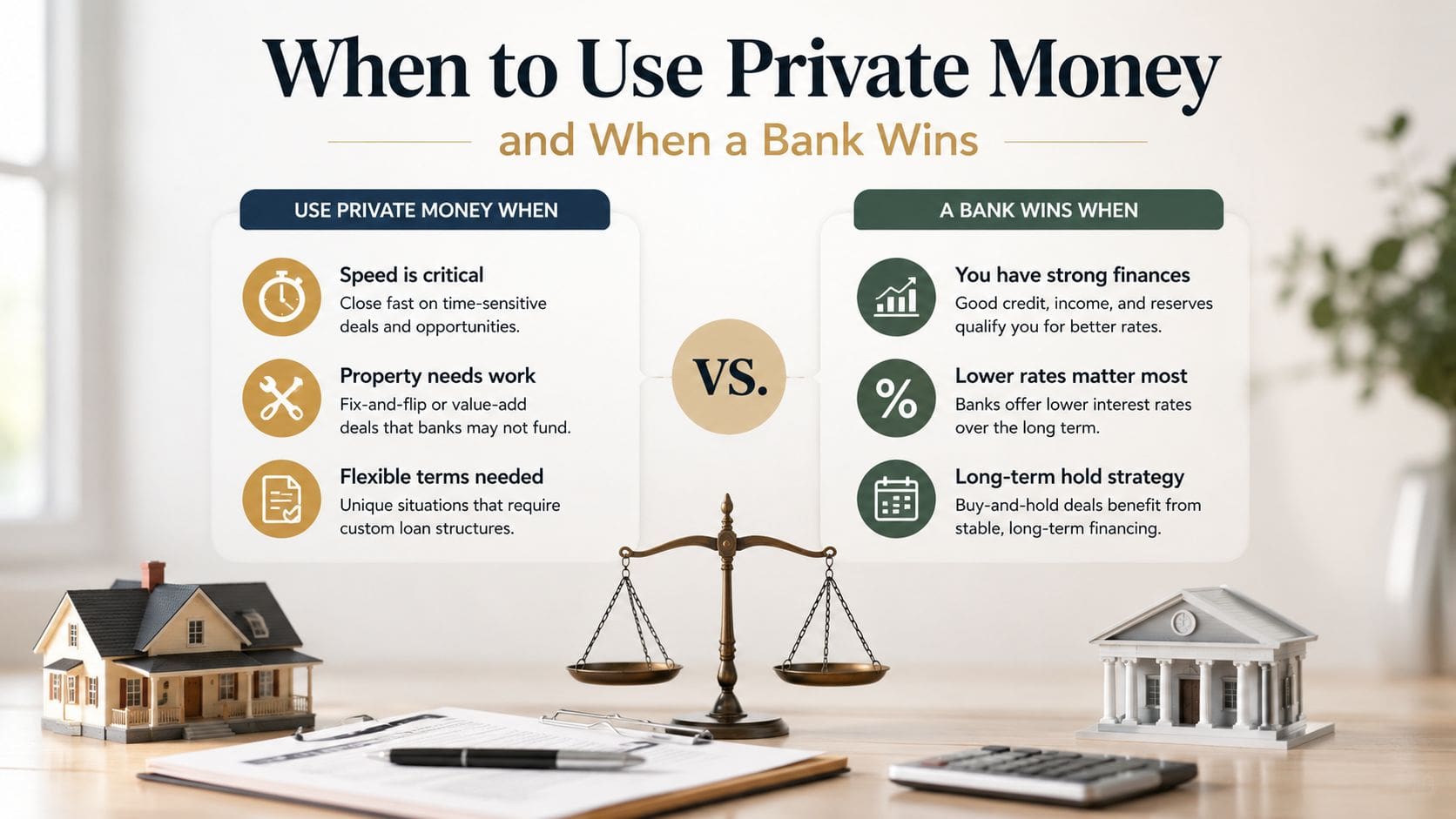
When to Use Private Money and When a Bank Wins
Private money wins when time, structure, or borrower profile makes bank debt the wrong tool. A bank wins when the property is stable, your documents are clean, and you can afford to wait. That's the decision.
Private money is strong because it's flexible. It can fund rehabs, new construction, bridge situations, and borrowers who don't fit bank underwriting. It can also let you move capital from one deal to the next without waiting on a full personal-income review every time. But the price is higher, and the points matter more when the term is short.
The bank wins on cost and sometimes on scale. If you've got a stabilized rental, clean documentation, and at least enough time for the process to breathe, conventional debt can be the better long-term answer. If the deal needs speed, if the asset needs work, or if your income doesn't fit the bank's box, you're probably already out of that lane.
Southeast market reality
In GA, NC, SC, and TX, the decision often comes down to market tempo. In hot investor corridors, appraisal timing can be tight, renovation schedules get compressed, and build-and-rent strategies need capital that won't stall the job. That's where private money often beats waiting on a bank that needs a longer runway.
There's also a useful policy lens here. The literature on underserved markets warns that weak access-to-capital settings can drift toward predatory lending when transparency is low, while better practice calls for clearer pricing, better data, and more standardized underwriting. That's why a private lender should explain the deal in plain English, not hide behind jargon or rush you past the fee stack. Policy research on underserved lending and transparency
If you want one blunt rule, use it here. Use private money for timing and structure. Use a bank for stability and lower cost. Don't force a deal into the wrong bucket just because the payment looks nicer on the first page.
Three Real-World Scenarios From the Southeast
A flipper in Atlanta finds a sub-$200K property, signs a contract, and needs to close in 14 days. The lender funds the acquisition and rehab with an ARV-based structure, the project gets finished, and the borrower refinances into a DSCR loan once the property is ready to hold. That's a classic bridge-to-permanent path.
A landlord in Charlotte owns three stabilized single-family rentals and wants cash out for a fourth purchase. Tax returns would slow the process and distract from what matters, the rental income already supports the debt. DSCR makes sense because the properties themselves are doing the work.
A small builder outside Dallas needs construction capital for a spec home. The loan is drawn in stages as milestones are hit, which keeps the lender's exposure aligned with progress instead of funding the whole project upfront. Once the home is stabilized, the builder takes it out with longer-term debt.
What these three deals have in common
- Speed mattered first: None of these borrowers could afford bank friction at the front end.
- The collateral told the story: The property, the plan, and the exit drove the decision.
- Each borrower had a next step: Refi, cash-out, or take-out financing was already part of the structure.
That last point is the one borrowers miss. Private money should not be a dead end. It should be part of a financing sequence that gets you from acquisition or construction to a cleaner long-term debt position.
In the Southeast, that sequence is common because investors are often working across multiple projects, not just one. A private lender solves for the gap in front of you. A good borrower also thinks about the exit behind it.
What to Gather Before You Talk to a Private Lender
Walk into the first conversation prepared, and you get a real answer faster. Show up vague, and you get a vague quote.
For a purchase or flip, bring the property address, the purchase contract, your entity documents such as the LLC operating agreement and EIN, and an insurance binder if you already have one. For a rehab deal, add a line-item rehab budget. For a rental, bring the rent roll and an operating statement. For construction, bring the budget and draw schedule. If you want a clear read on borrower readiness, review these hard money loan qualifications.
Ask the lender these questions
- What are the rate, points, borrowing cap, and term in writing? If they won't spell it out, keep moving.
- Do you underwrite in-house? If not, ask who makes the credit decision.
- What does your bridge-to-DSCR or take-out path look like? You want to know the exit before you close the entry.
- How fast can you quote once you have the documents? Speed matters, but only if the quote is real.
- What fees hit at closing, and what fees can hit later? That includes extension risk and any prepayment language.
The warning signs are plain once you know the trade. If a lender gets fuzzy on points, hides prepayment details, asks for large upfront fees before underwriting, or pressures you to sign before you see the term sheet, walk away. If they refuse to discuss DSCR minimums on a rental deal, they are not being selective. They are being unclear.
Use the lender's paperwork test: if the documents feel cleaner than the explanation, you are probably on the right track. If the explanation is smoother than the paperwork, you are probably not.
Sims Ventures works in this lane with DSCR refinance and purchase loans, bridge-to-DSCR paths, fix-and-flip loans, and ground-up residential construction financing for investors in GA, NC, SC, and TX. If your deal needs speed and you want the numbers read straight, start the conversation at Sims Ventures and bring the contract, the budget, and the exit plan with you.
If you are comparing a bank quote against a private money term sheet and want a straight read, Sims Ventures can help you pressure-test the deal before you sign. Visit Sims Ventures and bring the property, the numbers, and the timeline, because the right structure saves you more than a lower rate ever will.
