

Loan for Investment Property Options That Fit Your Strategy
You find a property that works on paper. The rent looks solid, the rehab is manageable, or the lot fits the kind of build you want to repeat. Then the financing question lands in your lap and suddenly the whole deal changes. The wrong loan can squeeze your monthly cash flow, delay closing, or trap equity that should be funding your next property.
That's why a loan for investment property isn't one thing. It's a set of tools. A landlord buying a stabilized rental needs something different from an investor flipping a dated house. A builder taking down a lot needs a different structure than someone refinancing a rental to pull out cash and buy again.
Most first-time investors get stuck because they shop for a rate before they define the job the loan needs to do. That's backwards. Start with the task. Are you trying to buy and hold, renovate and sell, build from the ground up, or refinance and redeploy equity? Once that's clear, the loan choice gets simpler.
The operational side matters too. If you're buying a rental, tenant quality affects the strength of the whole deal, which is why many landlords build screening into their process early with tools for rental applicant background checks. Financing and operations are tied together more than most beginners realize.
Introduction Why the Right Investment Loan Changes Your Returns
A first-time landlord often thinks the big decision is whether the property is good. That matters, but the financing can change the outcome just as much.
Take two common situations. In the first, you're under contract on a clean rental that's ready for tenants. In the second, you're buying a house that needs work before it can support long-term financing. Both are “investment properties,” but they call for different loan structures. If you use a long-term rental loan on a property that isn't ready, you may hit condition or income hurdles. If you use short-term debt on a stable rental and keep it too long, the carrying cost can eat into returns.
The loan changes more than the payment
A good loan does four jobs at once:
- Protects your timeline: It helps you close before the contract falls apart.
- Matches your exit: It fits whether you plan to rent, sell, build, or refinance.
- Preserves flexibility: It leaves room for rehab, lease-up, or a future refinance.
- Supports portfolio growth: It keeps today's deal from blocking the next one.
That last point is where many newer investors lose momentum. They focus on getting into one property, but not on how the capital structure affects deal number two and three.
The cheapest-looking loan can become the most expensive one if it slows the closing, limits rehab funds, or leaves you with no clean refinance path.
In practical terms, investors usually do best when they think in sequences, not isolated products. Buy. Improve. Stabilize. Refinance. Redeploy. When you look at the process that way, a bridge loan and a DSCR loan stop looking like unrelated options and start looking like connected phases of the same strategy.
For investors in Georgia, North Carolina, South Carolina, and Texas, that asset-based approach is a familiar fit because many deals don't line up neatly with traditional income paperwork. What matters more is whether the property can support the debt, whether the collateral is sound, and whether the exit makes sense.
How Investment Property Loans Work Differently
When you buy a primary home, the lender usually spends a lot of time asking, “Can your paycheck support this payment?” With an investment property, the lender is often asking a different question. “Can this property support this loan?”
That's the cleanest way to understand the difference. A primary-home mortgage leans heavily on personal income. Many investor loans lean heavily on property cash flow, collateral value, and exit strategy.

Lending to the house versus lending to the paycheck
Think of it this way.
If a lender is evaluating your paycheck, they care most about your job income, tax returns, debts, and monthly obligations.
If a lender is evaluating the house, they care most about these questions:
- Will the rent cover the payment?
- Is the property worth enough for the loan amount?
- What condition is it in now, and what will it be worth after repairs?
- What's your plan to pay off or refinance the loan?
That's why you'll hear terms like DSCR, LTV, and ARV.
- DSCR means debt service coverage ratio. In plain English, it asks whether the rent covers the debt payment.
- LTV means loan-to-value. It compares the loan amount to the property's value.
- ARV means after-repair value. It estimates what the property may be worth once the work is done.
Why investor loans feel stricter in some ways and looser in others
This confuses a lot of first-time landlords. Investor loans can be more flexible about income documentation, but stricter about risk.
A lender may not ask for the same traditional income package you'd see on an owner-occupied loan. But that same lender may care more about reserves, down payment, property condition, lease potential, and your exit plan. You get flexibility in one area and more scrutiny in another.
That trade-off shows up in speed too. Many investors are willing to pay more for a structure that can move with the deal. If a contractor is bidding your renovation, you may already be thinking about how project payments will flow. Some investors use resources that explain SuperiorPRO payment solutions to understand how financing and project cash management intersect once the loan closes.
Practical rule: If the property itself is carrying the story, focus on rent, value, condition, and exit. If your personal income is carrying the story, expect more traditional documentation.
One more point matters here. Investment-property financing has become far more central to the market. In the U.S. private-lending market, one industry source reported that DSCR and investor loan lock volume increased roughly 40% from January 2022 to mid-2025, then reached 130% growth by August 2026, while investor and DSCR loans rose from 22% of non-QM production in August 2022 to 28% in August 2025 and 35% in August 2026 according to HousingWire's reporting on DSCR and investor loan growth. That shift helps explain why more investors now see cash-flow-based underwriting as a normal part of financing, not a niche exception.
Main Loan Options for Investment Properties Compared
A loan for investment property should match the job you need done. That means the useful comparison isn't “Which loan is best?” It's “Which loan fits this deal and this exit?”
Here are the main categories most investors will run into.
Five common options and where they fit
Conventional investment loan
Best when the property is already in good shape, your documentation is strong, and you want long-term financing from day one. This can work well for stabilized rentals, but it's usually less forgiving when the property needs meaningful work or the borrower has harder-to-document income.
DSCR loan
Best when the property's rental income is the main story. Instead of centering the underwriting on your W-2 or tax returns, the lender leans on the rental numbers and the asset itself. This is a common fit for buy-and-hold investors, especially self-employed borrowers or portfolio owners who want simpler qualification.
Portfolio loan
Best when the property, borrower, or ownership structure falls outside standard boxes. A portfolio lender may keep the loan in-house and use more flexible judgment. That can help with mixed scenarios, but the trade-off is that structure and pricing can vary more from one lender to another.
Bridge loan
Best when the deal needs speed or transition capital. Maybe the property needs repairs, lease-up, title cleanup, or a faster close than a bank can support. Bridge financing is short-term money meant to get you from the property's current state to its next financeable state.
Hard money loan
Best when the property needs substantial work and the lender is focused primarily on collateral and execution. Investors often use it for fix-and-flips or heavy rehab projects where speed and project viability matter more than long-term rate.
Investment Property Loan Comparison by Use Case
| Loan Type | Best For | Underwriting Focus | Typical Term |
|---|---|---|---|
| Conventional investment loan | Stabilized rentals with strong borrower documentation | Personal income, credit, property basics | Long-term |
| DSCR loan | Buy-and-hold rentals | Property cash flow and collateral | Long-term |
| Portfolio loan | Nonstandard deals or borrower situations | Flexible lender-specific mix of borrower and asset review | Can vary |
| Bridge loan | Properties in transition, quick closings, lease-up or light rehab | Exit strategy, collateral, current and future property status | Short-term |
| Hard money loan | Heavy rehab, flips, time-sensitive acquisitions | Collateral, rehab plan, resale or refinance exit | Short-term |
The bridge-to-DSCR path most beginners miss
Many articles stop too early. They describe bridge loans and DSCR loans as separate products, but investors often use them in sequence.
Example: you buy a rental that needs repairs before it will appraise well or support stable rent. A bridge or hard money loan helps you buy and improve it. Once the property is repaired, leased, and producing reliable income, you refinance into a DSCR loan for long-term hold.
That sequence solves a common problem. The property may be a great rental eventually, but it isn't a clean long-term rental loan candidate on day one.
If you want a broader look at structures investors use across acquisitions, rehabs, and rentals, this guide to types of real estate financing for investors is a helpful companion.
The loan isn't just funding the purchase. It's funding a phase of the property's life.
What Lenders Evaluate to Approve Your Loan
A lender is trying to answer one practical question: will this property and this borrower get from today's plan to a clean payoff?
That payoff might come from rents, a sale, or a refinance into longer-term debt. That is why approval is not just about your credit score or the property address. The lender is checking whether the loan fits the job you need it to do now, and whether the next step is realistic later.

Cash flow coverage
For a stabilized rental, income is often the center of the file. Lenders want to see that the property can carry its own debt, taxes, insurance, and other required costs. In plain English, they ask whether the house pays for the house.
That is the role of DSCR, or debt service coverage ratio. A higher ratio usually means more room for vacancy, repairs, or rent softness. Analysts reviewing AAPL's report on bridge and DSCR activity found a median DSCR of 1.158 across 3,469 originated loans totaling $1.58B in 49 states. You do not need that number memorized. It gives you a reference point for how lenders size rental debt around income.
For properties in transition, cash flow gets judged differently. A bridge lender may care less about current rent today and more about whether repairs, lease-up, and timing can realistically lead to a DSCR refinance later. That is the bridge-to-DSCR path in underwriting form.
Equity and loan-to-value
The second test is how much of the property's value the lender is willing to finance.
Loan-to-value, usually shortened to LTV, works like a safety buffer. If a property is worth $200,000 and the loan is $140,000, the LTV is 70%. Lower LTV gives the lender more room if costs rise, values soften, or your exit takes longer than planned.
The same AAPL dataset reported a median LTV of 70%. Use that as orientation, not a fixed rule. A clean, leased rental often gets viewed differently from a vacant property, a light rehab, or a project that still needs major work before it can qualify for permanent financing.
Credit and liquidity
Asset-focused lending still includes a borrower review. The property matters, but the person steering the deal matters too.
Credit history shows how you have handled debt in the past. Liquidity shows whether you have enough cash or cash-equivalent reserves to absorb normal surprises, such as a vacancy stretch, a contractor overrun, or a slower closing. The same dataset showed an average credit score of 744. That does not mean every approved borrower fits one mold. It does show that many investors use these loans as strategy tools, not as a last-resort option.
Property condition and marketability
Lenders also look at whether the property matches the story in the loan file. A rent-ready duplex, a dated single-family home needing paint and flooring, and a half-finished rehab are three very different risk profiles even if the purchase price looks attractive.
Condition affects appraisal, insurance, lease potential, and resale options. Marketability is just as important. If you need to sell or refinance, the lender wants confidence that another buyer, tenant, or long-term lender will see value there too.
A stronger application usually includes:
- Clear rent support: a current lease, rent roll, or market rent evidence when relevant
- A defined scope of work: what you will repair or improve, what it costs, and how it supports value or rent
- Documented funds: bank statements, entity documents, and reserve proof that are easy to verify
- A believable exit: sale, refinance, or long-term hold that fits the property's actual condition and timeline
Approval usually gets easier when your file answers the lender's next question before they have to ask it.
Matching the Loan to Your Investment Strategy
A first-time landlord buys a dated duplex with a good location, loose handrails, old flooring, and rents that sit below market. The best loan for that deal is probably not the best loan for a clean, fully leased fourplex or a ground-up build on an empty lot. Loan choice changes returns because each strategy asks the money to do a different job.
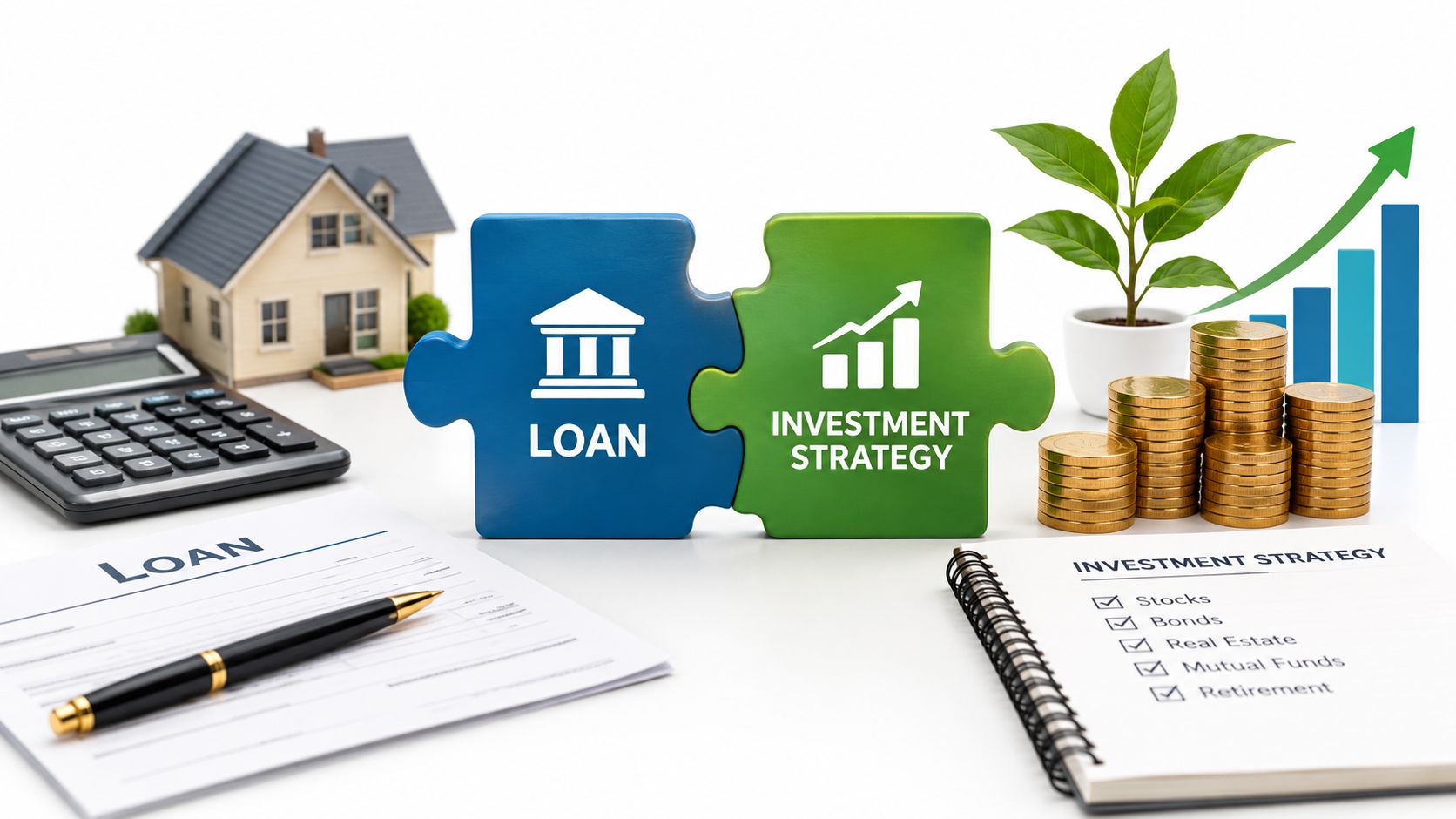
A useful way to sort the options is by investor job-to-be-done. Are you buying a rental to hold, flipping a property, building from the ground up, or refinancing to pull cash back out and reuse it? Start there, because the right loan should match the property's current stage and your next move.
Buy and hold rental
A property that is already rent-ready often fits a DSCR loan. In plain English, the lender focuses heavily on whether the property's rent can support the payment. That can help investors whose personal tax returns do not neatly show their real cash flow.
Loan-to-value still matters because it affects how much flexibility you keep if values soften or you want to refinance later. If you want a quick primer, LTV and mortgage approvals explains the concept clearly. For a hold strategy, this guide to a DSCR loan for rental property shows how income-based financing is typically structured.
Fix and flip
A flip usually needs speed and short-term funding. The property may not qualify for long-term rental financing on day one, especially if it needs significant repairs or cannot yet support market rent.
That is why many investors start with bridge or hard money financing. The lender is looking at the purchase, the rehab budget, the timeline, and the expected value after the work is done. If the plan is a clean resale, the loan exits at sale. If the sales market cools but the property can cash flow as a rental, a smart borrower leaves room for a second exit by choosing a loan path that can later convert into DSCR financing.
That bridge-to-DSCR sequence is one of the most useful patterns in investor finance.
Build and sell or build and hold
Construction financing serves a different job. You are funding a project in stages, not just buying an existing asset. Money is often released through draws after inspections confirm progress, much like paying a contractor as each phase is completed instead of handing over the full budget on day one.
For a build-and-sell plan, the key question is whether the loan gives enough time and budget control to finish and market the property. For a build-and-hold plan, the bigger question is what happens after construction ends. Some investors only solve the first half of the puzzle, then scramble for permanent financing later.
Refinance and redeploy equity
This strategy gets less attention than it deserves.
Many investors first think about financing as a way to buy a property. Experienced investors also use loans to recover trapped equity and put that capital back to work. The sequence is simple. Buy well, improve the property, stabilize rent, refinance into longer-term debt, then use the released cash for the next deal.
A practical version looks like this:
- Buy with short-term capital when the property needs work or a fast closing.
- Renovate and lease the property until rents and occupancy are stable.
- Refinance into DSCR financing built for a longer hold.
- Reuse the pulled-out equity for the next down payment, rehab, or acquisition.
That connected path matters because it treats the project as one business plan instead of two unrelated loans. In markets such as Georgia, North Carolina, South Carolina, and Texas, some investors use lenders such as Sims Ventures for that asset-based bridge-to-DSCR approach when they want one financing path that follows the life of the deal.
Timelines Costs and Closing Process Explained
A lot of financing stress comes from not knowing what happens between application and closing. The process is less mysterious once you break it into stages.
What usually happens first
You submit the basics of the deal. That usually includes the property address, purchase contract or payoff information, rent details if it's a rental, entity documents if you're borrowing in an LLC, and your plan for the property.
From there, the lender starts sizing the deal and ordering third-party items. Those commonly include appraisal or valuation, title work, and proof of insurance. If the property needs repairs, the lender may also review a scope of work and budget.
Where delays usually happen
Most delays don't come from the loan idea itself. They come from missing documents, slow title responses, appraisal scheduling, insurance issues, or unclear rehab numbers.
This is why investor lenders often talk so much about preparedness. A good file moves faster because fewer questions stay open.
A simple closing checklist helps:
- Entity readiness: Make sure your LLC documents, operating agreement, and signing authority are current.
- Insurance planning: Talk to your insurance agent early, especially for vacant, rehab, or builder-risk situations.
- Property access: Appraisals and inspections stall when no one can get inside.
- Scope clarity: If there's rehab, line items should be specific enough for the lender to understand the plan.
Speed versus cost
Traditional banks often move more slowly because the process is built around fuller documentation and layered approvals. Private and hard money lenders can often move faster when the third-party items are ready and the deal is straightforward.
For investors in a competitive contract, speed can be worth paying for. Not always, but often enough that it should be analyzed carefully. If a delayed closing costs you the deal, the lower rate never had a chance to save you money.
If your property needs a transitional structure before long-term financing, this page on a bridge loan for investment property gives a practical picture of how that phase works.
Fast closings usually come from clean files, clear exits, and prepared third parties. They rarely come from hope.
Common Misconceptions That Cost Investors Money
A few financing myths show up again and again.
Myth versus reality
Myth: Hard money and private lending are the same thing.
Reality: They can overlap, but the structure, underwriting style, and intended use can differ a lot from lender to lender.Myth: The lowest rate is always the cheapest option.
Reality: If a slower or less flexible loan causes a missed closing, thin rehab budget, or failed refinance plan, the lower rate may cost more overall.Myth: Every investment loan requires the same personal income documentation as a home mortgage.
Reality: Many rental and asset-based programs lean more heavily on the property's income and collateral than on tax-return-based qualification.Myth: Refinancing means something went wrong.
Reality: Investors often refinance because a property improved, rents stabilized, or equity became available for the next deal.
Good investors don't just ask, “What rate can I get?” They ask, “What structure leaves me in the strongest position six months from now?”
Choosing Your Next Loan With Confidence
A smart loan choice starts with a simple checklist.
First, define the exit. Are you holding, flipping, building, or refinancing? Second, test whether the property supports that plan through cash flow, debt, condition, and marketability. Third, weigh speed against cost with honesty. A slower loan isn't cheaper if it breaks the deal. Fourth, decide what happens after this loan. If the property is moving from rehab to rental, build the refinance path into the decision from the start.
That's the mindset that turns financing from a hurdle into a tool. When the loan fits the job, your cash flow is cleaner, your timeline is more stable, and your equity stays easier to redeploy.
If you're weighing a loan for investment property in Georgia, North Carolina, South Carolina, or Texas, Sims Ventures offers asset-based financing for rentals, flips, construction, and bridge-to-DSCR transitions. If you want help matching the deal to the right structure and planning the refinance path before you close, visit Sims Ventures.
