
What Is Equity Real Estate: Your Hidden Wealth Engine
Equity in real estate is the difference between a property's current market value and what you still owe on it. It's the part you own, and in a market where U.S. household real estate equity was estimated at $34.9 trillion in Q1 2026, equity isn't a side detail. It's one of the main engines behind how investors refinance, recapitalize, and keep buying.
Asking what is equity real estate is often a response to a practical problem, not a vocabulary problem. Someone who owns a rental, a flip, or a house that's gone up in value wants to know whether that equity is real money they can use or just a nice number on paper.
That distinction matters. I've seen plenty of investors feel wealthy on a balance sheet and still come up short at closing because their equity wasn't structured, documented, or accessible in time. Equity matters most when it changes what you can do next.
What Equity in Real Estate Actually Means
You are under contract on a new deal, your lender wants to see liquidity, and on paper you have six figures of equity in another property. Then the payoff comes in higher than expected, there is a second lien you forgot to account for, and the cash-out number shrinks fast. That is why equity needs a practical definition, not a textbook one.
Equity is the ownership value left after every secured debt attached to the property is deducted from its current market value. That includes the first mortgage, HELOC, second mortgage, private note, or any other recorded lien that has to be paid before you get paid.
The basic math
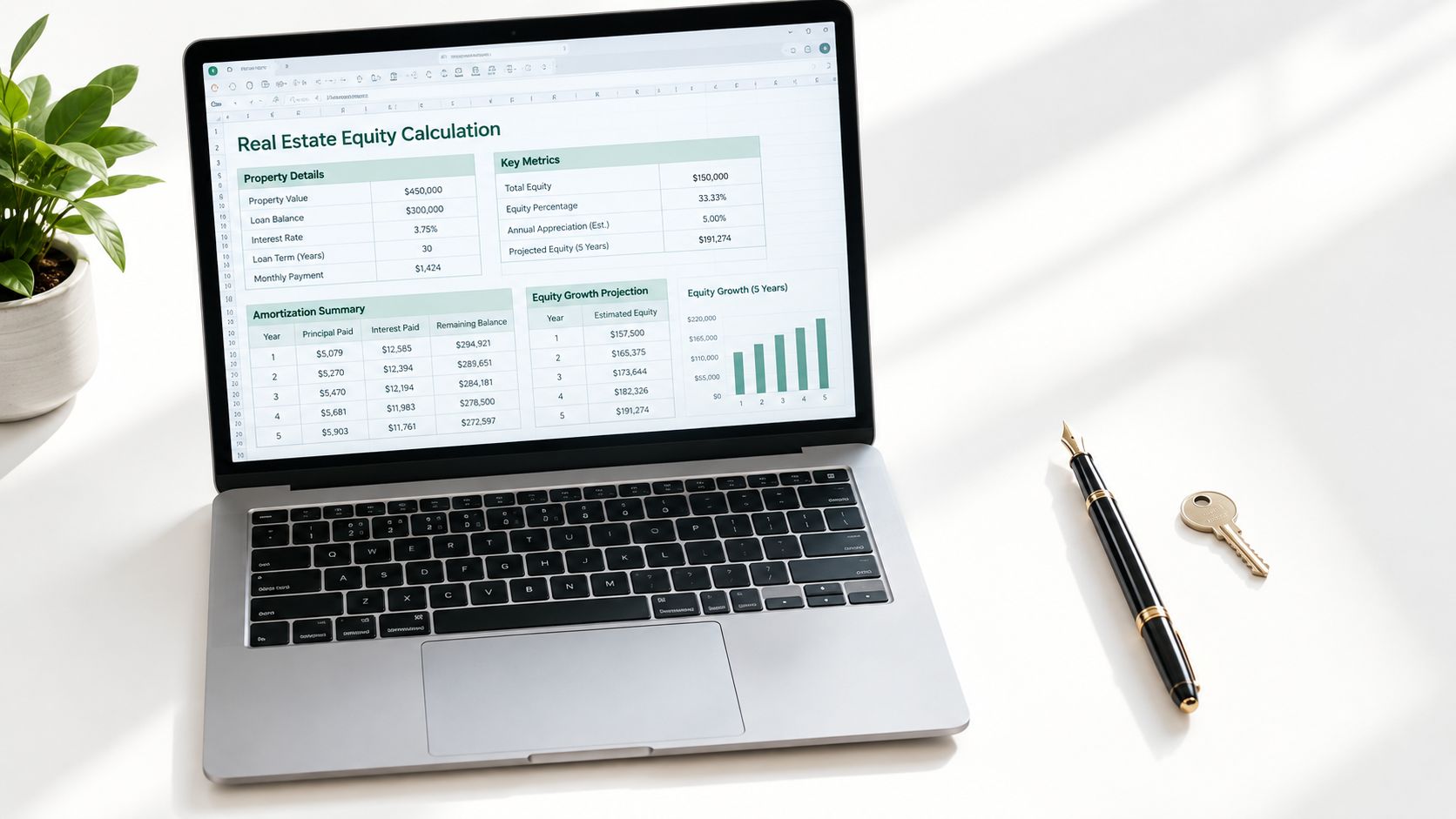
A simple example makes it clear:
- Property value: $400,000
- Total secured debt: $280,000
- Equity: $120,000
That $120,000 is your paper ownership stake.
Paper equity and usable equity are not the same thing. If you sell, closing costs and taxes can reduce what you keep. If you refinance, the lender may cap proceeds based on loan-to-value, debt service coverage, seasoning, property condition, or title issues. In real deals, the number that matters is not just equity on a spreadsheet. It is equity you can document and turn into capital on time.
What that number means in the field
Equity changes how much room a deal has to absorb stress.
A property with a healthy cushion gives you options if rehab costs run over, rents dip, or a sale takes longer than planned. A thin cushion does the opposite. Small problems start affecting loan terms, extension fees, and exit choices.
I learned that early with hard money loans. A property can show solid equity based on your own value estimate and still fail to help at closing if the lender's appraisal comes in light or if the lien stack is heavier than expected. Execution depends on verified equity, not assumed equity.
Practical rule: If you have not subtracted every lien and estimated your exit friction, you do not know your real equity position.
Why equity matters beyond the formula
For active investors, equity does more than show ownership.
- It takes the first hit if value drops. Debt stays fixed while your cushion shrinks.
- It affects financing options. More equity usually means better refinance chances and more flexibility with terms.
- It gives you choices. You can leave it in the property, borrow against it, or realize it through a sale.
That last point gets missed in a lot of basic explanations. Equity is not just a scorecard. It is part of your financing base. Used well, it can support the next acquisition, cover renovation capital, or help you clean up expensive debt. Used poorly, it stays trapped on paper while you scramble for cash elsewhere.
If you want a broader ownership perspective, the insights from Dealmaker Wealth Society are useful. The common thread is straightforward. Ownership has value, but the practical question is always the same: what can that ownership do for the next move?
How Equity Builds Over Time
A rental bought with thin cash reserves can look strong on paper after a good year. Rent is up, the loan balance is down, and local sale comps moved higher. Then the owner tries to refinance and learns a hard lesson. Equity may exist, but only part of it is durable, and only part of it is usable.
Equity builds over time in three practical ways. Loan paydown reduces the balance you owe. Market appreciation raises the property value. Execution can create forced equity if you improve the asset or solve a problem the next buyer will pay for.

Appreciation helps, but it should not carry the deal
Appreciation is the easiest form of equity to overestimate because the owner does not have to do much to claim it. A rising market can make average decisions look smart for a while.
That is not a plan I would underwrite against. If a rental only works because you expect values to rise, the margin for error is thin. Rent growth can stall. Insurance and taxes can jump. Buyer demand can soften right when you need to refinance or sell.
Paper gains also have a habit of shrinking under real deal conditions. A lender may use a more conservative value than the owner expected. A buyer will subtract for deferred maintenance, credits, and closing costs. Equity from appreciation counts most when the asset still performs without it.
Amortization is slower, but it is real
Principal reduction rarely feels exciting in the early years of a loan, especially on long amortization schedules. Still, it is one of the few equity drivers that happens on schedule if the note gets paid.
That matters for investors who hold property long enough to refinance, sell, or use the asset as collateral for the next move. Every principal payment improves the balance sheet a little. Over time, that creates room. Room to refinance out of expensive debt. Room to absorb a valuation haircut. Room to negotiate from a stronger position.
Slow equity is often better financing equity than flashy equity. Hard money lenders and refinance lenders care less about the story and more about the spread between verified value and actual debt.
Forced equity changes the timeline
Forced equity is where active investors can move faster than the market. Buy below stabilized value, fix what is broken, improve layout, add legal square footage, clean up management, or finish a half-executed project. If the work is real and the market recognizes it, equity can build in months instead of years.
This is the part newer investors often underestimate. The best forced-equity deals are not always the prettiest rehabs. They are the ones where the cost of the work is lower than the value created, with enough spread left over for carrying costs, financing costs, and resale friction.
Execution decides whether that equity holds up. Cosmetic work that photographs well but ignores drainage, systems, or permit issues can disappoint at appraisal and during buyer due diligence. For heavier renovation work, HomeProBadge permit guidance is a useful checkpoint before you assume renovation dollars will convert cleanly into appraised value.
The practical takeaway is simple. Equity growth matters, but the path matters more. Equity built through paydown and disciplined value creation usually stands up better in a real financing file than equity that exists only because the market was generous for a season.
Sources and Types of Real Estate Equity
Equity shows up in different forms, and the source matters because each type converts to financing differently.
Two owners can both claim $200,000 in equity and still have completely different options. One got there by paying down a long-term loan on a clean rental. The other got there by renovating a distressed property that has not been fully documented, leased, or seasoned yet. On paper, the number looks similar. In a real loan file, it does not.
Owner equity
Owner equity is the straightforward version. It comes from your down payment, principal reduction, and any increase in property value that the market or an appraisal will support.
For investors, this is often the easiest equity for lenders to understand. The property has a history. The debt is visible. If title is clean and the value is defensible, owner equity can become collateral for a refinance, a line of credit, or a sale.
It is still paper equity until a lender or buyer agrees with your valuation.
Investor equity
Investor equity is ownership capital from another party. It is not borrowed money with a fixed payment schedule. It is money exchanged for a share of the deal, the cash flow, the appreciation, or some combination of the three.
That structure can solve a real problem. A project may need more cash than debt alone will cover, especially on heavier renovations, ground-up construction, or deals with weak in-place income. The trade-off is simple. Equity partners expect upside, and they usually want approval rights over major decisions.
Before taking on an equity partner, get the operating terms clear in writing:
- Who controls refinance, sale, and budget decisions
- How cash flow distributions are split
- Whether preferred returns accrue
- How cost overruns are funded
- What happens if the project misses timeline or profit targets
- How either side can exit
Those terms matter more than the headline equity check. Cheap debt with full control can outperform expensive equity capital, even when the debt rate looks painful at first glance.
Accrued equity and built equity
These categories get blurred together, but they behave differently under pressure.
Accrued equity comes from time. Loan balances decline. Rents may improve. Market values may rise. It is usually the most stable form of equity because it did not depend on a tight rehab budget or a perfect resale window.
Built equity comes from execution. You bought below true value, corrected deferred maintenance, improved operations, added usable space, resolved legal or title issues, or finished construction that changed the property's income or resale value.
Built equity can grow faster.
It can also disappoint faster. If your rehab runs 20 percent over budget, permits drag for four months, or the appraisal gives partial credit for your scope, the equity you expected to use may not be available when you need it.
That distinction matters in practice. Accrued equity usually supports cleaner, lower-friction borrowing. Built equity often needs invoices, before-and-after scope, rent rolls, permits, and a lender who understands transitional assets.
The formula for equity is simple. The useful question is harder: what portion of that equity is financeable today, under current underwriting, with your actual documents and debt terms? That is the number active investors need to know.
How Investors Access and Monetize Equity
Paper equity matters only when you can turn it into usable capital. In the field, most investors use one of three paths. They refinance, they open a line against the property, or they sell.
Each route solves a different problem. None is automatically right.
Cash-out refinance
A cash-out refinance replaces your existing loan with a larger one and returns the difference to you in cash, subject to underwriting, valuation, and lender limits. This is usually the cleanest route for stabilized rentals because it preserves ownership while converting trapped equity into deployable capital.
It also resets the debt load. That's the trade. You gain liquidity, but you increase debt on the property. If rents are thin or expenses are rising, cashing out too aggressively can weaken a property that was previously carrying itself comfortably.
If you want a more detailed walk-through of how investors use this structure on rental properties, this guide to rental property cash-out refinance strategies is a practical next read.
HELOC or similar line access
A home equity line of credit can be useful when you need flexible access instead of a full refinance. It fits shorter-duration needs well. Think earnest money, rehab overruns, light repositioning, or fast-moving opportunities where you don't want to refinance the entire asset.
The drawback is discipline. Lines are easy to draw and easy to misuse. If the borrowed funds don't create more value than the cost and risk they add, the line becomes expensive convenience.
Sale
Selling is the cleanest way to realize equity because it converts ownership into unrestricted cash. No new debt. No added lien. No refinancing conditions.
But sale has its own cost. You lose the asset, the future cash flow, and any upside that would have come from keeping the property. If the property is strong and your financing alternatives are workable, selling can be the most expensive “easy” option you choose.
| Method | Speed | Cost | Best For |
|---|---|---|---|
| Cash-out refinance | Moderate | Transaction costs plus ongoing debt cost | Stabilized rentals and recapitalization |
| HELOC | Often flexible once established | Carry cost varies with use and terms | Short-term liquidity and smaller capital gaps |
| Sale | Depends on marketability and closing timeline | Selling costs and loss of future ownership | Full equity realization or strategy exit |
What works and what doesn't
- Works well: Pulling equity from a stable asset to buy another asset with better yield or clearer value-add.
- Usually doesn't: Stripping equity just because it's available, then parking the cash without a defined plan.
- Works well: Matching the access method to the project timeline.
- Usually doesn't: Using long-term financing to fund short-term chaos.
Real-World Equity Strategies for Active Investors
The mechanics make more sense when you tie them to actual decisions. In active markets across Georgia, the Carolinas, and Texas, equity becomes useful at the moment an investor treats it like working capital instead of a vanity number.

A flipper in Georgia
A flipper finishes a rehab in a suburban Georgia market and decides not to sell immediately. The property appraises above all-in basis, the work is documented cleanly, and the asset is now financeable on very different terms than it was at purchase.
That investor has a choice. Sell and realize the gain, or refinance and preserve the upside. In many cases, built equity from the rehab becomes the bridge to the next acquisition because the investor can recapitalize without starting from zero.
This is one reason BRRRR-style execution still appeals to disciplined operators. If you want the mechanics of that cycle laid out more directly, this overview of what the BRRRR method looks like in practice is worth reviewing.
A landlord in the Carolinas
A landlord with a small rental portfolio in the Carolinas owns one property that's seasoned, leased, and operating cleanly. Instead of selling, the owner refinances, pulls a portion of available equity, and uses that capital as the down payment and reserve base for another rental.
That move works when the first property still cash flows after the new debt. It fails when the investor gets greedy on proceeds and turns a stable rental into a marginal one.
Equity extraction should strengthen your portfolio's next move, not weaken the property that made the move possible.
A builder in Texas
A small builder in Texas controls a lot, completes vertical construction, and creates value between land basis, build cost, and completed market value. On paper, that's obvious. In financing, it only matters if the numbers are credible and the project is progressing as planned.
The builder who tracks draws, keeps budgets current, and documents progress can often use created equity to support follow-on financing on the next project or line up capital for additional starts. The builder who treats reporting casually often discovers that unproven equity doesn't travel well.
The common thread
These aren't flashy stories. They're normal investor moves. Equity becomes a deal-making tool when the asset is financeable, the value is supportable, and the next use of capital is already defined.
Common Misconceptions About Real Estate Equity
An investor sees a property with strong equity on a spreadsheet, assumes that means easy cash access, then gets surprised when the refinance comes in light or the lender cuts proceeds. That mistake is common because equity gets treated like money in the bank. In practice, it is only useful capital if a lender, buyer, or partner agrees with your value and the deal still works after costs, payoff, and underwriting.
Equity is not the same as available capital
Paper equity and usable proceeds are different things. A property can have a sizable ownership stake and still produce little to no cash if the appraisal comes in short, the debt-service coverage is thin, title has issues, or a junior lien shows up late.
I see this most often with investors who rely on market appreciation alone. They assume rising value created borrowing room, but accessible equity depends on loan-to-value limits, net operating income, seasoning, and the lender's view of risk. A good balance sheet helps. It does not guarantee liquidity on your timeline.
Equity-rich does not mean low-risk
A property with substantial equity can still be a weak asset.
Deferred maintenance, soft rents, bad tenants, insurance shocks, or a loan structure that resets at the wrong time can turn an equity-heavy deal into a headache fast. Equity gives you margin. It does not fix poor operations.
That distinction matters in real execution. If a property barely covers debt service, pulling more debt against it may solve one problem and create another.
Equity and cash flow measure different things
A property can appreciate nicely and still underperform every month. A different property can throw off dependable cash flow while showing little recent value growth.
Investors who confuse those two metrics usually make bad hold or refinance decisions. Equity measures ownership value after debt. Cash flow measures whether the asset carries itself month to month. You need both numbers, and they answer different questions.
Equity calculations often miss real debt
A lot of equity estimates are too optimistic because the owner subtracts only the first mortgage.
The number has to account for every secured claim against the property. That includes second liens, HELOC balances, seller carrybacks, recorded advances, and anything else attached to title. Miss one item and the equity story changes quickly, especially if you are trying to refinance or sell under pressure.
Equity does not have to come from appreciation
Some investors talk about equity as if market growth is the whole story. It is only one source.
Equity also builds through principal paydown, forced appreciation from rehab, better operations, rezoning, entitlements, or construction progress that is well documented and supportable. In active investing, created equity is often more useful than passive equity because you can explain exactly where it came from and why it should hold up under review.
A high equity number can still be unusable
This is the misconception that causes the most frustration. Owners see a strong estimated value, subtract debt, and assume the difference is ready to deploy into the next deal. Often it is not.
Transaction costs reduce proceeds. Lenders cap cash-out. Some properties no longer pencil after a refinance. Some equity exists only at a price the market will not support once a real buyer or appraiser steps in. That is why experienced investors ask a harder question than "How much equity do I have?" They ask, "How much of it can I access without hurting the asset?"
Using Equity as a Strategic Financing Foundation
A rental appraises higher than expected, and the owner immediately starts counting that spread as money for the next deal. Then the lender trims the value, caps the cash-out, and asks whether the property still performs after the new payment. That is the point where equity stops being a paper number and starts acting like a financing tool.
For active investors, equity works best as a base for future borrowing capacity. The job is not to pull out every possible dollar. The job is to turn existing value into usable capital without weakening the property that produced it.
A workable decision process
Start with the origin of the equity, because that affects how easy it is to finance against.
Equity built through long-term paydown usually creates a cleaner refinance file. Equity created through rehab, lease-up, or construction often needs better documentation, including scope, invoices, permits, rent comps, and a clear story for the value increase. If partners contributed capital, the ownership documents matter too, especially if distributions or consent rights affect the refinance.
Then test what is available.
That means reviewing current value, every recorded loan balance, prepayment costs, closing costs, reserve requirements, and the debt service after the new loan closes. A property with strong paper equity can still be a poor cash-out candidate if the revised payment squeezes monthly cash flow or shortens your runway.
Matching equity to the right use
Good operators treat equity like inventory. It should go into uses that produce more income, more control, or a better balance sheet.
- Use equity for productive purposes. Funding the next acquisition, finishing a value-add plan, retiring expensive short-term debt, or cleaning up a messy capital stack can all make sense.
- Be careful with personal spending. Pulling capital from a working asset for lifestyle use often weakens both the property and your flexibility.
- Keep margin for mistakes. Renovations run over budget, leases take longer than expected, and appraisals do not always come back where you want them.
If you want a quick way to test a few scenarios before talking to a lender, a home equity calculator for real estate apps can help estimate value, debt position, and possible borrowing room. It is not underwriting, but it can expose weak assumptions before you pay for an appraisal or loan package.
Why this matters for active investors
The practical question is simple. Can this equity support the next move without creating a worse problem on the current asset?
That standard filters out a lot of bad decisions. Some owners pull cash out of a property that is finally stable, only to trade a strong position for a tighter DSCR, less reserve capacity, and more pressure to execute perfectly on the next deal. In practice, that is where portfolios get stuck.
A better approach is to pair equity with a specific plan. Know the use of proceeds, expected timeline, carry costs, and exit before you borrow. If you want a clearer framework for how debt can increase returns and increase risk at the same time, this explanation of how borrowing magnifies both upside and risk in real estate fits directly with equity planning.
One practical example in the market is Sims Ventures, which offers asset-based refinance, cash-out, DSCR, bridge, and construction lending for investors in Georgia, North Carolina, South Carolina, and Texas. That structure can fit borrowers who need financing tied more to the deal and asset than to traditional income documentation. It still has to pencil. The property, payment, and exit plan all need to work together.
Use equity with discipline. Measure it, borrow against it selectively, and leave enough room that one bad quarter does not force a bad sale.
If you're trying to turn equity into your next rental, flip, or build, Sims Ventures works with investors who need practical financing tied to the deal itself, including refinances, cash-out strategies, and construction funding. For investors operating in Georgia, North Carolina, South Carolina, and Texas, Sims Ventures is a useful place to start if you want to map your equity position to a real lending strategy.
