

Short Term Rental Property Loan: A Guide for 2026
You've got a property under contract that would make a solid Airbnb, the numbers look workable, and your lender still says it'll take weeks to “review everything.” By the time the paperwork clears, the deal is gone or the seller has moved on. That's the trap with a short term rental property loan, the asset can be good while the financing process is built for something slower, cleaner, and easier to document.
The investors who win these deals don't start by asking, “Can I get the cheapest rate?” They start by asking, “What kind of financing will close on time, fit this property's current condition, and still make sense after it stabilizes?” That's the right question in Southeast markets where demand can be strong, but timing, regulation, and underwriting friction decide whether the deal closes.
Why Short-Term Rental Financing Demands a Different Approach
A buyer calls on Monday, walks a coastal cabin on Tuesday, and wants to write an offer before the weekend. The numbers look fine, the property already has furnishing potential, and the seller wants speed. Then the bank asks for full income documentation, a longer review window, and a file that looks more like a primary residence purchase than an income property acquisition. The deal slips away because the lender's process doesn't match the asset's reality.
That mismatch is the core issue. Short-term rentals don't behave like standard homes, and they don't behave like stable long-term rentals either. Income can be seasonal, platform history can be thin, and local rules can change how the property operates. Mainstream bank underwriting tends to get uncomfortable when the cash flow story isn't already neat and proven.
The deal gets judged on the wrong timeline
Conventional lenders want predictable borrower documentation and a clean file. Investors buying short-term rentals need speed, flexibility, and a structure that recognizes the property as an income-producing asset, not just a home with a kitchen and bedrooms. A short term rental property loan is usually about closing the gap between what the asset can become and what it can prove today.
A good deal can die from slow financing long before it dies from bad math.
In practice, that means the winning lender is often the one willing to underwrite the asset, not the borrower's tax-return story. For serious investors across the Southeast, private and asset-based lending has become the practical answer because it aligns the approval process with how these properties are bought, renovated, and stabilized.
Comparing the Main Short Term Rental Property Loan Types
Short-term rental investors usually end up choosing between four paths, and each one solves a different problem. The mistake is trying to force one loan type to do every job. A fast acquisition loan is not the same thing as a long-term hold loan, and a stabilized cash-flow property shouldn't be financed the same way as a house that still needs rehab.
What each loan type is really for
| Loan Type | Best For | Closing Speed | Income Verification | Typical LTV |
|---|---|---|---|---|
| Hard Money Loans | Time-sensitive acquisitions and heavy rehab projects | Fast | Asset-focused, limited borrower documentation | Usually lower than conventional structures |
| Bridge Loans | Transition periods between purchase, renovation, and stabilization | Fast to moderate | Often lighter than bank financing, more flexible than conventional | Often structured to support acquisition plus repositioning |
| DSCR Loans | Stabilized rental properties with demonstrable cash flow | Moderate | Property cash flow rather than personal income documentation | Varies by lender and deal strength |
| Conventional Investment Property Loans | Borrowers with strong W-2 income and patience for bank timelines | Slowest | Full income documentation | Often tighter and more conservative |
Hard money makes sense when speed matters more than cheap capital. It gives you a way to lock up a property, fund the rehab, and keep momentum when the seller expects a fast close. That's the right answer for a dirty acquisition, an outdated cabin, or a property that can't yet support a cash-flow refi.
Bridge loans are the transition tool. Use them when the property is close, but not quite ready for long-term debt. They work well when you need to buy now, improve the asset, and refinance later once the booking pattern and income story are cleaner. For a broader view of investor financing structures, see this breakdown of real estate financing types.
When DSCR becomes the better long-term play
DSCR loans are the natural finish line for a stabilized short-term rental. Once the property can stand on its own cash flow, that structure fits the asset better than a temporary loan. Conventional debt still has a place, but only if the borrower is willing to trade speed and flexibility for more documentation and bank process.
Use the loan that matches the property's condition, not the loan that sounds safest in theory.
That's the blunt answer. If the property is not stabilized, don't pretend it is. If it is stabilized, don't keep paying for bridge capital longer than necessary.
The Underwriting Reality for Properties Without Booking History
A brand-new short-term rental or a recently converted long-term rental can look attractive on paper and still get stuck in underwriting. The problem is simple. Lenders like evidence, and a property with no booking history doesn't have much evidence yet. That's why the “DSCR is easy” sales pitch can mislead people.
The underwriting challenge isn't just whether the property can generate income. It's whether the lender can trust the projection enough to fund it. Guidance in the market shows lenders may lean on projected income, comps, platform performance reports, bank deposits, booking agreements, and conservative occupancy assumptions, but the work is figuring out what the underwriter will accept and in what order. For a practical overview of that gap, review this financing guide for short-term rentals.
What underwriters actually want to see
When a property lacks a stable operating history, the file usually gets stronger if you present it in layers.
- Current property facts: location, condition, layout, and whether it is already furnished or ready to launch.
- Projected income support: realistic market comps and booking assumptions, not optimistic weekend math.
- Operating evidence: any platform report, bank deposit history, or prior rental performance if the asset was used before.
- Execution proof: a clear plan for setup, pricing, and management, especially if the property is newly converted.
The order matters. A lender will trust hard evidence before projections. If the property has no history, your job is to make the projection feel conservative, organized, and easy to verify.
Why stabilization matters more than borrower optics
A lot of investors get it backwards. They assume the question is whether their personal income is strong enough. It's usually more about whether the asset is stable enough. A borrower with a weak W-2 profile can still get traction on the right deal, while a borrower with strong income can still get stuck if the property looks speculative.
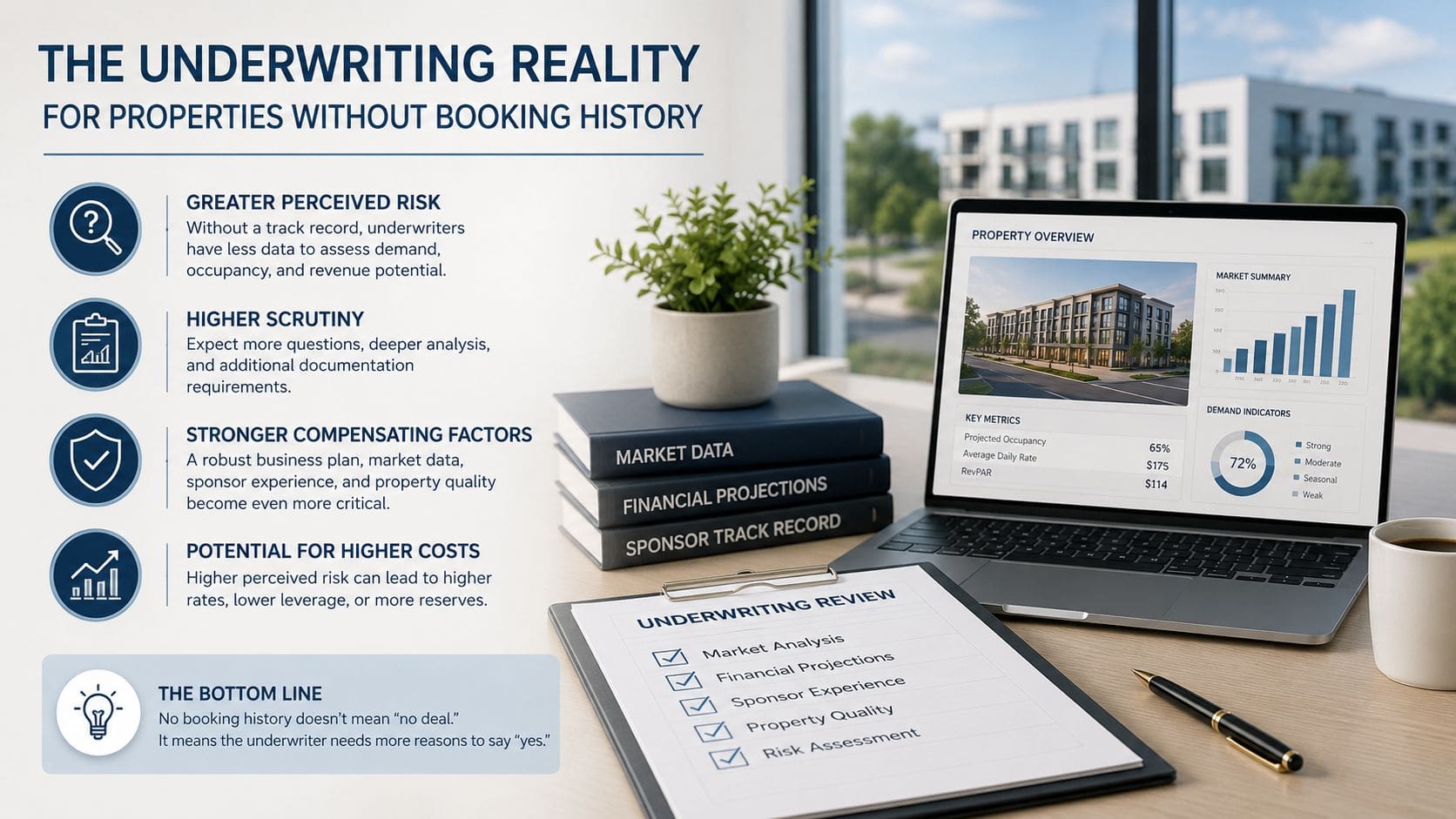
The cleaner the data, the easier the file. The less history the property has, the more discipline the projection needs.
That's the underwriting reality. New inventory can still finance well, but only if the story is disciplined from day one.
How Regulation and Market Shifts Are Changing the Math
Short-term rental underwriting used to feel easier when demand was hot and assumptions were generous. That environment is gone in many submarkets. Investors now have to ask a harder question, does the property still work after local rules, insurance pressure, seasonality, and more normal travel demand are all included in the model?
The current risk environment is more complex, and that matters because lenders are less interested in peak-case projections than they are in downside durability. U.S. short-term rental supply and listings have continued to evolve, while global travel demand has normalized enough that occupancy and daily-rate assumptions are no longer as forgiving as they were in the boom years. In plain English, you should not underwrite a vacation rental as if every month is peak season.
Stress-test the deal, not just the loan
A smart investor stress-tests with conservative occupancy, realistic RevPAR expectations, and enough reserve coverage to survive weaker months. That matters even more in markets where local rules can shift the way a property operates. The goal isn't to maximize fantasy revenue. It's to prove the property can stay alive in a bad stretch.
That's especially important in Georgia, North Carolina, South Carolina, and Texas. Demand can be strong in all four states, but the result can change dramatically by submarket, by neighborhood, and by the type of guest base the property attracts. A beach house, a mountain cabin, and an in-town business travel unit do not carry the same risk profile.
The right loan is the one that survives the downside
That's the part many investors miss. The best deal structure is not always the largest loan or the fastest close. In a tight or highly regulated pocket, a shorter bridge period, more reserves, or a more conservative DSCR structure can protect the investor better than squeezing every extra dollar out of the property.
If the deal only works at peak occupancy, it doesn't really work.
Use that as your filter. If the numbers break when the market softens, the financing is not problem. The deal is too thin.
Sequencing Your Financing From Acquisition to Stabilization
A good short-term rental deal usually gets financed in stages, not with one perfect loan. That sequencing is what separates investors who keep buying from investors who stay stuck waiting for one bank product to solve everything. The cleanest path is acquisition capital first, stabilization second, and long-term debt last.
Start with the fastest money that fits the property
If the property needs rehab, move quickly with a fix-and-flip or bridge structure that funds acquisition and renovation. That gives you the ability to close on time, make the property rentable, and avoid losing the asset to process delays. For a deeper look at the transition piece, see this bridge loan guide for investment property.
Once the work is done, shift into the stabilization phase. At that point, your focus should be on occupancy trend, booking consistency, and whether the property's operating picture is clean enough to support longer-term financing. Don't rush this step just because the rehab is finished.
Move to DSCR only after the asset can prove itself
When the property has real income behavior, refinance into a DSCR loan. That's where the deal stops being a project and starts being a hold. The point is not to stay in transitional capital longer than necessary. It's to use transitional capital for what it does well, then replace it with permanent financing once the asset earns it.
A simple decision sequence works best:
- Buy fast if the property is time-sensitive.
- Renovate with purpose so the unit can perform as a short-term rental.
- Stabilize the operating history before pushing for long-term debt.
- Refinance cleanly when the asset has enough evidence to stand on its own.
That path keeps you from overpaying for convenience after the property is already performing. It also protects your liquidity for the next acquisition, which is where serious investors build scale.

The point is discipline. Use the right capital at the right stage, then move on before one loan type starts working against the deal.
How Sims Ventures Programs Address Common Investor Challenges
Investors usually don't need more theory. They need a lender structure that fits the actual problem in front of them. That's where a platform like Sims Ventures fits into the financing sequence, especially for buyers and operators in Georgia, North Carolina, South Carolina, and Texas who need property-focused underwriting and quicker execution.
The useful part isn't the label on the loan. It's the way the programs line up with the job the capital has to do. A bridge-to-DSCR path works for a property that needs to stabilize before it can qualify for longer-term debt. ARV-based fix-and-flip loans fit a deal where purchase and rehab need to be funded on a clock. Ground-up construction loans and a Builder's Line of Credit make sense when the project is new-build, milestone driven, and too active for ordinary rental financing. Sims Ventures also states an expedited closing process commonly targeted around 15 days, along with asset-focused underwriting that does not rely on traditional income documentation, and its site cites $52M+ funded across thousands of investor deals.
Match the program to the phase of the deal
The wrong financing choice usually creates one of three problems, a missed closing, trapped equity, or a refinance that arrives too early. A bridge-to-DSCR structure helps solve the first and third issue by carrying the property until it's ready for permanent rental debt. Cash-out refinances can also help if you already own an asset and need to redeploy equity into the next acquisition.
That matters because investors rarely fail from lack of opportunity. They fail from capital being stuck in the wrong place at the wrong time.
Keep the conversation focused on execution
A good lender conversation should stay on these questions.
- What phase is the property in now? Acquisition, rehab, stabilization, or long-term hold.
- What proof exists today? Current condition, income evidence, and any operational history.
- What's the exit? Refi, sale, or a long-term rental hold.
- What slows the deal down? Title, appraisal, rehab scope, or missing documentation.
If the lender can answer those questions directly, the process usually goes smoother. If they can't, the file is probably too generic for an investor-grade deal.
For a closer look at how that kind of support fits growing portfolios, review Sims Ventures' approach to helping investors scale. Use the resource as a model for how to think about the financing conversation, not as a substitute for deal discipline.
Your Next Steps for Financing a Short-Term Rental Deal
Pull the deal together before you ask for money. Start with the property's operating reality, not your preferred loan. Gather local rental comps, confirm whether any regulation could affect the plan, and build a conservative cash flow view that can survive weaker occupancy.
Then choose the financing path that fits the current state of the asset. If it's a dirty acquisition or needs rehab, think bridge or hard money. If it's close to stabilized, think transition capital. If it already has real operating history, push toward DSCR.
For investors in Georgia, North Carolina, South Carolina, and Texas, the first lender call should be direct. Ask what documents they want, how they handle properties without booking history, and what the refinance path looks like once the asset stabilizes. If the answers sound vague, keep looking.
If you're evaluating a short-term rental deal and want financing that matches the property's actual stage, Sims Ventures can help structure the path from acquisition to stabilization. Visit Sims Ventures to review lending options, talk through your deal, and see whether the numbers and timeline fit a real investor loan.
