

How to Find the Cap Rate with Real Rental Math
You're looking at two similar rental houses. One is listed at a lower price, but its rent is also weaker and its insurance and maintenance burden is heavier. The second costs more, yet its stabilized income may produce the stronger yield. Without clean net operating income, you're not comparing investments. You're comparing asking prices and optimistic rent stories.
That's why learning how to find the cap rate matters before you make an offer. The formula is simple. The underwriting decisions behind the formula are where deals go right or wrong. A Southeast rental investor has to decide which income is repeatable, which expenses belong in NOI, whether the value basis is purchase price or market value, and how the result affects financing.
Why Cap Rate Matters Before You Make an Offer
A cap rate turns a property's operating income into a pricing signal. It tells you how much annual NOI the asset produces relative to its value, before mortgage payments and financing structure enter the analysis. The same property can show a different going-in cap rate depending on the price you pay, even though its operating performance hasn't changed.
Suppose the first house produces stronger stabilized NOI but the seller's price is aggressive. The second house has lower NOI but a meaningful discount. The cheaper property isn't automatically better. Divide each property's normalized NOI by its relevant value basis, then investigate why the results differ. A low cap rate may reflect a premium location and dependable demand. A higher cap rate may reflect deferred maintenance, weaker tenant depth, or income that won't hold after closing.
What cap rate can tell you
For an acquisition, the going-in cap rate is annual NOI divided by purchase price. It answers a narrow but useful question: what unlevered yield does the property provide at the price you're considering? That makes it effective for screening rentals in Georgia, North Carolina, South Carolina, and Texas before spending time on inspections, loan quotes, and detailed diligence.
Cap rate also helps expose pricing gaps. If two comparable rentals have similar stabilized income but materially different asking prices, their cap rates will point to the price premium. The metric won't tell you whether that premium is justified, but it tells you where to ask harder questions.
A practical overview such as this cap rate guide for international buyers can help establish the basic concept. The core work starts when you replace advertised income with an operating statement you would lend against.
What cap rate cannot tell you
Cap rate isn't cash-on-cash return. Cash-on-cash measures cash flow against the investor's cash invested after financing, while cap rate ignores debt entirely. Cap rate also isn't IRR. IRR incorporates the timing of cash flows and the eventual sale, so it can reflect appreciation, sale proceeds, and the holding period in a way a one-year yield cannot.
That distinction matters for a flip investor. A property may have a weak current cap rate because it needs renovation, but a credible stabilization plan could support a stronger long-term rental outcome. Conversely, a projected high cap rate may collapse when rent is adjusted to market and recurring expenses are brought up to realistic levels.
Underwriting rule: Use cap rate to screen the asset and challenge the price. Use cash flow, DSCR, renovation analysis, and exit assumptions to decide whether the deal belongs in your portfolio.
How to Find the Cap Rate With the Right NOI and Value
A rental can show strong advertised income and still fail your underwriting once vacancy, insurance, repairs, and management are included. The working equation is:
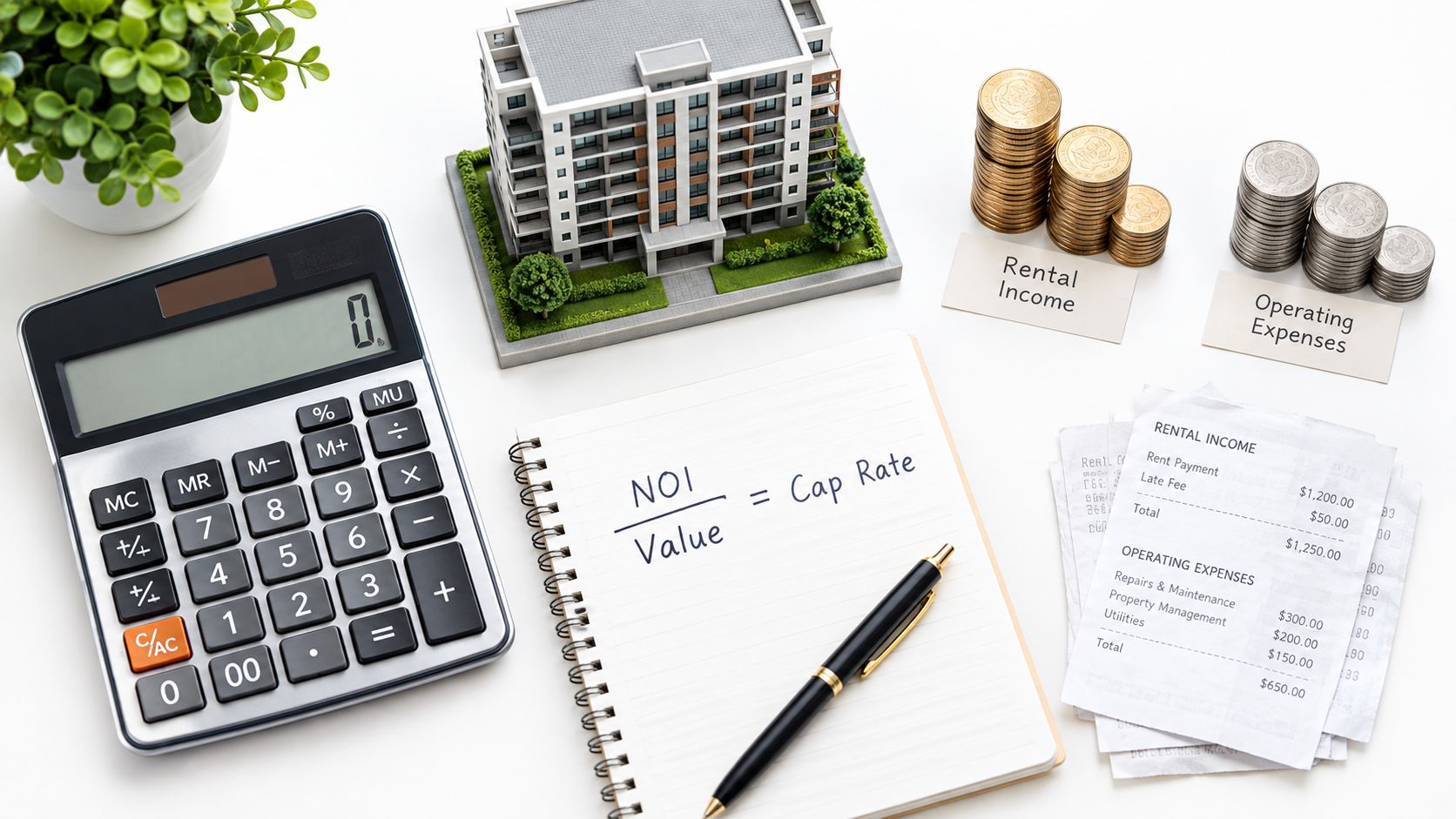
Cap rate = annual NOI ÷ property value
Multiply the result by 100 to express it as a percentage. The decision depends on NOI, not gross rent. Build NOI from gross potential rent, deduct vacancy and credit loss, then subtract recurring operating expenses before dividing by the purchase price or current market value. Projected rent must not be treated as collected revenue.
Build income from the top down
Start with gross potential rent, the scheduled rent at full occupancy under defensible market assumptions. Add recurring ancillary income only when operating history supports it, including dependable pet rent, parking, storage, or utility reimbursements.
Subtract vacancy and credit loss next. A rent roll is an input, not a guarantee that every scheduled dollar will arrive. For a transitional property, separate current in-place rent from stabilized rent. Current rent describes the operation today. Stabilized rent describes the operation after a defined renovation, leasing, or management plan.
Subtract recurring operating expenses
Include every recurring cost required to keep the property occupied and functioning:
- Property taxes: Use the applicable assessment and account for likely reassessment after purchase where local rules make it relevant.
- Insurance: Obtain a realistic quote, particularly for storm, flood, wind, or other regional exposure.
- Management: Include third-party management if you will not self-manage, even if temporary self-management is part of the plan.
- Repairs and maintenance: Use an allowance based on property age and condition, not a seller's unusually quiet year.
- Owner-paid utilities: Include water, sewer, trash, electricity, and other landlord-paid services.
- Association costs: Include recurring HOA or similar fees when applicable.
Exclude mortgage payments, principal, interest, and other financing costs. Cap rate measures the property before debt, so you can compare the asset independently of loan structure. Keep one-time renovations and major capital improvements outside recurring NOI, while including them in the broader investment budget.
A rental property cash flow analysis keeps this unlevered property metric separate from debt service and investor cash flow. That distinction matters for DSCR underwriting, where debt service is tested separately, and for flip investors deciding whether a completed project works better as a sale or a rental hold.
Choose the correct value basis
Divide NOI by purchase price for the going-in cap rate. Divide NOI by current market value to measure the yield on the property's present value. Label projected results as pro forma when using stabilized income.
The result can guide an offer, financing choice, or exit decision. If normalized NOI supports a lower value than the seller's price, the gap must be addressed through price, operating improvements, or a different capital plan.
Worked Examples for Rental and Flip Scenarios
The formula becomes useful when it changes an offer or financing decision. The examples below use illustrative figures to show the mechanics. They aren't market benchmarks, and they shouldn't replace local rent, tax, insurance, and management verification.
Stabilized single-family rental
Assume a Southeast rental has gross scheduled rent of $30,000 per year. Underwriting includes $1,500 for vacancy and credit loss. Recurring expenses total $10,500, including taxes, insurance, management, repairs, and owner-paid utilities.
NOI is:
$30,000 gross rent − $1,500 vacancy and credit loss − $10,500 operating expenses = $18,000 NOI
If the asking price is $240,000, the going-in cap rate is:
$18,000 ÷ $240,000 = 7.5%
That result is only as sound as the inputs. If the seller's rent is above what a new tenant will pay, or if management and repairs were omitted, the cap rate is overstated. If the property has a recurring expense that appears only in a separate ledger, it still belongs in the operating picture.
| Scenario | Gross Rent | Vacancy and Expenses | NOI | Value Basis | Cap Rate |
|---|---|---|---|---|---|
| Stabilized rental | $30,000 | $1,500 vacancy, $10,500 expenses | $18,000 | $240,000 purchase price | 7.5% |
| Flip to rental | $33,600 | $1,680 vacancy, $11,920 expenses | $20,000 | $250,000 all-in cost | 8.0% |
For additional valuation context, a practical rental value survey in London illustrates why income, property condition, location, and comparable evidence all matter when assessing value. The geography differs, but the valuation discipline transfers.
Pricing takeaway: A 7.5% going-in cap rate is a screening result, not permission to pay the asking price. Verify whether the rent and expenses are stabilized before treating it as an offer signal.
Flip to rental after rehabilitation
Now consider a property bought for $190,000 with a planned rehabilitation budget of $45,000. Add $15,000 for acquisition, carrying, and closing costs, producing an all-in basis of $250,000. The renovation is expected to support annual rent of $33,600 after stabilization.
Underwriting reserves $1,680 for vacancy and credit loss. Recurring operating expenses total $11,920. That produces:
$33,600 − $1,680 − $11,920 = $20,000 NOI
The pro forma cap rate on all-in cost is:
$20,000 ÷ $250,000 = 8.0%
The all-in basis is the relevant investor decision basis here. Dividing NOI by an optimistic after-repair value can make the yield look attractive while ignoring the capital required to create it. ARV still matters for the flip exit, refinance feasibility, and collateral analysis, but it answers a different question from yield on cost.
Use a cap rate calculator to test how changes in rent, expenses, or value alter the result, then validate the assumptions manually. A calculator gives you clean arithmetic. It doesn't decide whether the assumptions deserve to be in the model.
Value-add takeaway: A pro forma cap rate is a forecast tied to execution. Don't price the deal on it until the rent, scope, timeline, and recurring expense assumptions have independent support.
Where to Find Market Cap Rates and How to Adjust Your Inputs
A market cap rate is not a universal target. It is a range drawn from comparable transactions and investor expectations for a particular property type, location, income profile, and risk level. For an offer, local evidence matters more than a generic benchmark. Start with people who see investment property pricing firsthand.
Build the market range
Local brokers who sell investment property can discuss recent comparable sales. Ask for the sale price, the NOI used by the buyer or appraiser, the sale date, and whether the property was stabilized. A comparable based on seller-reported income or unusually low expenses may not match your normalized underwriting.
Appraisal data provides another reference point when the appraiser explains the income approach and comparable selection. Local investor surveys and lender conversations can show current sentiment, but assign each source a confidence level instead of treating it as the answer. You can also browse cap rate insights to see how practitioners discuss the metric, then bring those observations back to local, property-level evidence.
For DSCR underwriting, this range helps you test whether projected NOI supports the value and financing structure. For a flip investor deciding whether to hold after rehabilitation, it helps compare the stabilized rental yield with the expected sale outcome and capital tied up.
Normalize the operating statement
A market cap rate is useful only when your NOI follows comparable conventions. Review each input deliberately:
- Vacancy: Match the assumption to tenant demand, property condition, lease-up risk, and the gap between in-place and market rent.
- Management: Include a fee when professional management is the likely operating model. Self-management does not eliminate the economic cost of the work.
- Taxes and insurance: Confirm the post-closing tax situation and obtain property-specific insurance indications instead of copying the seller's prior bill.
- Repairs: Separate normal maintenance from deferred work identified during diligence.
- Replacement reserves: Decide whether reserves belong in your internal cash-flow model or in the market NOI convention. Do not compare one cap rate with reserves against another without reserves.
- Seasonality: For short-term or transitional income, use a normalized operating period and document the assumptions. A strong recent period may not represent a full operating cycle.
One-time rehabilitation, a roof replacement, or another irregular capital project should not sit inside recurring NOI. Put it in the acquisition, capital, or reserve analysis. This keeps recurring yield comparable while still requiring you to fund the work.

Read cap rate through the rate cycle
An institutional framing expresses cap rate as:
cap rate = risk-free rate + risk premium − long-run NOI growth
This explains why NOI divided by value can miss pricing dynamics. Recent market data cited in the provided research says cap rates remained broadly flat in H1 2026 while the 10-year Treasury yield peaked at 4.67%. That pattern illustrates why investors weigh interest rates alongside risk premiums and expected NOI growth rather than mechanically repricing every asset.
Apply the same reasoning at the property level. Ask whether growth prospects justify a lower market cap rate, whether local risk requires a wider spread, and whether your underwriting relies on current income or an unsupported growth story. The answer affects your offer price, your DSCR cushion, and whether the asset fits bridge, rental, or flip financing.
How Lenders and Investors Use Cap Rate to Underwrite Deals
Investors use cap rate to translate income into a price ceiling. If your target cap rate is known, the reverse relationship is:
maximum value = stabilized NOI ÷ target cap rate
That calculation doesn't make the target cap rate correct. It gives you a disciplined starting point for an offer. If the seller's price implies a cap rate below the range supported by comparable assets, you either need a documented reason to accept the premium or you need to reduce the price.
A lender looks at the same property through a different lens. Cap rate helps establish whether the collateral's income supports the proposed value, while DSCR tests whether the income can support the debt service under the actual loan structure. Collateral quality, borrowing capacity, liquidity, and execution risk still matter.
Match the financing to the asset stage
A property in poor condition may have weak current NOI, even when the renovation plan is credible. A bridge loan can address the acquisition and improvement phase, with a later transition into DSCR debt after the property is stabilized and its operating income can be documented. That bridge-to-DSCR path only works when the future rent and expense assumptions are realistic, the scope is controlled, and the refinance value is supportable.
For an income-producing rental, review cap rate alongside debt service coverage ratio. A strong cap rate can still produce weak cash flow after debt if the loan is too large or expensive. A lower cap rate may remain workable with conservative borrowing and dependable income.

Decide whether to hold, flip, or refinance
A flip investor should focus on margin, timeline, total basis, and the reliability of the exit. The rental cap rate becomes important when the backup plan is to hold, refinance, or retain the property after the renovation. In that case, calculate the yield on the full capital required, not only the acquisition price.
For an existing rental, compare the going-in cap rate with the market range and then test the financing. For a cash-out refinance, the supported value must align with credible NOI and an appropriate market cap rate. If you need an aggressive cap rate to justify the value, the refinance plan is fragile.
Sims Ventures offers DSCR purchase and refinance loans, bridge-to-DSCR pathways, fix-and-flip financing, and deal-focused advisory support for investors operating in Georgia, North Carolina, South Carolina, and Texas. Its underwriting materials describe an asset-focused approach that considers property cash flow and collateral strength rather than relying only on personal income documentation.
Cap rate prices the asset. DSCR tests the loan. Your offer should work under both views, not just the one that produces the more attractive headline.
Smart Checks and Next Moves Before You Trust Your Number
A cap rate is only as reliable as the NOI behind it. Before you use the result to make an offer, run a short audit that challenges both income and expenses.
Test the assumptions
- Replace gross rent with collected income: Start from scheduled rent, subtract a defensible vacancy and credit-loss allowance, and remove income that isn't recurring.
- Rebuild expenses independently: Verify taxes, insurance, management, repairs, utilities, association charges, and other costs the owner must pay.
- Separate operations from capital: Keep mortgage payments and financing costs outside NOI. Track one-time rehabilitation and major replacements in the capital budget rather than treating them as recurring expenses.
- Label the value basis: Mark the result as going-in, market, yield-on-cost, or pro forma. Don't compare those figures as though they answer the same question.
Run sensitivity tests before you trust a single output. Reduce rent to a defensible market level, increase vacancy, and challenge the repair allowance. Then compare the revised NOI with local comparable sales and ask whether the implied value still supports your offer.
Connect the result to the loan
The final check is financing. A cap rate can look acceptable while the proposed debt service leaves little room for operating volatility. Give the lender the same normalized income statement you used for the offer and ask how the assumptions affect DSCR, debt levels, reserves, and the refinance or sale path.
For investors in GA, NC, SC, and TX, the practical next move is to align the cap-rate conclusion with the capital plan before signing a contract. Don't chase a headline yield that depends on uncollected rent or missing expenses. Build the offer around income you can defend, value you can support, and financing the property can carry.
Sims Ventures helps real estate investors evaluate and finance rental purchases, fix-and-flip projects, bridge-to-DSCR transitions, refinances, and construction deals across Georgia, North Carolina, South Carolina, and Texas. Bring your normalized NOI, purchase assumptions, and exit plan to Sims Ventures to discuss a financing structure that fits the property and the strategy.
