

LLC for Real Estate Investors: What It Does & Why Use It
You've found a rental, the numbers work, and the closing attorney asks a simple question: should the buyer on the deed be you or an LLC? The same question becomes more urgent when you're moving from one property to several, buying in Georgia while living elsewhere, or combining rentals with flips and construction. An LLC can help separate property activity from your personal assets, but it can also affect title, lender consent, insurance, tax planning, and the timing of a refinance.
For an investor, entity choice isn't just a legal filing. It's part of the financing plan. The right structure should support the way you acquire, improve, stabilize, refinance, and eventually sell property.
Why Real Estate Investors Consider an LLC Right Now
Consider an investor buying a first rental in Georgia. The property will be titled in the investor's personal name because that feels simple. A year later, the investor buys another rental, starts a renovation project, and applies for a DSCR refinance. Suddenly, bookkeeping is mixed, insurance documents show different owners, and the lender needs to understand whether the borrower and title holder are the same party.
That situation is common among growing investors. The LLC question usually appears at one of three moments:
- The first purchase: The investor wants a layer between a rental property and personal savings, vehicles, or a primary residence.
- Portfolio growth: Several properties need cleaner accounting, ownership records, and liability boundaries.
- Strategy expansion: Rentals, flips, and construction create different risks and financing requirements inside the same investment business.
The ownership data explains why this conversation has become more important for larger portfolios. In the 2024 U.S. Rental Housing Finance Survey coverage, LLPs, LPs, and LLCs owned about 20.6% of rental properties and 43.0% of rental units, while individual investors owned 59.6% of properties but 31.6% of units. Entity ownership is concentrated in larger portfolios, rather than spread evenly across individual rental homes.
That concentration has grown. The entity share rose from 15.2% in 2021 to 20.6% in 2024, a gain of 5.4 percentage points in three years, according to the same source. The historical pattern is similar. The Congressional Research Service reported that LLPs, LPs, and LLCs together owned 15.4% of rental properties and 40.4% of rental units by 2022, including 67.8% of units in properties with 100 or more units.
Those figures don't mean every investor should form an LLC immediately. They show that entities are especially useful when ownership, risk, partners, debt, and operations become more complex. The practical question is whether your LLC will make the next deal cleaner, safer, and easier to finance, or whether it will add steps without solving a real problem.
How an LLC Works for Rental and Flip Investors
Think of an LLC as a business container for a property or investment activity. The container owns the asset, signs leases, receives rent, pays expenses, and enters contracts. You own the membership interest in the container, but you generally don't own the property directly in your personal name.
That separation can help isolate liabilities connected to the LLC's property and business activity. It isn't an invisible shield, and it won't protect you from every personal action, guarantee, or failure to maintain the entity. Still, it creates a clearer legal boundary than operating a rental as an informal personal side activity.

The ownership layer
A basic real estate LLC usually has:
- Members: The people or entities that own the LLC.
- A manager: The person or group authorized to operate it, depending on the operating agreement.
- Formation documents: The filing that creates the entity under state law.
- An operating agreement: The internal rulebook for ownership, decisions, contributions, distributions, and member changes.
- A bank account: The account used for property income and expenses.
For a rental, the LLC may collect rent, pay repairs, handle utilities, and maintain the property. For a flip, it may sign the purchase contract, borrow funds, pay contractors, and sell the completed project. For construction, it may own the land and coordinate the loan, draws, insurance, and builder agreements.
How the tax flow usually works
An LLC is a legal entity, not a single automatic federal tax treatment. Under the default treatment commonly used by real estate investors, income and losses generally pass through to the owners' personal returns instead of being taxed first at the company level. The RealtyMogul explanation of LLCs as real estate investment vehicles also highlights why member-level planning matters for basis, passive losses, and depreciation.
That flexibility has an important consequence. You shouldn't assume the LLC itself creates a corporate tax shield. Rental income, depreciation, losses, debt basis, and passive activity rules need to be coordinated at the member level. Active flips and construction can raise different tax questions from long-term rentals, so investors should have a tax professional review the intended activity before combining them.
Key Benefits and Real Limitations Every Investor Should Weigh
An LLC can be valuable because it creates separation, not because it makes risk disappear. If a tenant claim, contractor dispute, or property-related debt involves the LLC, the entity may help place the property and its assets on one side of the legal boundary while your personal assets remain on the other. The protection depends on state law, proper conduct, insurance, and the facts of the dispute.

Where the structure helps
Liability organization is the clearest benefit. An LLC can hold title, sign leases, and conduct property operations without making every contract a personal transaction. That distinction is useful when a portfolio includes tenants, vendors, lenders, and partners.
Portfolio organization matters just as much. Separate bank accounts and property-level records make it easier to see which asset produces cash, which project is consuming capital, and which property needs a refinance. A clean entity can also make ownership interests easier to document when another member contributes money or participates in a project.
Partner flexibility is another advantage. An operating agreement can establish how members vote, share distributions, approve debt, handle additional contributions, or respond when someone wants to exit. That's more practical than relying on informal promises between friends or family members.
Investors who want a deeper explanation of the legal boundary can review this guide to protecting personal assets in an LLC. The key lesson is practical: the entity works best when the owner treats it as a real business.
Practical rule: An LLC should have its own money trail, contracts, records, and insurance. The deed alone doesn't create disciplined separation.
Where the structure falls short
An LLC doesn't replace landlord insurance, liability coverage, appropriate property policies, or sound property management. It also doesn't erase a personal guarantee. A lender may require you to guarantee repayment, and your own negligence or conduct can create personal exposure even when the property belongs to an LLC.
The structure can also add ongoing work. You'll need to maintain state filings, keep records, update ownership documents, and preserve separate finances. Mixing personal funds with company funds can weaken the separation you formed the entity to create.
Tax flexibility isn't automatically tax savings. Pass-through treatment can be useful, but basis, depreciation, passive-loss rules, and the difference between rental activity and active project income require planning. The right answer may change as your business moves from one rental to a portfolio that includes flips and construction.
Finally, one LLC holding multiple properties creates concentration risk. If a claim reaches the LLC, assets inside that same entity may be exposed. That's why investors often compare one-property entities with portfolio structures before transferring title.
Choosing the Right LLC Structure Across GA NC SC and TX
An investor active in Georgia, North Carolina, South Carolina, and Texas needs to separate two decisions. The first is where to form the LLC. The second is where the LLC must be registered or recognized to conduct business and own property. The property's state still controls important real estate matters, including deeds, title work, landlord rules, taxes, and closing requirements.
Forming in one state doesn't automatically eliminate obligations in another. If an LLC owns property or conducts enough activity outside its formation state, it may need foreign registration, a registered agent, or additional filings. The right setup depends on the properties, the owners, the lender, and the expected transaction volume.
Portfolio structures compared
| Structure | Best For | Tradeoff to Consider |
|---|---|---|
| One LLC for one property | A first rental, a high-risk asset, or a project with distinct partners | More entities mean more records, filings, accounts, and lender documents |
| One portfolio LLC | Investors who prioritize simpler administration and centralized operations | A claim connected to one property may place other assets in the same LLC at risk |
| Holding company with property subsidiaries | Investors building a larger, organized portfolio across markets | The structure requires careful legal, tax, banking, and ownership coordination |
| Separate rental and project LLCs | Investors mixing stabilized rentals with flips or construction | Activity is cleaner by category, but the investor must manage multiple closings and accounting systems |
State choice should also fit the financing process. A lender reviewing a DSCR purchase or refinance needs to see the correct borrower, title holder, operating authority, insurance, and banking trail. A structure that looks elegant on paper can create delays if the closing team must verify several entities at the last minute.
For investors comparing broader entity approaches, this overview of real estate entity structures can help frame the decision, even though your own attorney and tax professional should apply the analysis to GA, NC, SC, or TX.
What state-specific planning should cover
Ask whether the entity can be formed and maintained efficiently where you operate. Confirm registered-agent requirements, annual reports, foreign-registration obligations, local filing expectations, and lender acceptance before making an offer.
Don't select a formation state based only on reputation or a general internet recommendation. A local property attorney can evaluate the deed, transfer process, insurance, homestead concerns where relevant, and the consequences of moving an already mortgaged property.
How Lenders View LLCs and What It Means for Your Financing
A lender doesn't evaluate an LLC only as a liability-planning tool. The lender wants to know who owns the collateral, who can sign for the borrower, what property produces repayment, and whether the loan documents permit the proposed ownership.
For a DSCR loan, the property's rental cash flow is central to underwriting. The LLC can be the borrower or title holder, but the lender may still review the members, managers, experience, liquidity, insurance, and guarantees. Asset-based underwriting doesn't mean the entity paperwork can be incomplete.

Match title to the financing path
With a DSCR purchase loan, decide before closing whether the LLC will take title. The lender, title company, insurance carrier, and closing attorney should all use matching ownership information. Correcting a title mismatch after documents are prepared can create avoidable work.
A bridge-to-DSCR strategy requires even more coordination. The bridge loan may fund acquisition and improvements, while the later DSCR refinance depends on stabilized property performance, completed repairs, acceptable title, and an eligible borrower structure. If the LLC changes between stages, confirm the transfer and refinance plan before the bridge closes.
For a fix-and-flip loan, the lender usually focuses on acquisition, scope of work, budget, collateral, exit strategy, and the borrower's ability to complete the project. The LLC can make project accounting cleaner, but it doesn't excuse unsupported construction costs or unclear signing authority.
A ground-up construction loan adds draw procedures, builder agreements, insurance, plans, permits, and project controls. The entity owning the land should align with the entity borrowing the money unless the lender approves a different structure.
Financing checkpoint: Tell the lender your intended title structure before signing final loan documents, not after the deed is ready.
The due-on-sale risk
The most important transfer issue involves an existing mortgage. Moving a mortgaged property into an LLC can trigger a due-on-sale clause, which gives the lender a contractual right to demand immediate repayment of the loan balance. The due-on-sale analysis for LLC transfers explains why investors should review loan covenants and obtain lender guidance before transferring title.
This matters to refinance timing. An unapproved transfer can disrupt a cash-out refinance, delay a bridge-to-DSCR transition, or force an investor to revisit the entire capital stack. Some loans may allow narrowly defined transfers based on control or ownership conditions, but investors shouldn't assume permission exists.
For a deeper look at how private lenders assess collateral, cash flow, and overall deal potential, review how private lenders evaluate a deal. The practical habit is simple: coordinate the deed, loan, insurance, and entity documents as one transaction.
Forming and Maintaining Your LLC Without Slowing Down Deals
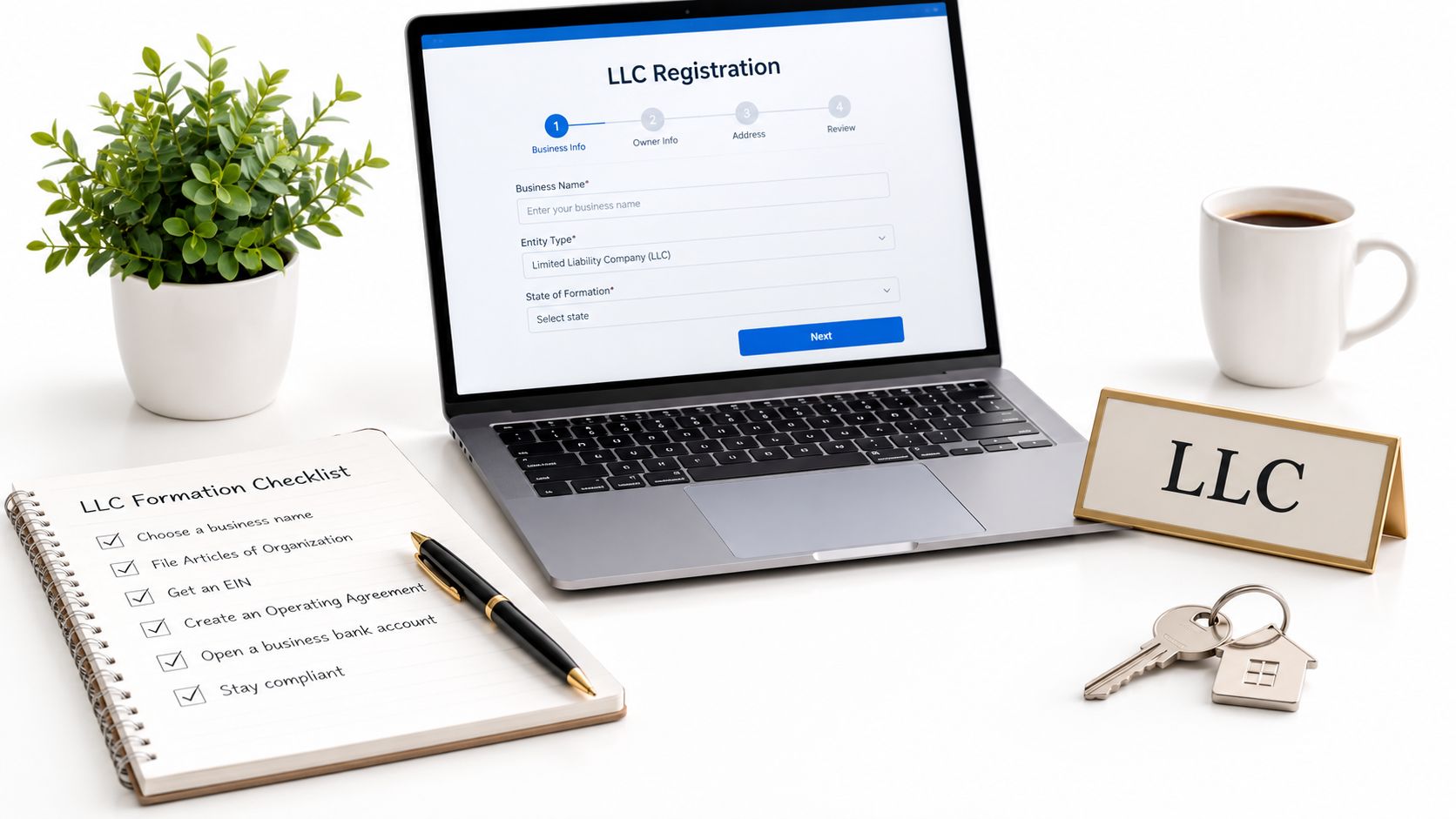
The smoothest LLC setup happens before a property is under contract. Investors create the entity, establish authority, open the bank account, and prepare ownership documents while the deal is still being evaluated. That gives the lender and closing team time to identify missing information without putting the contract timeline under pressure.
A practical setup sequence
Choose and clear the name. Confirm that the name is available and follows the formation state's naming rules. Use a name that won't confuse the title company, lender, tenants, or insurance carrier.
File the formation document. Submit the required formation filing in the selected state. Save the approved documents in a transaction folder that includes the operating agreement, ownership information, and state correspondence.
Prepare the operating agreement. Even a single-member LLC benefits from written rules covering management authority, contributions, distributions, property acquisitions, and future ownership changes. A multi-member agreement should address approvals, member exits, disputes, and additional capital.
Obtain the appropriate tax identification. Confirm with your tax professional whether the LLC needs an EIN based on its members, employees, tax elections, and filing obligations.
Open dedicated banking. Deposit investment funds into the company account and pay property expenses from that account. Don't use the LLC as a pass-through for unrelated personal purchases.
Coordinate title and insurance. The deed, loan application, settlement statement, insurance policy, leases, and vendor contracts should identify the correct legal owner.
A registered agent receives official state and legal notices. A virtual mailbox serves a different business function, usually handling ordinary correspondence and presenting a business mailing address. Investors deciding between those services can use this guide to compare registered agent and virtual mailbox, then confirm the state's actual requirements.
Keep the entity transaction-ready
Maintain annual reports, state filings, meeting or written-consent records, bank statements, leases, invoices, insurance renewals, and loan documents. Update the operating agreement when members, managers, ownership percentages, or signing authority change.
For acquisitions and refinances, prepare a reusable closing packet with the formation certificate, operating agreement, resolution authorizing the loan or purchase, member identification, tax information, insurance evidence, and banking details. Your broader real estate investment process should include an entity and title checkpoint before you submit an offer.
Ownership reporting rules also require current attention. Independent reporting says U.S. domestic companies, including LLCs, were exempt from beneficial ownership reporting as of March 2025, while New York's Transparency Act takes effect on January 1, 2026, and new reporting rules for some residential transactions began March 1, 2026, according to coverage of LLC compliance and real estate closing changes. Because these rules can change, confirm the requirements for the state, transaction, and parties involved before closing.
Smart Next Steps for Investors Using an LLC to Scale
An LLC makes the most sense when it matches a clear investment purpose. For a single rental, you might prioritize simplicity. For a growing portfolio, you may value liability separation, cleaner accounting, and easier partner documentation. For mixed rentals, flips, and construction, separate activity by risk and financing path instead of placing every asset and project into one container automatically.
Use this decision filter before forming or transferring property:
- Define the activity: Identify whether the entity will hold rentals, complete flips, build homes, or perform more than one type of work.
- Map the financing: Confirm whether the next loan is DSCR, bridge-to-DSCR, fix-and-flip, construction, or cash-out refinance.
- Check title first: Ask whether an existing mortgage restricts transfer and whether the lender will approve the proposed ownership.
- Protect the separation: Use dedicated accounts, proper insurance, written approvals, accurate books, and timely state filings.
- Coordinate professionals: Have legal and tax advisers review state registration, basis, depreciation, passive-loss treatment, and ownership changes.
- Prepare before the offer: Give the lender and closing team the entity documents early, especially when buying across GA, NC, SC, or TX.
Tax planning deserves its own review for investors with active improvement and development activity. The 2026 tax conversation includes 100% bonus depreciation, a $2.5 million Section 179 limit, and the continuing 20% QBI deduction, as summarized in this 2026 real estate investment entity guide. Those provisions can affect the LLC-versus-other-entity discussion, but they shouldn't replace individualized tax advice.
Sims Ventures provides DSCR purchase and refinance loans, bridge-to-DSCR pathways, fix-and-flip financing, ground-up construction loans, builder lines of credit, and cash-out refinance options for qualifying investors in Georgia, North Carolina, South Carolina, and Texas. Visit Sims Ventures to discuss how your LLC, title plan, and financing strategy can work together before your next acquisition or refinance.
